
The Best Timbers for Outdoor Structures Compared
Selecting the best timber for outdoor structures is the most critical decision we make when designing a pavilion, pergola, or trellis. We believe that understanding the biological and structural properties of different wood species is essential for any homeowner looking to invest in a structure that will stand for decades. This guide serves as an expert resource to help you navigate the complexities of timber selection, focusing on natural resistance, structural capacity, and long-term performance.
Key Takeaways for Selecting Outdoor Timber
- Prioritize Natural Durability: We recommend species like Western Red Cedar and White Oak for their inherent resistance to rot and insects.
- Assess Structural Requirements: For large spans or heavy snow loads, Douglas Fir provides the highest strength-to-weight ratio among common softwoods.
- Consider Dimensional Stability: Timbers that resist warping and twisting, such as Alaskan Yellow Cedar, ensure that traditional joinery remains tight over time.
- Evaluate Environmental Context: Your local climate, whether humid or arid, should dictate the specific cellular properties you look for in a timber.
- Invest in Longevity: While premium timbers have a higher upfront cost, their 30 to 50 year lifespan offers far better value than temporary alternatives.
Western Red Cedar and Douglas Fir: Our Preferred Timbers for Outdoor Structures
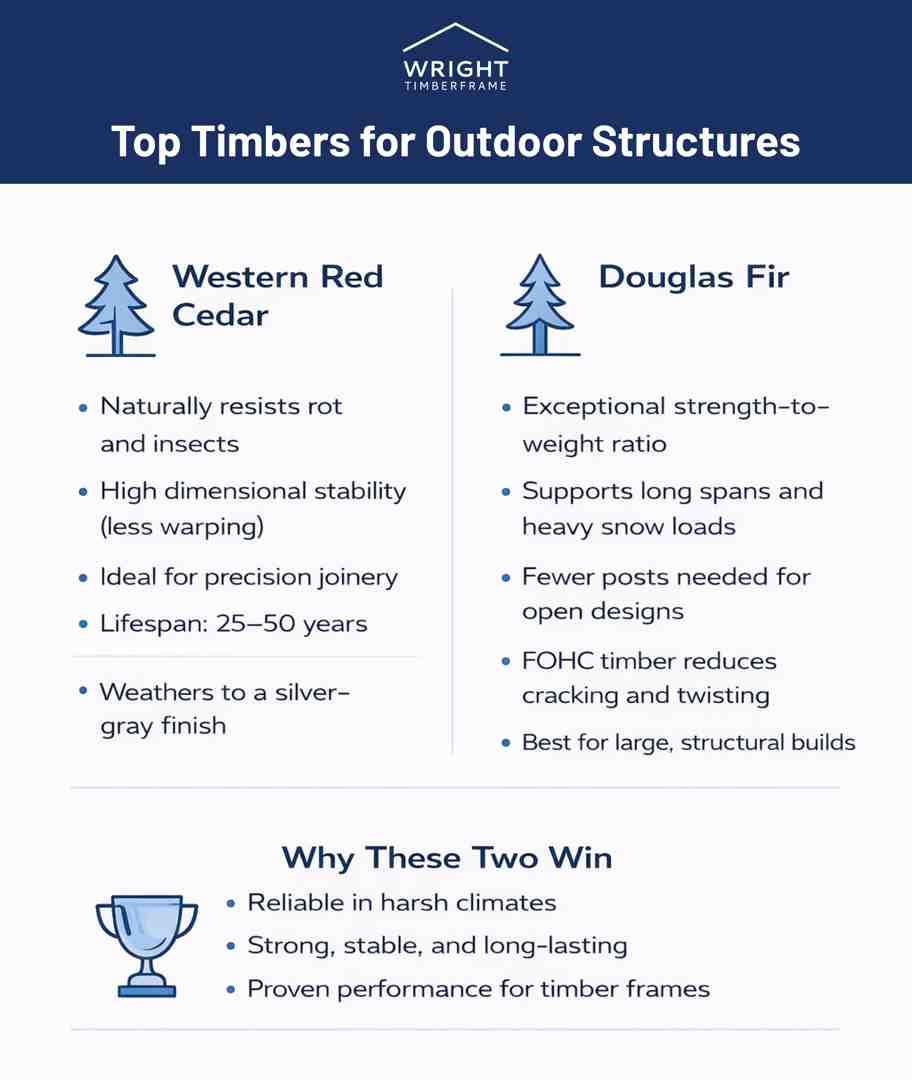
When we evaluate the best timber for outdoor structures, Western Red Cedar and Douglas Fir consistently emerge as the top contenders. We exclusively utilize these premium softwoods for our projects because they offer a predictable response to environmental stress. They provide a balance of aesthetic warmth and structural reliability that is difficult to match with other species.
Western Red Cedar: The Gold Standard for Natural Resistance
Western Red Cedar is widely regarded as the gold standard for outdoor applications. The heartwood of this species contains high concentrations of natural oils and organic compounds known as thujaplicins and phenolics. These substances act as natural fungicides, actively inhibiting the growth of decay-causing fungi and deterring wood-boring insects. This biological defense mechanism allows cedar to remain in service for 25 to 50 years, even when exposed to the elements.
Beyond its chemical resistance, we value cedar for its exceptional dimensional stability. It has one of the lowest shrinkage factors of any softwood, meaning it is less likely to warp, cup, or twist as it seasons. This stability is vital for maintaining the precision of mortise and tenon joinery. Over time, cedar weathers to a sophisticated silvery-gray patina, though it can be stained to maintain its original warm, reddish-brown hues.
Douglas Fir: Best Strength for Grand Designs
For projects that require expansive spans or must support significant weight, Douglas Fir is our primary recommendation. It is renowned for its superior strength-to-weight ratio and high modulus of elasticity. This means we can design structures with longer beams and fewer support posts without sacrificing safety or structural integrity. In regions like Utah, where heavy winter snow loads are a certainty, the structural capacity of Douglas Fir is a non-negotiable advantage.
To ensure the highest quality, we specify free-of-heart-center (FOHC) timber for our Douglas Fir structures. By excluding the center pith of the tree, we significantly reduce the internal stresses that cause checking and twisting. This results in a cleaner, more stable timber that ages beautifully.
For those interested in the technical engineering properties of these materials, we recommend consulting the Scientific research on wood as an engineering material provided by the USDA Forest Service. You can also explore our guide to the best woods for a durable timber frame pavilion for more specific selection criteria.
Hardwoods and Modified Wood for Lasting Performance
While softwoods like cedar and fir are versatile, certain environments or design requirements may call for the unique properties of hardwoods or technologically advanced modified woods. We often look to these materials when a project demands extreme density or a specific aesthetic profile.
White Oak: The Water-Resistant Hardwood
White Oak is a powerhouse of durability. Unlike Red Oak, which has open pores, White Oak features unique cellular structures called tyloses. These tyloses effectively plug the wood’s vascular system, making the heartwood nearly impervious to water penetration.
This is the same reason White Oak has been the preferred choice for shipbuilders and barrel makers for centuries. In an outdoor structure, this means the wood resists rot from the inside out, providing a lifespan that can exceed 40 years with minimal intervention.
Cypress and Redwood: Resilient and Beautiful
Cypress is an excellent choice for high-humidity environments. Its heartwood produces an oil called cypresene, which provides natural protection against decay. It is particularly favored in the Southeastern United States but performs well anywhere moisture is a constant factor.
Redwood, similarly, is prized for its high tannin content, which makes it unpalatable to insects and highly resistant to rot. Its deep, rich color is iconic, though it requires regular UV protection to prevent it from darkening over time.
Alaskan Yellow Cedar and Thermally Modified Wood
Alaskan Yellow Cedar is actually a cypress, and it is one of the hardest and most durable cedars available. Its fine grain and high density make it incredibly resistant to wear and weathering. For clients seeking a modern, sustainable option, we also consider thermally modified wood.
This process involves heating the timber in an oxygen-free environment to alter its cellular structure, removing the sugars that fungi feed on and significantly increasing dimensional stability.
For more information on hardwood applications, see our article on the best hardwood for pergola.
| Timber Species | Durability Class | Rot Resistance | Insect Resistance | Dimensional Stability | Aesthetic Notes | Typical Lifespan (Years) |
|---|---|---|---|---|---|---|
| White Oak | 2 | High | Moderate | Good | Light to medium brown, prominent grain | 20-40 |
| Cypress | 2-3 | Moderate | Moderate | Good | Light yellow-brown to reddish | 15-30 |
| Redwood | 1-2 | High | High | Excellent | Rich red, weathers to gray | 25+ |
| Alaskan Yellow Cedar | 1-2 | High | High | Excellent | Pale yellow, fine grain | 30+ |
| Thermally Modified Wood | 1-2 | High | High | Excellent | Darker tone, stable | 25-50 |
The Truth About Pressure-Treated Pine
We are often asked about the viability of pressure-treated pine for outdoor structures due to its lower initial cost. While the chemical treatments used in this wood do provide protection against rot and termites, they do nothing to improve the physical stability of the timber. Pine is a fast-growing softwood with a high moisture content, and as it dries in the sun, it is prone to significant warping, bowing, and deep cracks known as checks.
In our experience, these stability issues lead to compromised joinery and a structure that quickly loses its visual appeal. Furthermore, the incising process used to force chemicals into the wood leaves thousands of small slits on the surface, which many find unattractive for a high-end outdoor living space.
We believe that for a structure intended to be a permanent addition to your home, the long-term costs of maintenance and potential replacement of treated pine far outweigh the initial savings. We advocate for using naturally resilient timbers that offer both beauty and structural integrity without the need for heavy chemical saturation.
Key Decision Factors for Your Outdoor Timber Structure
Selecting the best timber for outdoor structures requires a holistic view of the project. We guide our clients through a process that balances environmental realities with their personal aesthetic and functional goals. In our work across the Mountain West, we have identified several non-negotiable factors that should influence your choice.
_compressed.jpg?alt=media&token=c33d4085-eb2d-40f5-b2a2-7b4afd23859e "Custom Timber Frame Pergola Patio Design")
Climate and Structural Needs
Your local climate is the most influential factor in timber performance. In arid regions like Utah, the primary challenges are intense UV radiation and low humidity, which can cause wood to dry too quickly and crack. In these areas, we prioritize species with high dimensional stability like Western Red Cedar. Conversely, in coastal or high-rainfall areas, the focus shifts to rot resistance and moisture management.
We also must account for structural loads. A pergola in a snowy climate requires the density and strength of Douglas Fir to ensure the roof beams do not sag under the weight of a winter storm.
Budget, Lifespan, and Maintenance
We view timber selection as a long-term investment. While premium species like Alaskan Yellow Cedar or White Oak require a higher initial outlay, they often require less maintenance over their 30 to 50 year lifespan. We recommend a simple maintenance schedule of cleaning and applying a high-quality penetrating oil every two to three years.
This protects the wood from UV degradation while allowing the natural grain to remain visible. For further technical guidance on wood standards, the American Wood Council provides extensive resources on wood construction and safety.
Aesthetics and Timber Quality
The visual character of the wood should align with your home’s architecture. Each species has a unique grain pattern and color profile. We select timbers that meet architectural appearance grades, ensuring that the wood is not only strong but also free of large knots or defects that could detract from the finished look.
Whether you prefer the rustic charm of Douglas Fir or the refined elegance of Cedar, the quality of the timber is what defines the final result.
Custom Builds vs. Pre-Cut Kits: Tailoring Your Timber Frame Dream
Once the timber species is selected, the next step is determining the method of construction. We offer two primary paths to achieving a high-quality timber structure: bespoke custom builds and precision-engineered pre-cut kits. Both approaches utilize the same premium materials and traditional mortise and tenon joinery that we are known for.
Custom builds are ideal for complex sites or unique architectural requirements where every dimension must be tailored to the environment. Our pre-cut kits, on the other hand, offer a streamlined way to bring a professional-grade timber structure to your home anywhere in the country. Each kit is crafted in our shop with the same attention to detail as our custom projects, ensuring that every joint fits perfectly.
We believe that by providing these options, we can help more homeowners experience the lasting beauty of a well-crafted timber frame. You can see examples of our work in our gallery of timber frame pavilion designs.
Frequently Asked Questions about Best Timber for Outdoor Structures
How does a dry climate affect the best timber for outdoor structures?
In dry climates, the main concern is rapid moisture loss, which leads to warping and checking. We recommend Western Red Cedar or Douglas Fir for these areas because of their excellent dimensional stability and ability to handle intense UV exposure without losing structural integrity.
What is the difference between heartwood and sapwood?
Heartwood is the older, non-living inner portion of the tree that contains the natural preservatives and oils that resist rot. Sapwood is the outer, living layer that transports water and nutrients; it lacks these preservatives and is highly susceptible to decay. We always ensure our outdoor structures are primarily composed of heartwood.
How long can a premium timber structure last?
When built with high-quality species like Cedar, Redwood, or Douglas Fir and maintained properly, a timber structure can easily last 30 to 50 years. The use of traditional joinery also extends this lifespan by reducing the reliance on metal fasteners that can rust or loosen over time.
What maintenance is required for these structures?
We suggest a light cleaning and the application of a UV-resistant penetrating oil finish every 2 to 3 years. This prevents the wood from turning gray and helps maintain the moisture balance within the timber, reducing the likelihood of surface cracking.
Is sustainability a factor in timber selection?
Yes, we prioritize timbers sourced from sustainably managed forests. Wood is a renewable resource, and choosing species that are native to North America, such as Douglas Fir and Western Red Cedar, reduces the carbon footprint associated with transportation while supporting responsible forestry practices.
Selecting the Best Timber for Outdoor Structures
Choosing the best timber for outdoor structures is a foundational step in creating an outdoor living space that provides value for generations. At Wright Timberframe, we combine our deep knowledge of wood species with time-honored craftsmanship to build structures that are as durable as they are beautiful. By selecting the right timber for your specific climate, load requirements, and design goals, we ensure that your pavilion or pergola becomes a lasting landmark on your property.
The right material makes all the difference in long-term performance, appearance, and maintenance. If you’re ready to invest in a timber structure built with premium materials and expert joinery, we invite you to connect with our team. Contact Wright Timberframe today to schedule a consultation and start designing an outdoor structure that will stand strong for decades.

