
Every spring, Utah homeowners reach out to Wright Timberframe with the same first question: “Do I actually need a permit?” The honest answer is: it depends on size, footing type, and where you live. This guide breaks that down city by city so you can walk into your local planning office prepared.
Utah follows the International Building Code (IBC) as its base standard, but individual municipalities adopt local amendments that can shift the thresholds significantly. What requires no permit in Sandy might require a full structural review in Salt Lake City. Do not assume.
When Does a Pavilion Require a Permit in Utah?
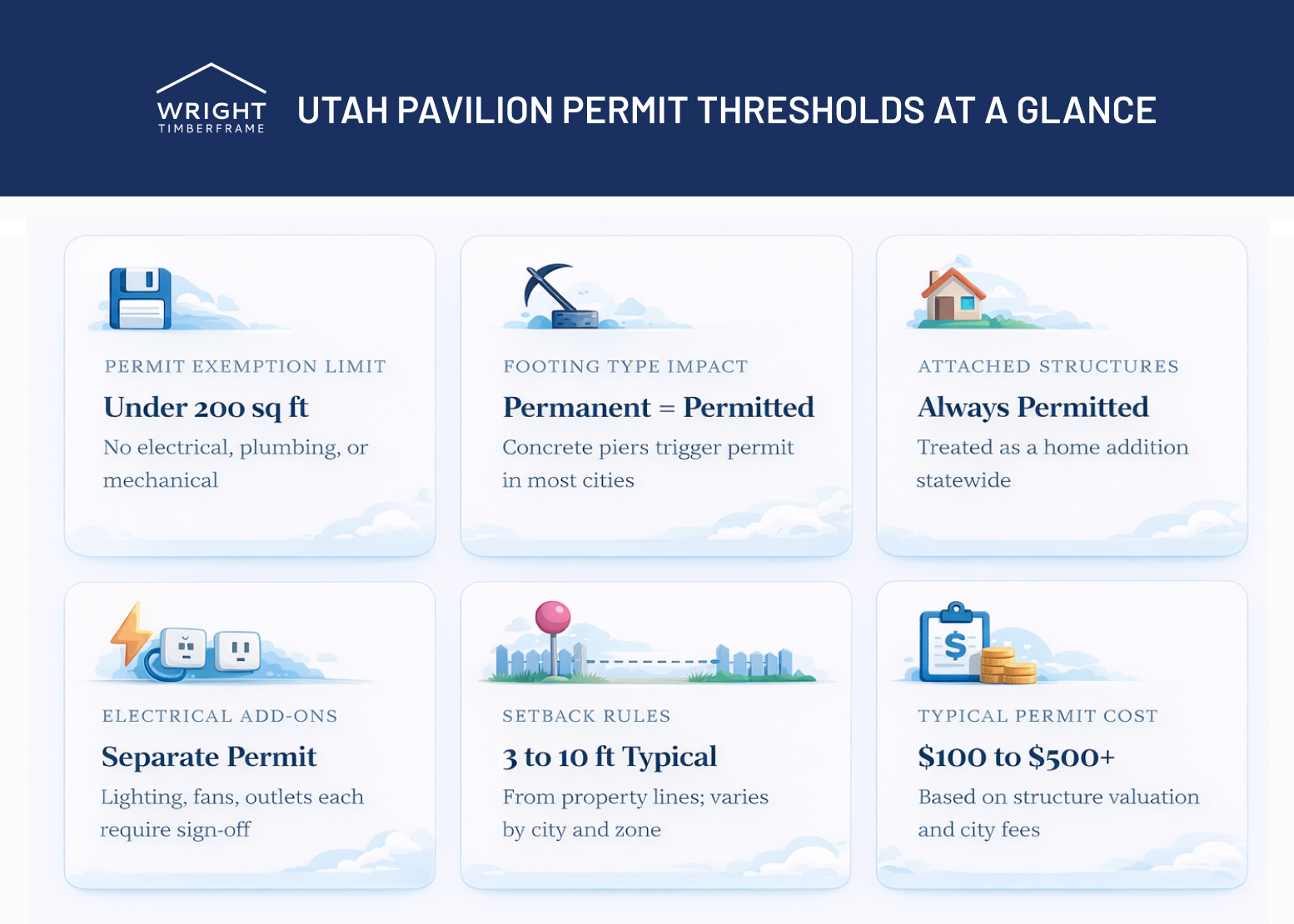
Utah’s State Construction Code sets a general exemption for accessory structures under 200 square feet with no electrical, plumbing, or mechanical systems. Once your pavilion crosses that threshold, a building permit is required in virtually every Utah city.
That said, 200 sq ft is smaller than most people picture. A modest 14 x 16 pavilion already sits at 224 sq ft. Here are the three factors that most consistently trigger the permit requirement:
- Size over 200 sq ft: Nearly universal trigger across Utah municipalities.
- Permanent concrete footings: A structure anchored with concrete piers or a monolithic slab is classified as a permanent structure, regardless of size, in some cities.
- Attached to the home: Any pavilion or covered patio physically attached to your house is treated as an addition and requires a full permit.
- Electrical or lighting: Adding outlets, ceiling fans, or hardwired lighting to your pavilion typically triggers a separate electrical permit.
- Commercial use: Event pavilions or structures on commercial property have their own permitting track with stricter requirements.
City-by-City Overview: Utah Pavilion Permit Rules
Below is a working reference for five of Utah’s most active cities where Wright Timberframe regularly installs timber frame pavilions. These details reflect general policies as of 2025. Always confirm current thresholds directly with your city’s building department before submitting drawings.
| City | Permit Threshold | Setback (Typical) | Key Notes |
|---|---|---|---|
| Salt Lake City | Over 120 sq ft | 3 ft rear / side | Lower threshold than state baseline; historic districts have additional review |
| Provo | Over 200 sq ft | 5 ft from property line | Aligns with state code; check BYU-adjacent zone rules for height limits |
| Sandy | Over 200 sq ft | 5 ft rear, 3 ft side | Requires site plan; inspections at footing and final stages |
| Draper | Over 200 sq ft | 5 ft from any line | HOA approval often required before city application; two-step process common |
| St. George | Over 200 sq ft | 3 ft to 5 ft varies by zone | Hot climate considerations: roof pitch and drainage often reviewed closely |
HOA Considerations for Timber Frame Structures in Utah
A building permit from the city does not override your HOA’s design guidelines. In Utah’s planned communities across Draper, South Jordan, and the Canyons area, HOA approval is often the longest and most detailed part of the process.
Common HOA requirements for timber frame pavilions include:
- Pre-approved material lists (cedar and Douglas fir generally pass; pressure-treated wood sometimes does not)
- Stain or paint color must match or complement the primary residence
- Maximum roof height restrictions (often 12 to 14 feet from grade)
- Submission of a site plan showing the distance from neighbors and the home
- Approval from an architectural review committee before any work begins
Wright Timberframe builds exclusively with Douglas fir or cedar using traditional mortise and tenon joinery, which consistently meets HOA material standards across Utah communities. Our team can provide specification sheets and detailed drawings that streamline the HOA review process.
What to Submit: Typical Permit Documentation
Once you confirm a permit is required, gathering the right documents upfront is the difference between a one-week approval and a month of back-and-forth. Most Utah building departments ask for the following when reviewing an outdoor structure permit application:
- Site plan: A scaled drawing of your property showing the proposed pavilion location, all setbacks from property lines, existing structures, and any easements.
- Construction drawings: Floor plan, elevation views, and cross-sections with labeled dimensions, beam sizes, and post spacing.
- Structural specifications: Load calculations for snow, wind, and dead loads. Utah’s snow load requirements vary significantly between a Salt Lake Valley lot and a Summit County property.
- Footing details: Concrete pier depth, diameter, and reinforcement schedule. This is reviewed against local frost depth requirements.
- Materials list: Species, grade, and dimensions of all structural timber. Douglas fir No. 1 or better is the standard for structural members.
Wright Timberframe provides construction drawings and material specifications as part of every project, which can be submitted directly to your city’s building department. We have completed this process dozens of times across Utah’s municipalities and know what each department looks for.
How Permanent vs. Temporary Footings Affect Permit Status
The footing question is one of the most misunderstood parts of outdoor structure permitting in Utah. Some homeowners assume that using post bases instead of concrete piers will keep their structure “non-permanent” and therefore permit-exempt. That logic does not hold up consistently across Utah cities.
Here is how the two approaches are typically treated:
Permanent Footings (Concrete Piers or Monolithic Slab)
- Clearly classified as a permanent structure in all Utah jurisdictions
- Requires a building permit if over the size threshold
- Offers significantly better resistance to Utah freeze-thaw cycles
- Typically required for any structure over 400 sq ft or with a fully enclosed roof
Surface-Mounted or Temporary Footings
- May avoid permanent structure classification in some cities
- Still requires a permit if the structure exceeds 200 sq ft in most Utah jurisdictions
- Less stable in high-wind or snow-load conditions common to Utah’s Wasatch Front
- HOAs often prohibit non-permanent footings for large structures, regardless of city rules
For a thorough breakdown of footing types and how each affects both permit status and structural performance, see our guide on timber frame pavilion foundation options. The right footing choice depends on your soil type, frost depth, and the pavilion size, not just the permit strategy.
Wright Timberframe’s Experience with Utah Regulations
Over more than a decade of building custom timber frame structures across Utah, Wright Timberframe has navigated permit processes in Salt Lake City, Utah County, Summit County, and Washington County. Each jurisdiction has its own pace, its own checklist, and its own preferences for how drawings are formatted.
That experience means we can:
- Identify whether your project will require a permit before any design work begins
- Provide stamped engineering drawings when Summit County or higher-elevation sites require them
- Flag HOA-specific requirements during the design phase, not after fabrication
- Adjust footing depth and beam sizing to meet local snow and wind load requirements
If you are still in the early planning stage, our timber frame pavilion page walks through size options, finish choices, and design considerations. If you are closer to submitting, visit our contact page and include your city and approximate pavilion size. We will tell you what to expect from your local building department.
For homeowners comparing structure types before committing to a permit application, our guide on timber frame pavilion vs. pergola clarifies how the two structures differ in both permitting requirements and long-term value. A pergola without a solid roof often falls into a different permit category, which matters for your planning timeline.

Frequently Asked Questions About Utah Pavilion Permits
Do I need a permit for a 10×10 pavilion in Utah?
How long does it take to get a pavilion permit in Utah?
Can my HOA reject a pavilion that the city already approved?
What happens if I build a pavilion without a permit in Utah?
Does Summit County have different pavilion permit requirements than Salt Lake County?
Does a timber frame pavilion add value to my Utah home?
Does Wright Timberframe help with the permit process?
For official code reference, the Utah Division of Occupational and Professional Licensing’s construction code rules provide the state-level framework that municipalities build on.
Getting Your Pavilion Building Permit in Utah the Right Way
A pavilion building permit in Utah is not a bureaucratic hurdle; it is the document that protects your investment, confirms your structure meets local safety standards, and keeps your property’s title clean for future sale. Most homeowners who have gone through the process with a prepared set of drawings find it far simpler than they expected.
The variables, city-specific thresholds, footing type, HOA rules, and snow load requirements, are real. But they are also knowable before you spend a dollar on materials. A few phone calls to your local building department and a conversation with a builder who has navigated the process dozens of times will answer most of your questions before the design phase begins.
Wright Timberframe has built custom timber frame pavilions across Utah for over a decade. We know what Sandy’s inspectors look for at the footing stage. We know which Summit County projects need stamped engineering. We know how to format drawings for Salt Lake City’s plan check. That experience is part of what you get when you work with a local builder rather than a national kit company.
If you are ready to move from research to planning, reach out to our team. If you are still in the comparison stage, explore our full line of custom timber frame pavilions and see what is possible. And if you want to understand how a pavilion compares to a pergola for your specific situation, our kits page is a good starting point for sizing and budget planning.

