

Pavilion vs Gazebo: The Core Differences Explained
The pavilion vs gazebo comparison comes down to one fundamental question: do you want an open, large-scale entertaining structure with a solid roof, or a compact, semi-enclosed garden retreat? The two structures share a roofline but serve very different purposes, and choosing the wrong one can mean years of frustration with a space that never quite fits how you live.
- Pavilions are rectangular, fully open-sided, and built for large gatherings, outdoor kitchens, and all-weather use.
- Gazebos are typically octagonal or round, partially enclosed, and designed as intimate garden focal points.
- Pavilions are generally larger and offer more layout flexibility for furniture and entertaining.
- Gazebos work best as quiet retreats, decorative yard elements, or cozy two-to-six person spaces.
- Timber frame pavilions built with traditional joinery outperform both in long-term durability.
What Is a Pavilion? The Open-Air Structure Side of the Debate
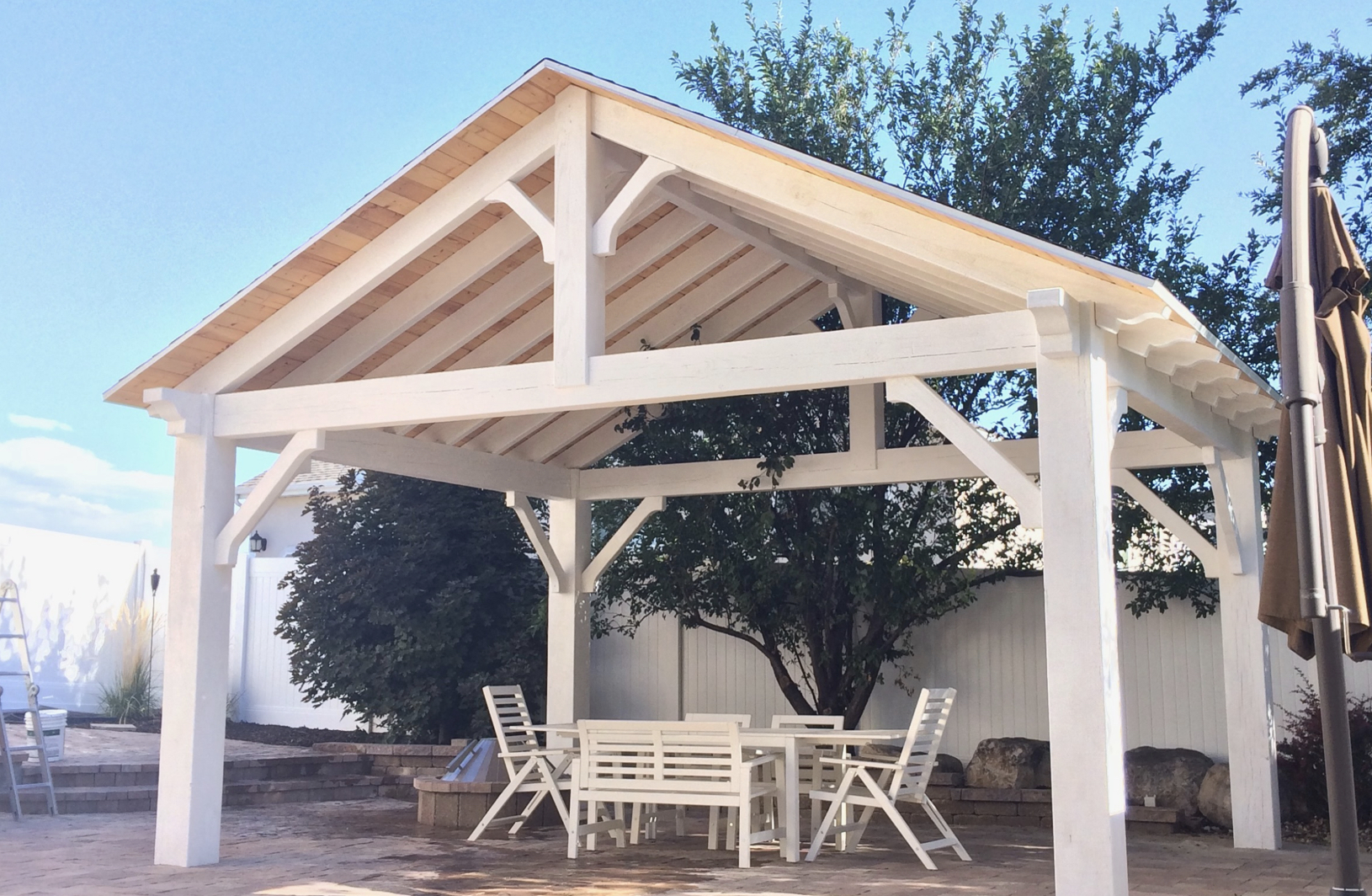
When comparing a pavilion vs gazebo side by side, the pavilion is the larger of the two: a freestanding outdoor structure with heavy corner posts, open sides, and a solid roof that provides complete overhead protection from rain and sun. The shape is almost always rectangular or square, which creates a clean, unobstructed interior that you can arrange any way you want.
This open-air structure design is what separates a pavilion from a gazebo most visibly. Air moves freely through the fully open sides. You can run a long dining table down the center, put a grill station on one end, and still have room for a seating area at the far edge. Guests move between all of it without stepping into sun or light rain.
The roof can take several forms: a classic gable ridge, a hipped pyramid roof, or a shed-style mono-pitch. Each changes the architectural character of the structure. A gable roof reads as rustic and traditional. A hipped roof looks cleaner and more modern. All three options appear in custom timber frame pavilion builds where the roof style is matched to the home’s existing architecture.
When sizing a pavilion for entertaining, plan for at least 25 square feet per person. A group of 10–12 people comfortably occupies a 16×20 structure. If you want an outdoor kitchen as well, go larger: a 20×24 is a practical minimum for a cook station plus seating.
What Is a Gazebo? The Other Side of the Pavilion vs Gazebo Question
On the other side of the pavilion vs gazebo spectrum, a gazebo is a freestanding outdoor structure most often built in an octagonal or circular footprint, with railings, partial walls, or latticework that give it a more enclosed feel. The roof typically comes to a single peak, specifically a pointed cap or cupola, which makes gazebos visually distinctive and symmetrical from any angle.
The enclosed character of a gazebo is both its appeal and its limitation. It creates a genuinely cozy atmosphere that works well for a swing, a bistro table, or a quiet reading spot. However, the smaller footprint and decorative side elements make it difficult to accommodate large dining sets, grills, or groups beyond six to eight people.
Gazebos lean toward decorative impact. Many homeowners position them as a garden focal point: at the end of a path, near a water feature, or framed by plantings. The structure itself becomes part of the landscape design rather than the primary outdoor living zone.
Key Differences: Shape, Roof, Size, and Openness
The pavilion vs gazebo comparison starts with shape. Pavilions use a rectangular footprint that mirrors a room floor plan. Gazebos use a circular or octagonal footprint that produces equal interior dimensions from every angle. That geometric difference drives almost every other distinction between the two structures.
On the roof, both structures offer complete overhead coverage, unlike a pergola, which uses open slats. However, pavilion roofs span a large rectangular area and typically use gable or hip framing, which allows the structure to cover far more square footage. Gazebo roofs meet at a central peak and are generally constrained to a smaller span by the geometry of the design.
Regarding size, a residential gazebo typically falls in the 10×10 to 12×12 range when measured across its widest points. A residential pavilion commonly starts at 12×16 and scales up to 20×30 or beyond, depending on the intended use. Furthermore, open-air structure comparisons consistently show that a pavilion can accommodate an outdoor kitchen, dining table, seating group, and overhead lighting within one unified covered footprint. An octagonal gazebo simply cannot do.
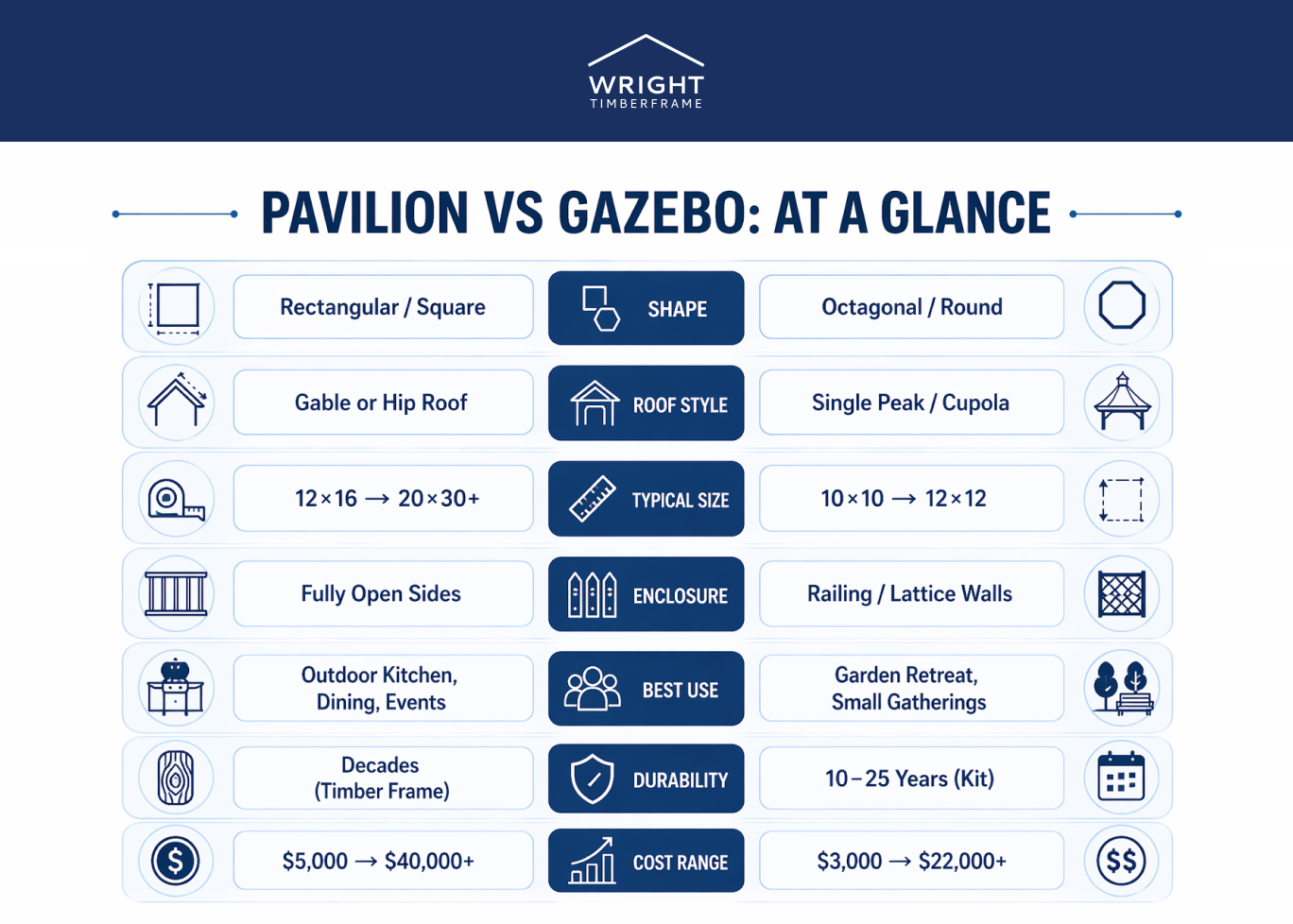
Full Side-by-Side Comparison: 10 Criteria
| Criteria | Pavilion | Gazebo |
|---|---|---|
| Shape | Rectangular or square | Octagonal, round, or square |
| Roof | Solid gable, hip, or shed roof, full coverage | Solid single peak, full coverage |
| Typical Size | 12×16 ft to 20×30 ft+ | 10×10 ft to 12×12 ft |
| Side Openness | Fully open for maximum airflow and flexibility | Partial walls, railings, or latticework |
| Primary Material | Douglas Fir, Cedar (timber frame) | Wood, vinyl, metal, or composite kit |
| Durability | Generations with timber frame joinery | 10–25 years (varies by material) |
| Customization | Highly customizable: size, roof style, stain, extras | Limited to standard kit sizes and shapes |
| Best Use Case | Entertaining, outdoor kitchen, events, year-round use | Quiet retreat, garden focal point, small gatherings |
| Cost Range | $5,000–$40,000+ (varies by size and build type) | $3,000–$22,000+ (kits start lower) |
| Permitting | Often required for larger structures | Often required for larger structures |
Which Is More Durable? The Timber Frame Advantage
In the pavilion vs gazebo durability debate, the outcome hinges on two things: the material and how the pieces are joined. A timber frame pavilion built with Douglas Fir or Western Red Cedar, connected through mortise and tenon joints secured with oak pegs, will outlast nearly every gazebo kit on the market. That is not a marketing claim. It reflects how these joinery methods work mechanically.
Traditional mortise and tenon connections interlock the wood rather than relying on metal hardware. As the timber seasons and settles over time, the joints actually tighten. Metal fasteners, by contrast, can corrode, loosen, or work free as the surrounding wood expands and contracts through seasons. According to the USDA Forest Products Laboratory Wood Handbook, both Douglas Fir and Western Red Cedar heartwood classify among the most durable domestic species for above-ground structural use.
Most prefabricated gazebo kits use pressure-treated pine or composite materials with metal bracket connections. Those structures typically perform well for 10 to 20 years with consistent maintenance. After that, the hardware begins to fail and sections may need to be rebuilt. In contrast, a properly built timber frame pavilion with a quality stain reapplied every two to three years is a generational structure. Additionally, the USDA Forest Service’s comparative durability research on untreated heartwood confirms that both Douglas Fir and Western Red Cedar exceed 20 years of service life when kept above ground. That figure climbs significantly with proper sealing.
When evaluating long-term durability, look beyond the wood species and ask specifically about the joinery. A kit using box-end screws or galvanized brackets will degrade faster than a hand-cut mortise and tenon connection, even if both use the same species of timber. Ask your builder to show you the joinery before committing.
Pavilion vs Gazebo Cost: Understanding the Price Difference
In the pavilion vs gazebo cost comparison, gazebos can start cheaper, especially at the kit level. A basic prefabricated wood or vinyl gazebo runs from roughly $3,000 to $6,000 installed. However, those entry-level structures come with limited size options, pre-set designs, and shorter lifespans.
Pavilions carry a higher starting price because they cover more ground and require more material. A custom timber frame pavilion built to specific dimensions typically begins around $15,500 and increases based on size, roof complexity, and finishing choices. For an accurate figure on your build, contact Wright Timberframe for a custom quote.
Consequently, the cost-per-year calculus often favors the pavilion. A timber frame structure maintained with periodic staining and minimal upkeep can serve a family for 40 or 50 years. A cheaper gazebo kit requiring partial replacement at the 15-year mark effectively doubles your cost over that same period. Similarly, pavilions add more usable square footage to your property, an important factor if you plan to sell.
Pavilion vs Gazebo: Best Use Cases for Each Structure
When a Pavilion Wins the Pavilion vs Gazebo Decision
Choose a pavilion when your primary goal is entertaining a group of eight or more people. The rectangular open-air structure accommodates a full outdoor kitchen with a grill, a dining table that seats ten, and a separate lounge area, all under one solid roof. Overhead fans, string lights, and even outdoor heaters can be mounted to the beam structure without compromising the open feel.
Additionally, pavilions are the better fit for year-round use in variable climates. Their roof spans are engineered for real snow loads and high-wind conditions. A custom timber frame pavilion designed for a Utah yard, for example, is built to handle the region’s heavy winter snowfall without structural compromise. Explore the full range of custom timber frame pavilions to understand what is possible for your site.
When a Gazebo Makes More Sense
A gazebo fits well when your outdoor space is compact and your goal is a defined garden retreat rather than an entertainment zone. If you want a structure that reads as a decorative landscape element: somewhere to sit quietly on a summer evening with a book or a glass of wine. The enclosed character of a gazebo delivers that experience effectively.
Gazebos also work for homeowners who want a lower entry-point cost and are comfortable with a smaller footprint and limited customization. For anyone who wants to learn more about how pavilions compare to other structures, the detailed pavilion vs pergola comparison covers the differences in roof design, shade, and structure type in depth.
Does Wright Timberframe Build Gazebos?
The short answer is no. Wright Timberframe specializes exclusively in timber frame construction: pavilions, pergolas, and trellises built from premium Douglas Fir and Cedar using traditional joinery. That specialization is intentional.
Gazebos, particularly the octagonal or round versions most homeowners picture, are almost universally sold as prefabricated kits assembled from smaller dimensional lumber with metal hardware. That build method is fundamentally different from timber framing. Wright does not produce kit-based structures of that type, and building a custom gazebo in timber frame style would require pricing and structural engineering that few residential budgets accommodate.
In practice, most homeowners who revisit the pavilion vs gazebo question after speaking with a builder end up choosing a pavilion once they see what the structure can actually do. A well-designed timber frame pavilion handles everything a gazebo handles, and scales up to everything a gazebo cannot. If you are still weighing the two, reading the timber frame pavilion vs pergola comparison is a useful next step before your consultation.
Why Wright Timberframe Is the Right Builder for This Decision
Wright Timberframe is Utah’s oldest timber frame company, with more than ten years of completed projects ranging from intimate backyard pavilions to large commercial event structures. Every build uses mortise and tenon joinery, hand-finished with premium Douglas Fir or Western Red Cedar selected for structural integrity and grain character.
What sets the company apart is the combination of handcrafted joinery and a straightforward process. From the first site visit through final installation, the team guides each project to fit the specific property: the dimensions, the roofline, the stain, and the layout. There are no cookie-cutter templates and no shortcuts in the joinery.
Wright also offers pre-cut timber frame kits shipped nationwide for homeowners who want the same premium material and joinery in a DIY format. For anyone in Utah ready to move from concept to build, contact Wright Timberframe to schedule a site consultation.

Frequently Asked Questions About Pavilion vs Gazebo
Is a pavilion or gazebo bigger?
Pavilions are significantly larger. Residential pavilions typically range from 12×16 to 20×30 ft or more. Gazebos usually max out around 12×12 ft, making them better suited for two to six people rather than large gatherings.
Which outdoor structure lasts longer, a pavilion or a gazebo?
In any pavilion vs gazebo durability comparison, a timber frame pavilion with mortise and tenon joinery will outlast a prefabricated gazebo kit by decades. Properly maintained, a timber pavilion is a generational structure. Most gazebo kits are rated for 10–25 years before hardware and materials degrade.
Can a gazebo be used as an outdoor kitchen area?
Not effectively. Gazebos are too compact and partially enclosed for safe grill or appliance use. A pavilion’s open sides and larger footprint make it the practical choice for any outdoor cooking setup.
What is the difference between an open-air structure and a gazebo?
Open-air structures like pavilions have no side walls, giving maximum airflow and flexibility. Gazebos include railings, lattice, or partial walls that create a more enclosed, intimate feel, closer to an outdoor room than an open covered area.
Do I need a permit for a pavilion or gazebo?
Usually yes for permanent structures, though requirements vary by city and county. Structures over 200 sq ft or with a foundation typically trigger a permit. Always verify with your local building department before construction begins.
Pavilion vs Gazebo: Making the Right Choice for Your Backyard
The pavilion vs gazebo decision ultimately comes down to how you use your outdoor space and how long you want your investment to last. If your backyard is the place where your family gathers, where you host dinners in the summer and football afternoons in the fall, a timber frame pavilion delivers the scale, durability, and layout flexibility that no octagonal gazebo can match. The pavilion vs gazebo choice becomes clear once you see both structures side by side. If you want a quiet corner retreat with decorative appeal and a lower entry cost, a gazebo fills that role well.
For homeowners who want the structure they will still be proud of in 30 years, the timber frame pavilion is the clear answer. The joinery is stronger, the material is premium, and the design is built around your specific yard rather than a kit template. Wright Timberframe has guided hundreds of Utah homeowners through exactly this decision, and the team is ready to do the same for you.

