
Essential Timber Pergola Maintenance Tasks Every Homeowner Should Know
Timber pergola maintenance is the key to keeping your timber frame beautiful for decades. Your timber frame pergola was built to last, but “built to last” and “left to fend for itself” are two very different things. The good news? Timber pergola maintenance is surprisingly simple.
With just a few hours of attention each year, a premium Douglas Fir or Western Red Cedar pergola can look stunning and stand strong for 25 to 50 years. The key is consistent, seasonal care rather than expensive overhauls.
Whether you already own a timber pergola or are researching ownership costs before buying, this guide walks you through exactly what to do, when to do it, and what to watch for, straight from the team at Wright Timberframe.
How Long Does a Timber Frame Pergola Actually Last?
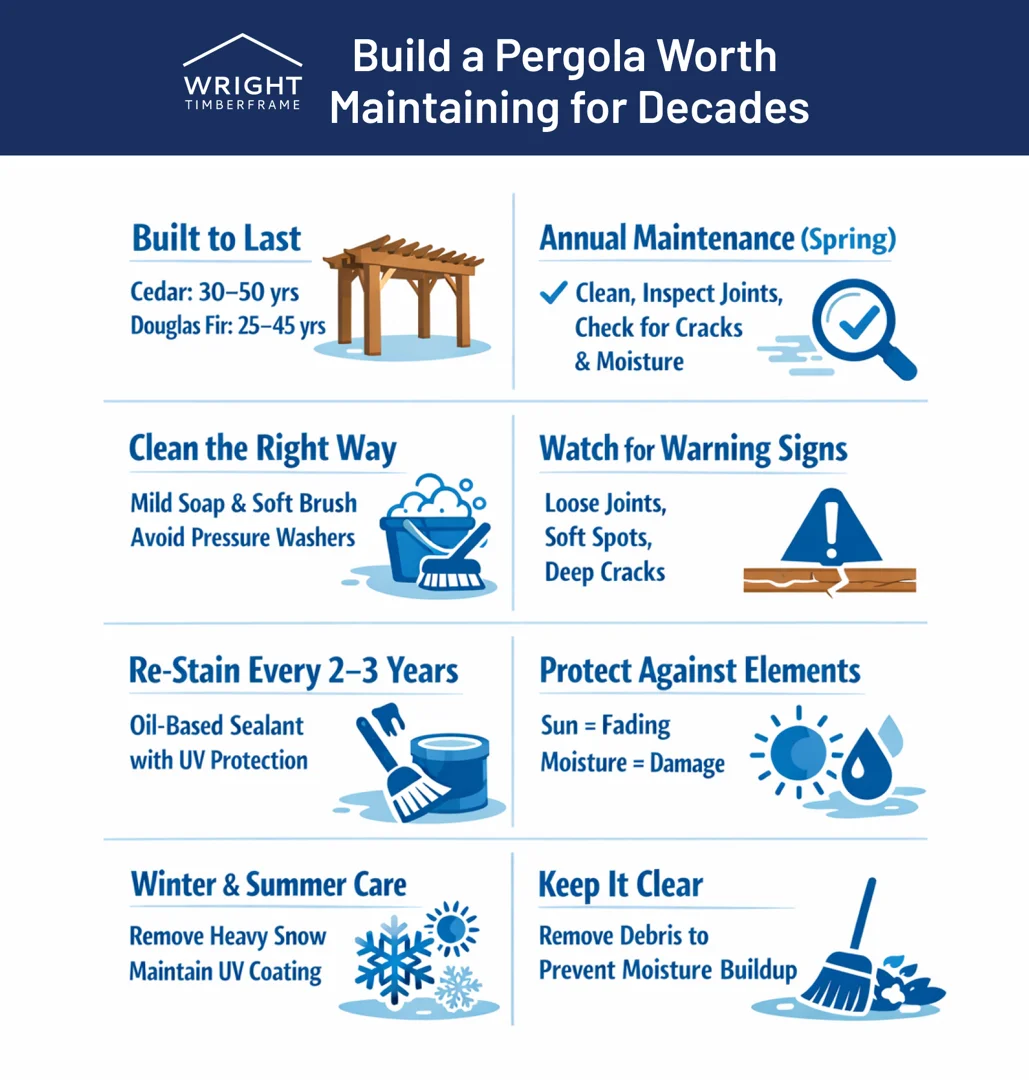
A well-built timber frame pergola using premium softwoods and traditional mortise-and-tenon joinery will comfortably outlast most things in your backyard. Here is how the numbers break down by material:
| Timber Type | Expected Lifespan | Maintenance Frequency | Primary Threat |
| Western Red Cedar | 30 to 50 years | Seal every 2 to 3 years | Moisture and UV |
| Douglas Fir | 25 to 45 years | Seal every 2 to 3 years | UV and surface checking |
| Pressure-Treated Pine | 10 to 15 years | Annual treatment needed | Warping, rot, cracking |
The lifespan ranges above reflect properly maintained, premium-grade heartwood. For context, the USDA Forest Products Laboratory’s long-term field study on above-ground wood durability classifies both Douglas Fir heartwood and Western Red Cedar among the most decay-resistant species, with untreated service lives exceeding 20 years. With the sealing and care outlined in this guide, quality installations significantly exceed that baseline.
The difference is dramatic, and it is why Wright Timberframe exclusively builds with Cedar and Douglas Fir for their custom timber pergolas. The material does most of the heavy lifting. Your job is simply to back it up with routine care.
Your Annual Timber Pergola Maintenance Checklist
Think of this as your pergola’s yearly physical. Once a year, ideally in early spring after winter’s grip loosens, set aside a morning and work through these steps:
- Wash all timber surfaces with mild soap, warm water, and a soft-bristle brush to remove dirt, pollen, and mildew
- Inspect every joint, connection, and fastener for looseness, movement, or visible wear
- Look for signs of surface checking, which are small cracks along the grain. These are natural but worth monitoring
- Check the base of each post where it meets the ground or footing for moisture damage
- Evaluate the stain or sealant condition. If water no longer beads on the surface, it is time to refinish
- Clear any debris, leaves, or plant material that has accumulated on top of beams or in joint pockets
That is the whole list. No specialty tools, no professional crew required.
How to Clean Cedar and Douglas Fir Pergolas Without Damaging Them
Cleaning is the most overlooked step in timber pergola maintenance, yet it is also the easiest. Dust, pollen, bird droppings, and algae build up slowly, and if left unchecked, they trap moisture against the wood grain.
Mix a gentle solution of warm water and oxygen-based cleaner, avoiding bleach, which can strip natural wood oils and damage the fiber. Apply it with a soft brush, working in the direction of the grain. Rinse thoroughly with a garden hose. Resist the pressure washer. High-pressure water drives moisture deep into the timber and can raise the grain, creating a rough surface that ages faster.
For stubborn mildew spots on Cedar, a diluted vinegar solution works well as a natural alternative. Let the pergola dry completely for at least 48 hours before applying any stain or sealant.
Re-Staining Your Pergola Timing, Products, and Technique
Re-staining is where you truly extend the life of your investment. A high-quality, penetrating oil-based finish with UV inhibitors is the gold standard for both Douglas Fir and Cedar. Avoid film-forming products like paint or solid-coat polyurethane. They peel, trap moisture underneath, and create more work down the road.
The general rule is to re-stain every two to three years, though south-facing pergolas in Utah’s intense sun may need attention closer to the two-year mark. You will know it is time when the wood surface no longer repels water droplets and the color looks washed out.
Apply stain on a dry, overcast day when temperatures sit between 50 and 80 degrees Fahrenheit. Work one beam at a time, brushing with the grain and maintaining a wet edge to avoid lap marks. Two thin coats outperform one heavy coat every time.
For a full breakdown of sealant types, application schedules, and product recommendations, read: Mastering the Elements: Essential Pergola Weatherproofing Techniques.
Surviving Utah’s Extremes: Winter Snow and Summer Sun
Utah does not go easy on outdoor structures. Heavy snowfall in the mountains loads weight onto beams, while the valley’s relentless summer UV bleaches and dries unprotected wood in a single season.
For winter, the structural side is already handled if your pergola was engineered with the right timber dimensions and traditional joinery. Douglas Fir’s superior strength-to-weight ratio is exactly why it is recommended for snow-load regions. On the care side, brush off heavy snow accumulations to reduce sustained weight, and avoid chipping ice off timber surfaces, which can gouge the finish.
For summer, your UV-blocking sealant is your pergola’s sunscreen. Reapply it on schedule, and your timber will retain its rich color rather than fading to silver-gray prematurely.
Understanding and Fixing Cracks in Timber Frame Structures
Cracks are one of the most common concerns among timber pergola owners and one of the most misunderstood. Most cracks you will see in a healthy structure are cosmetic, not structural. Knowing the difference protects both your investment and your peace of mind.
Surface Checking vs. Structural Cracking
| Crack Type | Direction | Concern Level | Action Needed |
| Surface checking (hairline) | Along the grain | Normal / Cosmetic | Monitor annually; seal with stain |
| Seasoning cracks (wider) | Along the grain | Monitor closely | Fill with flexible wood sealant |
| Cross-grain cracks | Across the grain | Call a professional | Structural assessment required |
| Joint separation | At connection points | Call a professional | Structural evaluation; re-tighten or replace |
Why Do Timber Frames Develop Cracks?
There are four primary causes:
- Moisture cycling. Changes in temperature and humidity cause wood fibers to expand and contract across seasons. During humid months, timber absorbs moisture and swells. As it dries out, it contracts, and that repeated movement eventually produces surface checks along the grain. This is completely natural in solid timber.
- Improper initial construction. Pergolas assembled with undersized joinery, incorrect fasteners, or timbers installed while still green are far more prone to problematic cracking. Poor construction creates stress concentrations in the wood that widen under seasonal load.
- Low-quality timber. The wood’s own density, grain structure, and moisture content at milling affect long-term stability. Wright Timberframe uses free-of-heart-center Douglas Fir and Cedar specifically to minimize this.
- Deferred maintenance. When protective coatings are not renewed on schedule, moisture infiltrates the wood surface freely. Staying current on your re-sealing schedule is the single most effective crack prevention measure available to homeowners.
How to Fix Surface Checks and Minor Cracks
For hairline surface checks and minor seasoning cracks running with the grain, the repair process is straightforward:
- Clean the crack with a dry brush to remove dust and debris.
- Apply a flexible, paintable wood filler or outdoor-rated epoxy wood filler into the crack using a putty knife. Avoid rigid fillers, which break out as the wood continues to move seasonally.
- Let the filler cure completely per the manufacturer’s instructions.
- Sand lightly with 120-grit sandpaper, working with the grain.
- Apply your stain or penetrating sealant over the repaired area, blending with the surrounding surface.
When to Call a Professional About Cracks
Contact Wright Timberframe or a qualified timber frame professional if you observe any of the following:
- Cracks that run across the grain. Perpendicular cracking indicates tension or shear stress in the beam, not simple drying, and requires structural evaluation.
- Cracks accompanied by soft spots. If probing a cracked area reveals soft or spongy wood, rot may have entered through the crack.
- Cracks at or near mortise-and-tenon joints. Joint-area cracking can compromise the connection itself and the load transfer it provides.
- Cracks that are widening year over year. Progressive widening is a sign of ongoing structural movement, not stable seasoning behavior.
Pro tip: Take a photo of any visible checks during your annual spring inspection and compare year over year. A crack that stays the same size for two or three years is almost certainly cosmetic. One that grows measurably warrants a professional look.
Seasonal Timber Pergola Maintenance Checklist
Breaking your care routine down by season ensures nothing is missed. Here is a quarter-by-quarter guide tuned to Utah’s climate.
Spring: Your Primary Maintenance Season
Do your big annual inspection now.
- Full surface wash with mild soap, soft brush, and garden hose
- Inspect all joints and fasteners after the winter expansion and contraction cycle
- Check post bases for moisture intrusion or frost heave movement
- Assess sealant condition. Does water still bead up on the surface?
- Photograph and measure any visible checks or cracks
- Apply new sealant coat if on a 2 to 3 year schedule
- Tighten any loose bolts or hardware
Summer: Monitor UV Exposure and Heat Stress
- Spot-check sealant on south- and west-facing surfaces, which get the most UV exposure
- Look for early bleaching or color fade as a sign that re-staining will be needed soon
- Check for insect activity. Small round holes or fine sawdust can indicate wood-boring beetles
- Clear any plant growth from joints, as trapped moisture accelerates decay
- Rinse off bird droppings promptly, since the acid etches through sealant
Fall: Prepare for Freeze-Thaw Cycles and Snow Load
- Clear all leaf and debris accumulation from the top of beams and in joint pockets
- Inspect and clean drainage pathways around post footings
- Apply a fresh sealant coat if the spring assessment indicated it was needed
- Tighten any hardware that may have loosened through summer heat cycling
- Treat any exposed end-grain with an end-grain sealer. This is the most moisture-vulnerable part of any timber
Winter: Mostly Passive Monitoring
- After heavy snowfall of 6 inches or more, gently brush snow off beams using a soft roof rake or broom. Avoid metal tools that gouge the finish
- Never chip ice directly off timber surfaces
- Avoid using salt-based ice melt near post bases. Salt draws moisture into wood and accelerates rot
- After significant freeze-thaw events, do a quick visual check for new joint movement
- Note any new cracking that appears mid-season for your spring inspection log
When to Call a Pro for Your Pergola
While homeowners can handle most timber pergola maintenance, some warning signs require an expert. Here is what to look out for:
- Persistent soft spots. Soft areas in the wood, especially near post bases, can indicate rot beneath the surface.
- Loose joints. If joints shift or feel loose even after tightening, it might point to wood degradation within the connection.
- Large structural cracks. Deep cracks that run across the grain need a professional assessment, not to be confused with cosmetic surface checking.
These problems are uncommon in well-kept Cedar and Douglas Fir pergolas, but addressing them early can save you from a full replacement.
Wright Timberframe’s Post-Installation Support
Wright Timberframe does not disappear after installation day. The team is available to answer maintenance questions, recommend specific stain products for your timber species and climate zone, and inspect structures when something does not look right.
Timber pergola maintenance is not complicated, but knowing you have a knowledgeable partner on call makes the process even easier.

Frequently Asked Questions about Timber Pergola Maintenance
How do I care for a wood pergola?
Annual cleaning and periodic resealing are the core of wood pergola care. Each spring, wash your pergola with mild soap and water using a soft-bristle brush, inspect all joints and fasteners, and check the sealant condition. Reapply a penetrating oil-based finish with UV inhibitors every 2 to 3 years. Avoid pressure washers, which can damage wood fibers and drive moisture into the grain.
What is the lifespan of a wood pergola?
A well-built timber frame pergola using premium Douglas Fir or Western Red Cedar has a lifespan of 50 years or more with routine maintenance. By contrast, a pressure-treated pine pergola typically fails within 10 to 15 years. The combination of quality timber, traditional mortise-and-tenon joinery, and consistent sealing every 2 to 3 years is what delivers decades of performance.
How do I weatherproof a pergola?
Weatherproofing starts with the right finish. Apply a high-quality, penetrating oil-based sealant with UV inhibitors to all timber surfaces every 2–3 years. This protects against both moisture infiltration and sun damage, the two main forces that age wood. In snow-prone areas, ensure your pergola is engineered with adequate timber sizing for snow loads, and brush off heavy accumulations to reduce sustained weight on beams.
Can I use a pressure washer to clean my timber pergola?
No. Pressure washers are not recommended. High-pressure water forces moisture deep into the wood grain, raises the surface fibers, and can cause the timber to age faster. Use warm water, mild soap, and a soft-bristle brush instead, scrubbing in the direction of the grain. Rinse with a standard garden hose and allow the wood to dry fully before applying any stain or sealant.
What type of stain or finish is best for a timber pergola?
High-quality, penetrating oil-based finishes with UV inhibitors are the right choice. These breathable products soak into the wood rather than forming a surface film, which means they will not peel or trap moisture. Both Douglas Fir and Cedar accept these finishes readily. Avoid paint, solid-coat polyurethane, or film-forming products, which peel over time and create more maintenance work.
Does surface checking mean my pergola is failing?
Not at all. Surface checking, which refers to small cracks that appear along the grain, is a natural characteristic of solid timber, especially Douglas Fir, as the wood dries and acclimates. It is cosmetic, not structural. Wright Timberframe minimizes checking by using free-of-heart-center timber, which is cut from outside the tree’s core to reduce twisting and warping. Monitor checks during your annual inspection, but unless cracks are deep and run across the grain, they are simply part of the natural beauty of real wood.
How do I tell the difference between normal surface checking and a crack that needs repair?
The key indicators are direction and depth. Checks that run lengthwise, parallel to the wood grain, and are shallow are normal seasoning behavior. Cracks that run across the grain, cracks that have visibly widened year over year, or cracks accompanied by soft spots nearby are all reasons to have a professional assess the structure. When in doubt, photograph the crack and contact the Wright Timberframe team for guidance.
Your Timber Pergola Maintenance Plan Starts Here
A well-built pergola deserves more than neglect. The good news is that timber pergola maintenance does not take much. A yearly inspection, a fresh coat of sealant every two to three years, and a little seasonal attention is genuinely all it takes to protect a structure built to last decades.
Cracks along the grain are normal. A pressure washer is not your friend. And if something looks off at a joint or post base, Wright Timberframe is one call away.
Whether you built with us or inherited a timber frame that needs some love, this guide gives you everything you need to stay ahead of the wear. No guesswork, no expensive surprises, just a straightforward routine that works.
Need professional maintenance advice? Contact Wright Timberframe for maintenance advice, a product recommendation, or a professional inspection.

