

Choosing among pergola materials for a Utah yard starts with understanding how snow, canyon wind, and high-elevation sun affect the structure. Wright Timber Frame builds custom timber pergolas in Douglas Fir and Cedar, but wood is not the only option worth considering. This guide compares timber, aluminum, steel, and vinyl so you can choose a material that fits your site’s conditions, maintenance preferences, and design goals.
For most Utah yards, heavy timber such as Douglas Fir or Cedar is a strong all-around pergola choice because properly sized beams can handle site-specific snow loads, while solid timber offers a substantial, traditional look. Aluminum needs less routine maintenance and does not rot, while steel can support long spans with slimmer members when properly engineered. The best material depends on your site’s snow and wind loads, exposure, maintenance preferences, and budget.
A few points rarely make it into material comparisons:
- Surface heat is measurable. But material conductivity is only part of the picture. The American Wood Council, drawing on the USDA Forest Products Laboratory’s Wood Handbook, reports thermal conductivity values of 0.7 to 1.0 Btu·in/(h·ft²·°F) for structural softwood lumber at 12% moisture content, compared with approximately 1,500 for aluminum and 310 for steel. These figures explain why wood transfers heat much more slowly than metal, although actual surface temperatures also depend on sunlight, finish color, and other conditions.
- Weight is one factor in wind resistance. But it requires proper anchorage. A heavy timber frame may benefit from its mass, yet wind uplift and lateral forces must still be transferred safely through the connections and footings. Aluminum and steel pergolas also need anchorage designed for their site conditions, so compare the complete structure rather than judging wind performance by material weight alone.
- Repair is part of the price. Timber can be tightened, sanded, and restained in place. A dented aluminum beam or a rusted steel weld usually means a replacement part.
What Is the Best Material for a Pergola in Utah?
Heavy timber is the best material for a pergola in most Utah yards, because it handles snow, wind, and sun with the fewest trade-offs. That answer comes from more than 10 years of building timber frames in Utah and hundreds of finished projects. It also comes from homeowners who live with these structures year-round. Our 4.9-star Google rating reflects that. One customer, Kim Jones, wrote that her pergola held up well over its first year. She also noted that we came back to tighten pieces that had loosened and re-stained several areas.
That detail matters because all outdoor structures need periodic inspection. Timber joints and finishes may be adjusted, repaired, or renewed in place when the damage is minor. Metal frames also offer long service life when properly designed and maintained, although bent members, damaged coatings, or corroded connections may require specialist repairs or replacement parts.
There are honest exceptions. Aluminum makes sense if you never want to stain anything and your site sees light snow. Steel makes sense for slim, modern lines or long spans designed by an engineer. For everyone else, timber is the safer bet.
Quick comparison table: timber, aluminum, steel, and vinyl pergola materials
| Material | Snow | Wind | Surface heat | Upkeep | Look |
| Heavy timber (Douglas Fir or Cedar) | Strong when beams and posts are sized for the site | Resists through mass and joinery | Stays cool to the touch | Restain every few years | Warm, traditional, shows the joinery |
| Aluminum | Depends on the rated load; lighter members | Relies on anchorage | Gets hot in direct sun | Washing; coating can fade | Clean and modern |
| Steel | Strong; can span far | Strong; heavy to install | Gets hot in direct sun | Touch up chips before rust starts | Slim and industrial |
| Vinyl (for comparison only) | Often needs internal reinforcement | Light; relies on anchorage | Moderate | Low; cannot be refinished | Bright and uniform |
What Utah’s Climate Demands From a Pergola
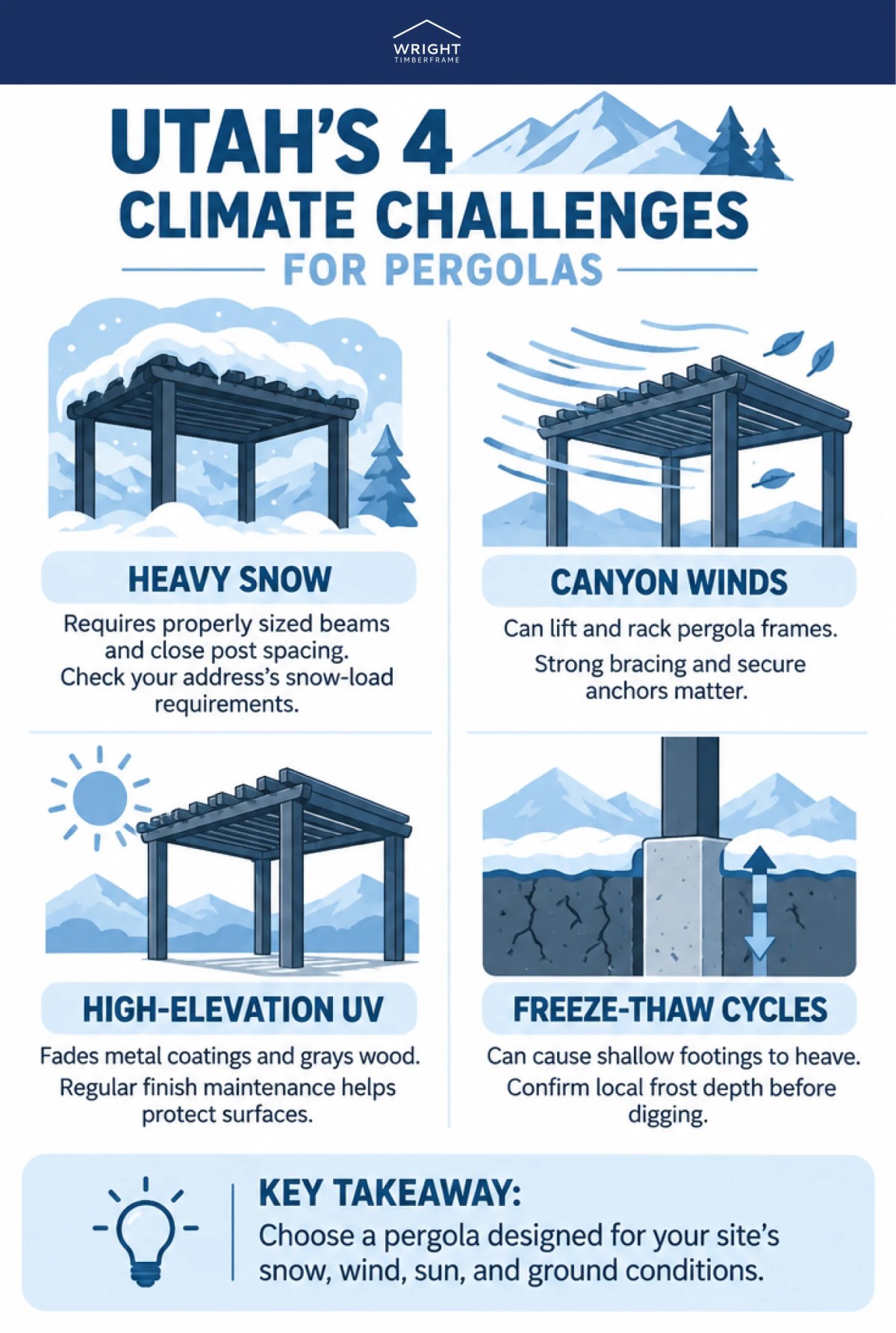
A Utah pergola has to handle four stresses: snow load, canyon wind, high-elevation UV, and freeze-thaw cycles. Few national comparison guides account for all four at once.
Snow is the biggest variable. Ground snow load changes sharply with elevation, so a valley-floor yard in Murray and a bench lot above it can carry very different requirements. The Utah Ground Snow Load Map from Utah State University and the Structural Engineers Association of Utah lets you look up the value for your address. Your local building department and a licensed engineer still govern what your structure must carry.
Wind arrives fast in canyon-mouth neighborhoods. Light structures act like sails when they carry shade cloth or a solid roof. UV at elevation grays wood surfaces and fades powder coat. Freeze-thaw cycles work on footings more than frames, which is why frost depth matters. That depth varies by municipality, so confirm it with your city before any digging starts.
| Climate stress | What it does | How timber responds | How metal responds |
| Snow load | Adds weight to rafters, purlins, and beams | Properly sized beams and posts can carry the required site-specific snow load; performance depends on span, spacing, connections, and roof design. | Carries it if rated; thin members can deflect |
| Canyon wind | Lifts and racks the frame | Mass and knee braces resist racking | Depends on anchors and bolted connections |
| High-elevation UV | Breaks down surface finishes | Surface grays; restaining restores it | Powder coat fades; recoating is shop work |
| Freeze-thaw | Heaves shallow footings | Same footing rules apply to all materials | Same footing rules apply to all materials |
Is an Aluminum or Wood Pergola Better?
Wood is the better choice for most Utah yards that see real snow and wind, while aluminum is better for buyers who want the lowest possible upkeep and accept a lighter structure. Both are legitimate choices. They simply solve different problems.
Where aluminum does well
Aluminum does not rot, warp, or attract insects. It never needs stain. A powder-coated frame usually needs only an occasional wash. Aluminum is also light, which makes it easy to ship and quick to assemble. Many louvered roof systems are built in aluminum because the moving parts need tight tolerances.
Those are real advantages. If your yard sits low, your snow load is modest, and maintenance is the deciding factor, aluminum can serve you well.
Where heavy timber does better

Heavy timber wins on mass, heat, and repair. A timber beam with real depth carries snow without the flex you can see in thin metal members. The frame’s weight helps it stay planted in a canyon gust. Its surface stays cool enough to lean on in July.
Timber also ages in a way you can fix. Scratches sand out. Faded faces take fresh stain. A loosened joint can be snugged up by hand. Our guide to Douglas Fir outdoors explains how the species behaves in sun, snow, and dry air.
Then there is the look. A timber frame shows its structure. The beam-end profile, the knee brace, and the joint itself are the design.
Are Steel Pergolas Better Than Wood?
Steel is stronger than wood for its size and can span farther with slimmer members, but it is not better than wood for most residential pergolas once rust, heat, and fabrication cost are counted. Steel earns its place on modern homes and engineered long spans. In an ordinary backyard, its strengths often go unused.
Strength, rust, and fabrication cost
Steel’s stiffness lets a designer stretch a span or build a dramatic cantilever. That is a genuine advantage. The tradeoff is that steel rusts once its coating is broken. A chip from a ladder or a snow shovel can start corrosion, so touch-ups become part of ownership.
Fabrication adds cost. Steel members are cut, welded, and coated in a shop, then set with heavy equipment. Changing the design later means more shop work. Timber can be cut, fitted, and adjusted on site with hand tools.
Heat applies here too. The same American Wood Council figures show steel conducting heat hundreds of times faster than softwood. A dark steel post in full sun can be hot to the touch by midafternoon.
What About Vinyl and Composite Pergolas?
Vinyl and composite pergolas need little routine care, but they are not structural timber, and we do not build with either material. Some buyers like them for a bright, paint-free look. In Utah, the downsides add up.
Years of strong UV can fade vinyl and make it brittle. Cold snaps add to that risk. Hollow profiles often need internal reinforcement to span any real distance, so the visible material is not what carries the load. A faded or cracked vinyl member also cannot be sanded or refinished. It has to be replaced.
We build in select Douglas Fir as standard, with a Cedar upgrade available. Both species carry load through solid wood, and both take fresh stain when the surface weathers.
Why the Joint Matters More Than the Material

A pergola usually wears out at its connections before its members fail, so how the pieces join matters as much as what they are made of. This is where most material debates miss the point.
A bracketed structure, in any material, transfers load through bolts, plates, and fasteners. Those points concentrate movement. Over time, they can loosen, and on timber, steel hardware can corrode and stain the wood below it.
We cut mortise and tenon joints by hand. A tenon is shaped on the end of one timber and fits a matching mortise cut into the next. The tenon shoulder bears against the face of the post, and a timber peg locks the joint. In draw-boring, the peg holes are offset slightly, so driving the peg pulls the joint tight. As our homepage puts it, “This classic wood-to-wood connection is stronger than bolts and far more beautiful.”
Our page on traditional timber frame joinery walks through the joints in more depth. For a sense of how seriously the craft treats this, the Timber Framers Guild’s Timber Frame Engineering Council exists to research and codify timber frame joinery and structural practice.
Wood-to-wood joinery has one honest quirk. Heavy timber releases moisture as it dries, which causes checks, or surface cracks along the grain. Green timber checks more than kiln-dried stock, and dimensional stability improves as the wood seasons. Our guide to checking and cracks in new timber explains why these are normal and do not affect how the joint carries load. You can see finished joinery up close on our Suncrest Project.
Lifespan and Cost of Ownership by Material
A well-built and maintained timber pergola can last for decades, metal pergolas last as long as their coatings and connections hold, and total cost of ownership depends on upkeep and repair as much as on the upfront price. Comparing bids on day one tells you only part of the story.
| Material | Upfront cost drivers | Routine upkeep | Typical repair | What shortens its life |
| Heavy timber | Span, species, beam profile, installed or kit | Restain on a schedule set by sun exposure | Sand, restain, or tighten joints in place | Skipped stain cycles, standing water at post bases |
| Aluminum | Rated load, roof system, coating | Wash; inspect fasteners | Replace dented or bent members | Underrated snow load, loose anchors |
| Steel | Fabrication, welding, coating, equipment | Touch up chips and scratches | Shop repair or recoat | Rust at broken coating and welds |
| Vinyl | Profile size, internal reinforcement | Wash | Replace faded or cracked members | UV and cold brittleness |
We do not publish a price list. Pricing depends on span, style, species, and site, so we quote each project. Our breakdown of timber frame pergola cost explains the variables that move the number. For lifespan, see how long wood pergolas last under real conditions.
How to Choose: Matching Material to Your Yard and Goals
Choose the material that fits your site’s snow load, your tolerance for upkeep, and the architecture of your house. Rank those three in order, and the answer usually becomes clear.
| If your priority is | Lean toward | Why |
| Carrying heavy snow at elevation | Heavy timber | Deep beams and close bays carry load without visible flex |
| Never staining anything | Aluminum | Coated metal needs washing, not refinishing |
| Slim, modern lines over a long span | Steel, engineered | Stiffness allows thinner members and cantilevers |
| A cool surface and a warm look | Heavy timber | Wood conducts far less heat than metal |
| Repairing rather than replacing | Heavy timber | Joints, faces, and finish can be renewed in place |
Once you settle on timber, the species question follows. We keep that comparison in one place: our guide to comparing hardwoods for a pergola and our notes on choosing timber for a pergola cover strength, weight, and decay resistance. If you are weighing a ready-made frame against a built one, read custom vs. prefab pergolas.
Before you sign any bid, in any material, ask four questions. What snow load is this structure rated for in pounds per square foot? How are the beams, rafters, and posts connected? What is the finish schedule? How will the footings be set to meet local frost depth and setback rules? A builder who answers all four plainly is worth talking to.
Outside Utah, the same frame is available as a pre-cut kit shipped nationwide. You choose a beam profile from seven end-cut styles, a knee-brace style from four profiles, and any Behr stain color. We cut the joinery in the shop, pre-stain and label every piece, and ship it with layout diagrams. You or your contractor assemble it on site. Corners interlock and support beams slide into place. You can configure one on our timber frame kits page. Kit buyers do not receive installation, so plan your footings with your local building department.

Frequently Asked Questions About Pergola Materials
Do metal pergolas get too hot in the sun?
They can. Aluminum and steel conduct heat far faster than wood, so posts and beams in direct sun can become hot to the touch, especially in southern Utah. Wood insulates rather than conducts. Lighter powder-coat colors reduce the effect but do not remove it.
What is the most durable pergola material?
It depends on the threat. Aluminum and steel do not rot, while heavy timber resists snow and wind through mass and can be repaired or refinished in place. A properly built and maintained Douglas Fir or Cedar pergola can last for decades.
Which pergola material needs the least maintenance?
Aluminum needs the least routine care, usually just washing. Wood needs fresh stain every few years in Utah’s strong sun, sooner on faces that take hard afternoon light. Vinyl needs little care but can fade or turn brittle after years of UV. Our guide to timber pergola maintenance keeps the routine simple.
Can an aluminum pergola handle Utah snow?
Some can and some cannot, because it depends on the rated snow load rather than the material alone. Ask the seller for the rating in pounds per square foot, then compare it with the requirement for your address. Open slats shed more snow than a solid or closed louvered roof.
Do I need a permit for a pergola in Utah?
Sometimes. Requirements vary by city and county across the Wasatch Front, and they often turn on size, height, setbacks, and whether the structure has a roof. Read our overview of permits for a freestanding pergola, then confirm with your local building department before you build.
Choosing the Best Material for a Pergola in Utah
The best pergola material for a Utah yard is the one built for your snow load, your sun, and the way you plan to use the space. For most homeowners, that is heavy timber joined wood to wood. Aluminum earns its place where upkeep is the deciding factor, and steel where an engineered span calls for it. Quality is not added later. It starts with the first cut, the right species, and a joint that carries load through the wood itself.
If you are in Murray or the greater Salt Lake area, Wright Timber Frame can help you compare your options based on your yard’s layout, local snow loads, and preferred maintenance routine. Explore our custom timber pergolas to see our designs, beam profiles, and joinery options.
Still unsure which material is right for your project? Send us a photo of your yard and tell us what you want from your pergola. We can discuss the practical trade-offs and help you decide whether a custom timber structure fits your needs. Get a free pergola quote to start planning your outdoor space.

