
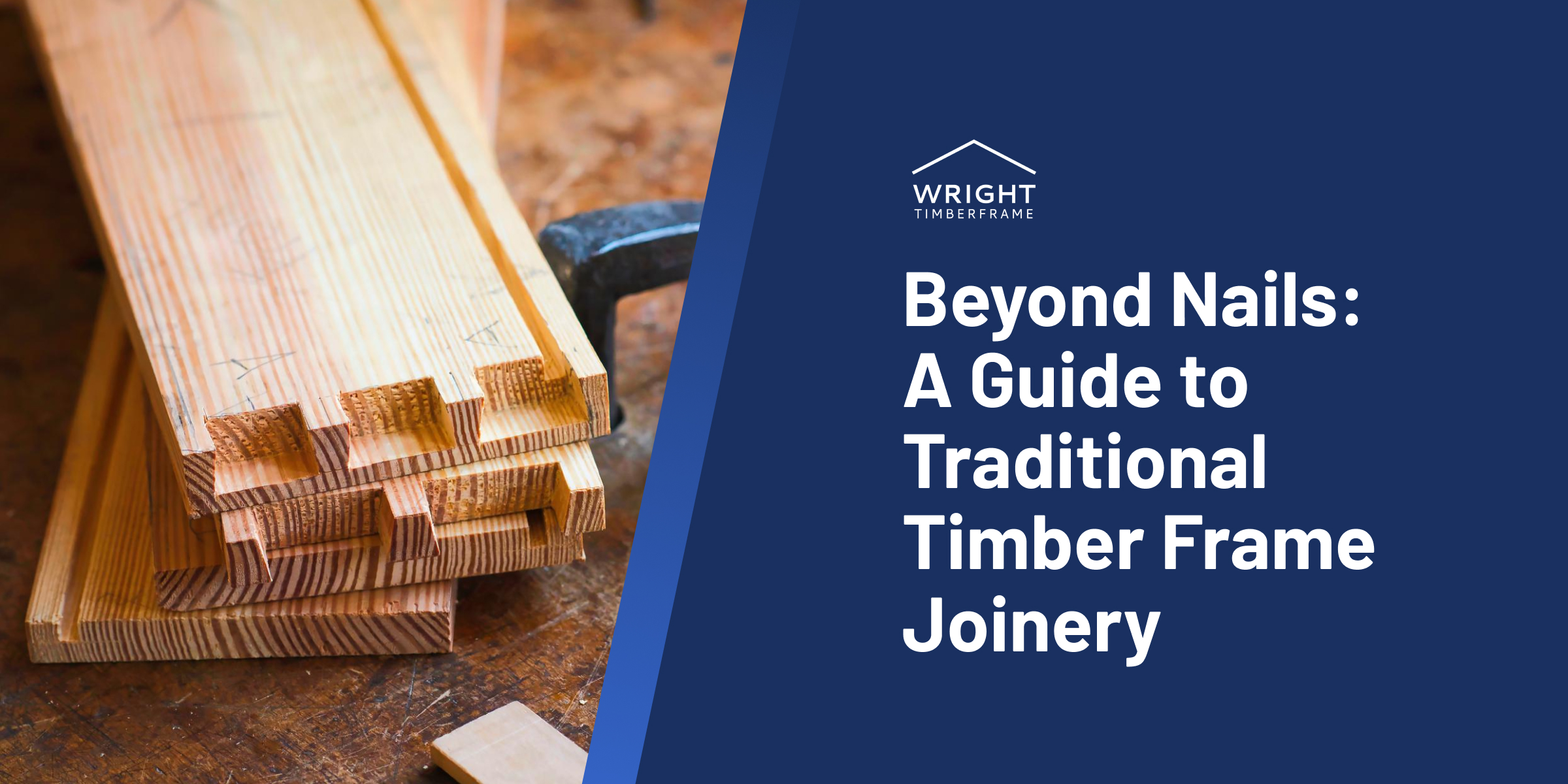
Why Traditional Timber Frame Joinery Defines True Craftsmanship
Traditional timber frame joinery is the time-honored method of connecting large structural timbers through precisely carved, interlocking wood-to-wood joints secured with wooden pegs, no metal fasteners required. This ancient craft creates structures of exceptional strength and lasting beauty.
Key characteristics of traditional timber frame joinery:
- Mortise and tenon joints – The fundamental connection where a tenon (tongue) fits precisely into a mortise (pocket).
- Wooden pegs – Secure joints naturally, allowing wood to move with seasonal changes.
- Mortise and tenon joints – Provide superior resistance to tension and pulling forces.
- Scarf joints – Join timbers end-to-end to create longer beams.
- Longevity – Properly crafted joints last for centuries, as proven by historic buildings worldwide.
This building practice, used globally until around 1900, was revived in the United States during the 1970s by craftsmen who recognized its best structural integrity and timeless aesthetic. Unlike modern construction that relies on metal brackets and fasteners prone to rust and failure, traditional joinery harnesses wood’s natural properties to create connections that actually grow stronger over time.
At Wright Timberframe, your local timber experts, we bring this craft to life in custom pergolas, pavilions, trellises, and precision-cut kits. Every mortise and tenon joint we cut is engineered to endure and to elevate your outdoor space with warmth and character.
The Heart of the Craft: What is Traditional Timber Frame Joinery?
Traditional timber frame joinery is the art of connecting heavy timbers, typically 6″x6″ and larger, without relying on metal connectors. Instead, we carefully cut and shape the ends of timbers to interlock, much like pieces of a three-dimensional puzzle. These wood-to-wood connections are then secured with wooden pegs, creating a structural framework that is both incredibly robust and visually stunning.
This is what fundamentally distinguishes the true Timber Framing we practice from simpler post and beam construction. While post and beam often relies on metal plates or bolts, our craft uses the wood itself as the connector. The difference is profound, it’s the difference between assembling parts and creating a living structure.
For thousands of years, this method was the standard for building structures across the globe. This practice continued until roughly 1900, when the rise of cheaper, faster construction methods using dimensional lumber and metal fasteners led to a decline in timber framing. But the 1970s brought a revival in the United States, as craftsmen and homeowners rediscovered the lasting strength and aesthetic appeal of this ancient building art.
The revival emphasized using large section green timbers, joined using traditional mortise and tenon techniques, and secured with dry oak tapered pegs. Green timbers, wood that hasn’t been kiln-dried, are easier to work with hand tools and naturally tighten as they dry, actually strengthening the joints over time.
The result is a structure with exceptional strength and longevity. These frames are designed to stand for centuries, a testament to the inherent durability of carefully crafted wood-to-wood connections. Beyond the structural benefits, the exposed joinery provides an aesthetic beauty that modern construction simply cannot match. The intricate patterns of the joints, the warmth of the wood, and the sheer scale of the timbers create spaces that feel grounded, timeless, and deeply personal.
The Historical Significance of the Craft
The story of timber frame joinery is woven into the fabric of human history. From the grand medieval cathedrals of Europe to the serene temples of Japan, and the sturdy barns of early America, this ancient building practice has shaped our built environment for millennia.
Walk through a centuries-old cathedral and look up at the massive timber roof trusses. Those beams, connected only by wooden pegs and precisely cut joints, have been carrying their load for hundreds of years. Japanese temples showcase some of the most intricate joinery ever created, with connections so precise they require no fasteners at all. And right here in America, the early settlers built barns using these same techniques, many of which still stand strong today.
These structures are a powerful testament to the enduring effectiveness and reliability of this building method. It’s a legacy of durability that inspires us every day at Wright Timberframe. When we craft a pergola or pavilion, we’re not just building an outdoor structure, we’re connecting to a tradition that spans continents and centuries.
The Fundamental Principles
The magic of traditional timber frame joinery lies in its fundamental principles. Each joint is engineered to distribute loads effectively, leveraging the natural properties of wood. By carving precise male components (the tenon) and female components (the mortise), we create connections that resist compression, tension, and shear forces.
The beauty of eliminating metal fasteners is that the wood itself becomes the structural element. As wood naturally expands and contracts with changes in humidity and temperature, it actually tightens the joints over time rather than loosening them. This is the opposite of what happens with metal bolts, which can rust and loosen.
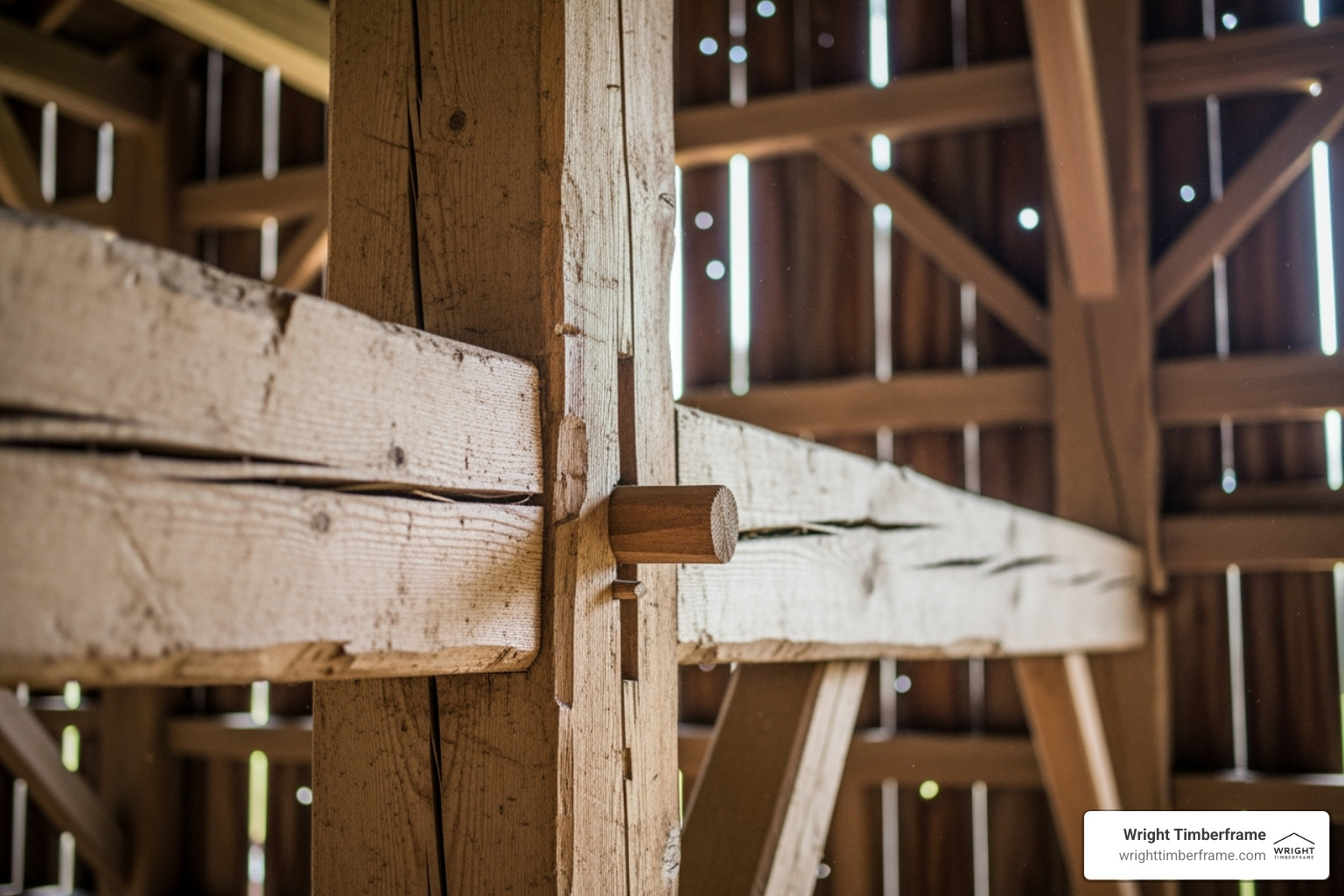
Wooden pegs play a crucial role in this system. They lock the joint into place while still allowing for the natural movement of the wood. This creates a structural frame that is not only strong but also inherently flexible and resilient, capable of withstanding heavy snow loads, high winds, and even seismic activity.
The frame itself becomes a cohesive whole, where each timber and each joint works together to create something greater than the sum of its parts. It’s this dedication to these principles that defines our superior craftsmanship at Wright Timberframe.
The Workhorse Joint: Mortise and Tenon in Traditional Timber Frame Joinery
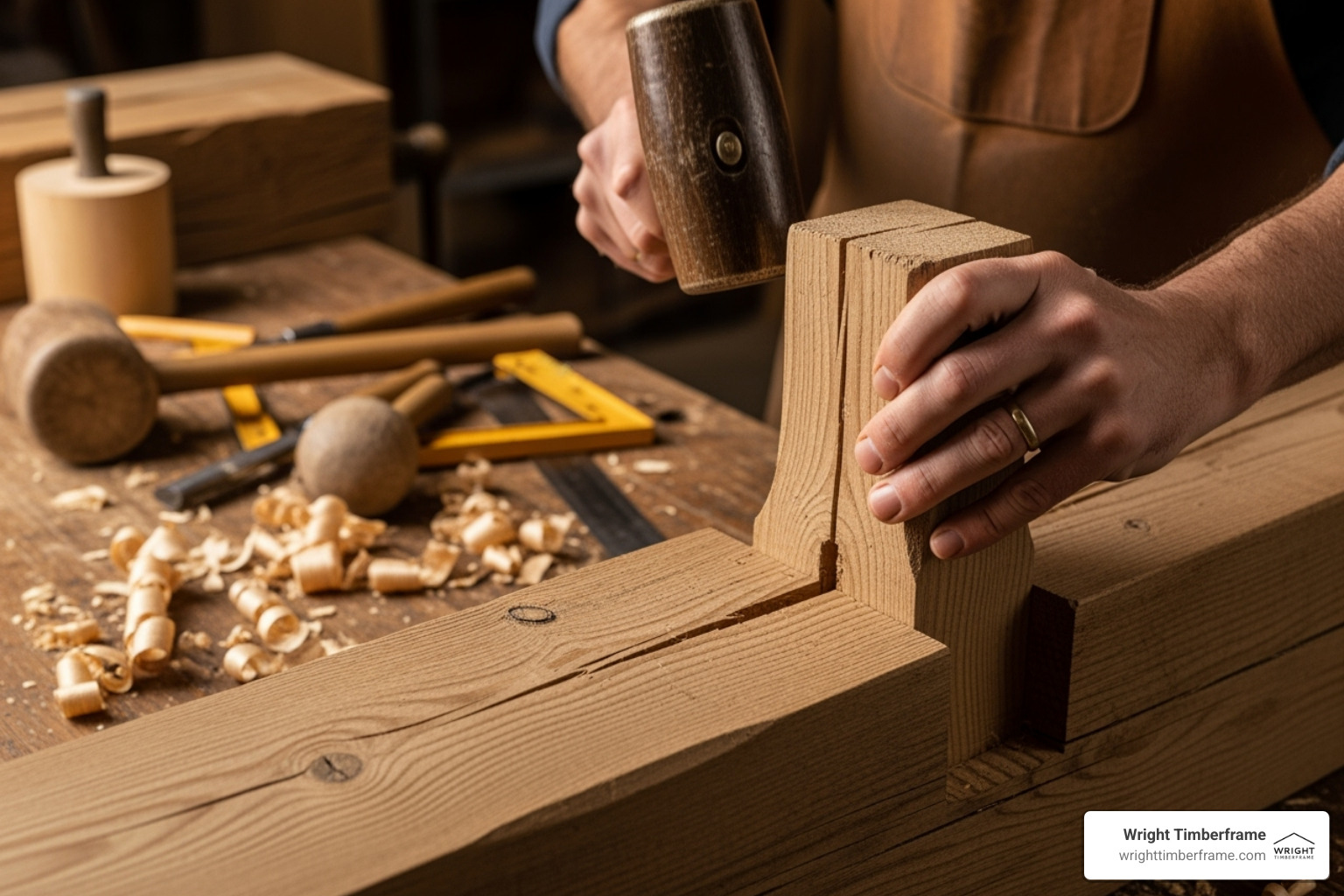
Picture this: one timber has a carefully carved rectangular pocket cut into it, that’s the mortise. The connecting timber features a precisely shaped projection on its end, the tenon. When these two pieces come together, they fit like puzzle pieces, creating a connection that has held buildings together for thousands of years. This is the mortise and tenon joint, and it’s the absolute foundation of traditional timber frame joinery.
We call it the “workhorse” joint because it’s the cornerstone upon which every timber frame structure is built. At Wright Timberframe, we rely on this time-tested connection for virtually every pergola, pavilion, and trellis we craft. It’s not just about making pieces fit together, it’s about creating a bond that will last for generations.
The genius of this joint lies in how it works. When the tenon slides into the mortise, it creates direct wood-to-wood contact that transfers loads from one timber to another. The shoulder of the tenon, that flat surface around the base, bears firmly against the face of the mortised timber, while the tenon itself prevents any lateral movement. It’s simple physics, but executed with precision.
To secure this critical connection, we drive wooden pegs through both pieces, typically using strong, seasoned oak. These pegs lock everything in place permanently. Sometimes we use a technique called drawboring, where we drill the peg hole in the tenon slightly offset from the hole in the mortise.
When we drive the peg through, it actually pulls the tenon tighter into the mortise, creating an even stronger fit. This meticulous attention to detail is what sets true timber framing apart.
According to the Timber Framers Guild, this ancient joinery technique has been used in construction for over 7,000 years, with examples found in archaeological sites across Europe and Asia. The longevity of these structures speaks to the effectiveness of the mortise and tenon joint.
Common Variations in Traditional Timber Frame Joinery
While the basic mortise and tenon is fundamental, our craft includes dozens of variations, each designed for specific structural needs. Think of them as specialized tools in a craftsman’s toolkit, each one perfect for a particular job.
The shouldered mortise and tenon is our go-to for main carrying beams, like when horizontal girts connect to vertical posts. We “shoulder” or “house” the beam onto the post, meaning we cut a shallow recess so part of the beam’s cross-section rests directly on the post, usually about one inch deep.
This housing distributes the weight more effectively across a larger bearing surface, adding significant strength beyond what the tenon alone provides. The tenon then extends into the mortise, and we lock everything together with wooden pegs. It’s engineering that’s stood the test of time.
For diagonal brace mortise and tenon joints, we typically cut tenons that are one or two inches wide and four inches deep. These braces create triangular structures that resist racking, that sideways movement that can compromise a frame. They’re critical for handling wind loads and keeping everything rigid and square, which is especially important in Utah’s varied weather conditions.
The through tenon passes completely through the mortised timber, visible on the other side. It’s both strong and beautiful, showcasing the joinery itself. In contrast, a blind tenon stays hidden within the timber, used when we need a flush surface or want a cleaner aesthetic on one side.
Housed joints take things a step further by cutting a shallow recess into the mortised timber to accept the entire cross-section of the connecting beam. This dramatically increases the bearing surface, allowing weight to transfer more broadly onto the supporting post. We often combine this with a tenon for maximum stability, it’s the kind of detail that ensures our structures will be standing strong decades from now.
Each variation serves a specific purpose in our custom-built, never cookie-cutter approach, contributing to structures that are both beautiful and built to last.
Beyond the Basics of Traditional Timber Frame Joinery: Mortise and Tenon, Scarf, and Other Essential Joints

While the mortise and tenon form the backbone of any timber frame, mastering traditional timber frame joinery means understanding the full vocabulary of connections available to us. At Wright Timberframe, we draw on this rich tradition through our innovative techniques, carefully selecting the perfect joint for every structural challenge your pergola, pavilion, or trellis presents.
The mortise and tenon joint stands out as the cornerstone of authentic timber framing. In timber framing, we scale this joint up to handle the substantial forces in large structural timbers. The “tenon”, a precisely shaped projection on the end of one timber, fits snugly into a matching “mortise” pocket cut into the connecting timber, creating direct wood-to-wood contact that transfers loads cleanly from one member to the next. Secured with a hardwood peg driven through both pieces, this connection gets tighter as the timbers season, making it ideal for post-to-beam connections where compression and shear forces meet, and where structural integrity must endure for generations.
When you need a beam longer than any single tree can provide, scarf joints become essential. These connections join two timbers end-to-end with such strength that the splice becomes virtually as strong as the continuous wood around it. The secret lies in the interlocking pattern cut into both timber ends – a long, angled cut that maximizes contact area and distributes stress across the entire connection. Once fitted and secured with pegs or wedges, you’d be hard-pressed to find where one timber ends and the next begins.
Knee brace joinery creates those beautiful diagonal supports you see connecting posts to beams in traditional frames. These aren’t just decorative, they form rigid triangles that prevent the frame from racking sideways under wind loads. Each brace connects with its own mortise and tenon joint, typically with a tenon that’s one to two inches wide and four inches deep, creating a structural system that’s stood the test of centuries.
The tongue and fork joint represents one of timber framing’s most efficient solutions. Early builders used this precise connection where rafters meet at the roof peak, creating such a strong bond that they could sometimes eliminate the ridge pole entirely. The “tongue” on one rafter fits perfectly into the “fork” (a split) in the opposing rafter, forming a self-supporting connection at the roof’s apex.
The Unique Strength of Mortise and Tenon and Scarf Joints
Understanding why mortise and tenon and scarf joints work so well helps explain why we choose them for specific applications in your outdoor structure.
A mortise and tenon joint is simple in concept but powerful in practice. One timber gets a rectangular pocket carved into it (the mortise), and the connecting timber has a matching tongue shaped on its end (the tenon). The tongue slides into the pocket like a key into a lock, fitting very snug so that the wood touches wood across the entire connection.
That tight fit is what gives the joint its strength. When wind pushes against your pavilion or snow piles up on the roof, the load doesn’t rest on a single bolt or bracket, it spreads across the whole joint, the way pressure spreads across the palm of your hand instead of poking you with one finger. A wooden peg driven through both timbers locks everything in place.
As the wood naturally dries and settles over the years, the fibers squeeze together and the joint actually gets tighter, not looser. It’s the opposite of how metal hardware behaves.
Scarf joints solve the age-old problem of limited timber length through smart geometry. A long, shallow angle with interlocking steps spreads forces like tension, compression, and shear over a large surface area. Drive in wedges and the splice locks into a tight mechanical bond, often becoming the most robust part of the beam.
The Enduring Advantages of Traditional Timber Frame Joinery
When you choose traditional timber frame joinery for your outdoor structure, you’re investing in something fundamentally different from what most builders offer today. These aren’t just pretty joints, they’re engineering solutions that have been proven over centuries of real-world performance.

Let’s talk about what happens to a structure over time. Metal fasteners – the brackets, bolts, and plates used in most modern construction- have a predictable lifecycle. They rust. They loosen as wood shrinks and swells with the seasons. Eventually, they fail. We’ve all seen it: the corroded bracket, the pulled screw, the weakened connection that compromises an entire structure.
Traditional timber frame joinery works differently. As the large timbers naturally season and dry after installation, the joints tighten. The wood fibers compress against each other, creating connections that grow stronger with age rather than weaker. It’s physics working in harmony with wood’s natural properties.
Independent research backs the benefits. Wood products lock away carbon for the life of the structure; roughly half of wood’s dry weight is carbon, stored from the atmosphere. And organizations like FEMA note that well-detailed wood systems can dissipate energy thanks to their ductility, a key advantage for wind and seismic events.
The structural integrity extends beyond simple longevity. When properly engineered, timber frames with mortise and tenon joints connections offer remarkable resilience. Heavy snow loads? The distributed load paths through multiple joints handle them well. High winds? The inherent flexibility in the joints allows the frame to absorb and dissipate forces rather than fighting them rigidly.
Even seismic activity, a real concern here in Utah, poses less threat to timber frames than to many rigid systems. The natural “give” in traditional joinery creates survivability that inelastic construction cannot match.
And then there’s the beauty. When you walk under a timber frame pergola or sit in a pavilion crafted with exposed joinery, you’re experiencing something special. The intricate mortise and tenon connections, the carefully fitted scarf joints shows the precision and care.
The environmental advantages matter too. Wood is renewable, and large timbers store carbon for the entire lifespan of your structure. Compare that to the energy-intensive manufacturing required for steel brackets and concrete, and the choice becomes even clearer.
| Feature | Traditional Joinery (Timber Frame) | Modern Fasteners (Stick Frame) |
|---|---|---|
| Longevity | Centuries; joints tighten over time | Decades; fasteners can rust, loosen, or fail |
| Strength | High; wood-to-wood contact, distributed loads, inherent flexibility | High initially; relies on metal strength, concentrated stress points |
| Aesthetics | Exposed, intricate, warm, timeless, handcrafted | Hidden, often utilitarian, can detract from appearance |
| Maintenance | Minimal for joints; focus on timber protection | Regular inspection for rust, corrosion, or loosening |
| Resilience | Excellent against seismic, wind, snow (flexible) | Can be brittle; relies on engineered rigidity, less flexibility |
Craftsmanship Meets Modern Precision
We honor hand-cut traditions and also insist on precision. Our equipment cuts every mortise and tenon to tight tolerances, so your frame fits together perfectly on site. The joint designs remain authentically traditional.
This approach pairs beautifully with premium timbers like Douglas Fir and Cedar. Douglas Fir offers strength and straight grain for main structural members. Cedar brings natural resistance to rot and insects, plus gorgeous color and texture. Cut with CNC precision and assembled with traditional joinery, the result is truly custom built,
As local timber experts in Utah, we design for intense sun, winter snow loads, and mountain winds, combining time-tested joinery with exacting standards so your pergola, pavilion, trellis, or kit stands strong for generations.
Frequently Asked Questions about Traditional Timber Frame Joinery
What is the strongest timber frame joint?
Mortise and tenon is our joint of choice because it does what timber framing is supposed to do: transfer loads through wood-to-wood contact, not metal hardware. The tenon seats firmly into the mortise pocket, distributing weight across a broad bearing surface and resisting compression, tension, and shear all at once. Secured with hardwood pegs and locked tighter by the natural seasoning of the wood, it’s a connection that performs in every direction force can act on it.
Can timber frame structures handle bad weather?
Yes. Traditional wood-to-wood joints offer slight, controlled movement that helps dissipate wind, snow, and seismic forces. The result is durable, resilient performance in changing conditions.
How long do traditional timber frame joints last?
Centuries with proper design and care. As timbers season, wood fibers compress and joints tighten, unlike metal fasteners that can loosen or corrode over time.
Are timber frame kits with traditional joinery hard to assemble?
No. Precision-cut mortises and tenons fit intuitively. With labeled parts and clear guidance, assembly is straightforward and rewarding, like building a life‑size puzzle.
Which woods are best for outdoor timber frames?
Douglas Fir for strength and straight grain; Cedar for natural decay and insect resistance. Both pair beautifully with mortise and tenon joinery for long-term performance.
Building Your Legacy with Traditional Timber Frame Joinery
Choosing traditional timber frame joinery is choosing integrity you can see and feel, every mortise and tenon, every wooden peg, working together to create a structure that ages beautifully and performs in all seasons.
At Wright Timberframe, we design and craft custom pergolas, pavilions, trellises, and precision-cut kits using premium Douglas Fir and Cedar. Our local expertise ensures your frame is engineered for Utah’s climate, from snow loads to summer sun, and assembled with joinery that stands the test of time.
Ready to create a timeless outdoor space for gathering, cooking, and relaxing? Let’s craft a pergola, pavilion, trellis, or kit that’s purpose-built for your home, where traditional craftsmanship meets modern precision, and every detail is made to last. Call us today!

