

Covered Pavilion vs Open Pergola: What Is the Real Difference?
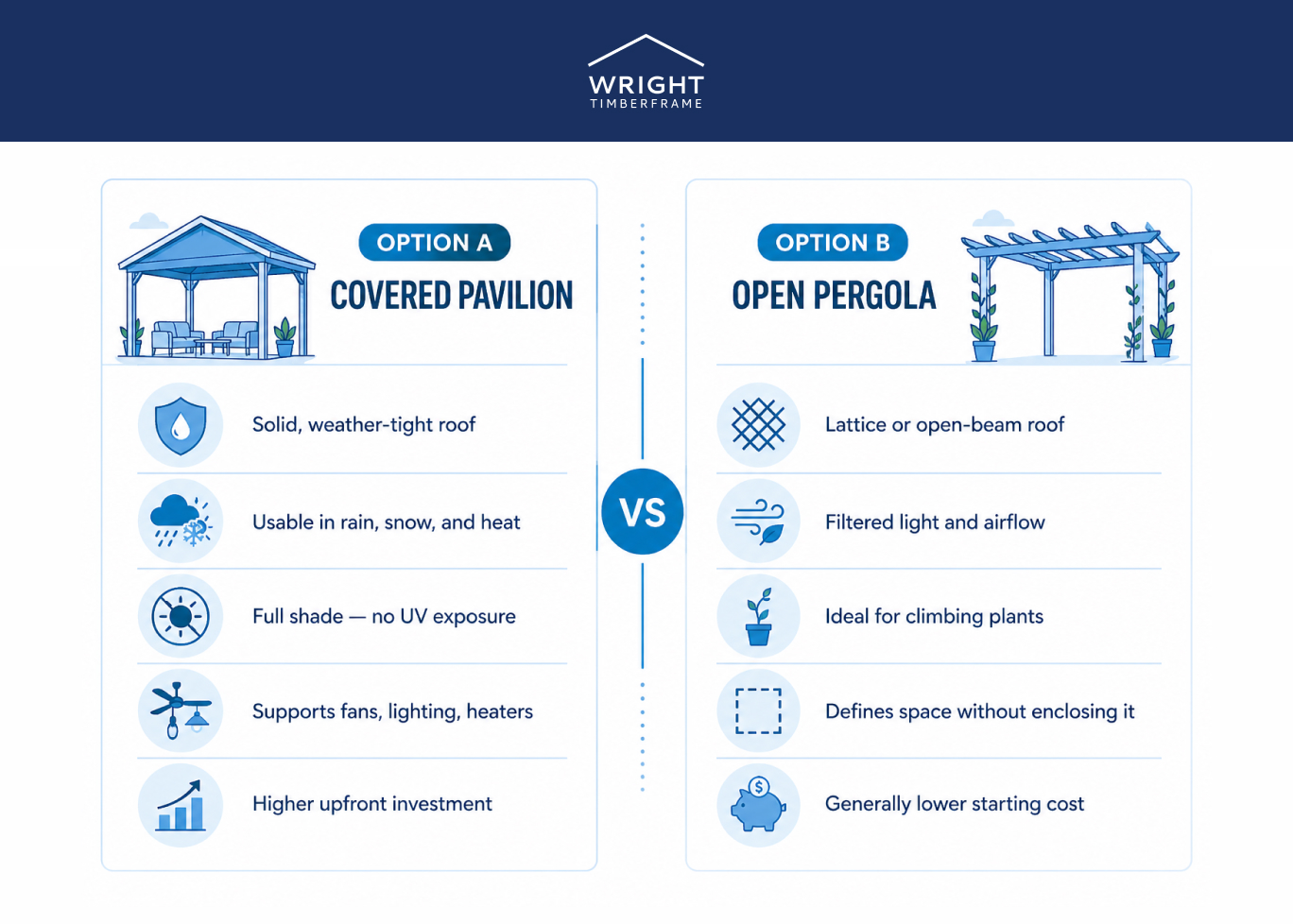
Key Differences: Pavilion vs Pergola
- solid roof, all-weather use
- fans, heaters, lighting-ready
- year-round outdoor room
- built for Utah’s weather swings
Pergola
- open lattice, light and airflow
- garden-friendly, plant support
- lower starting cost
- open and connected to the landscape
Both structures are available in timber frame construction. However, they deliver fundamentally different experiences. Understanding that difference before you build saves you from a costly mistake later.
For a deeper look at timber construction methods, see our guide to timber frame pavilion vs. pergola construction.
Solid Roof vs Lattice Roof: How Each Overhead Style Works
The roof is the defining feature of each structure. A solid roof vs lattice roof comparison reveals why these two structures behave so differently in real use.
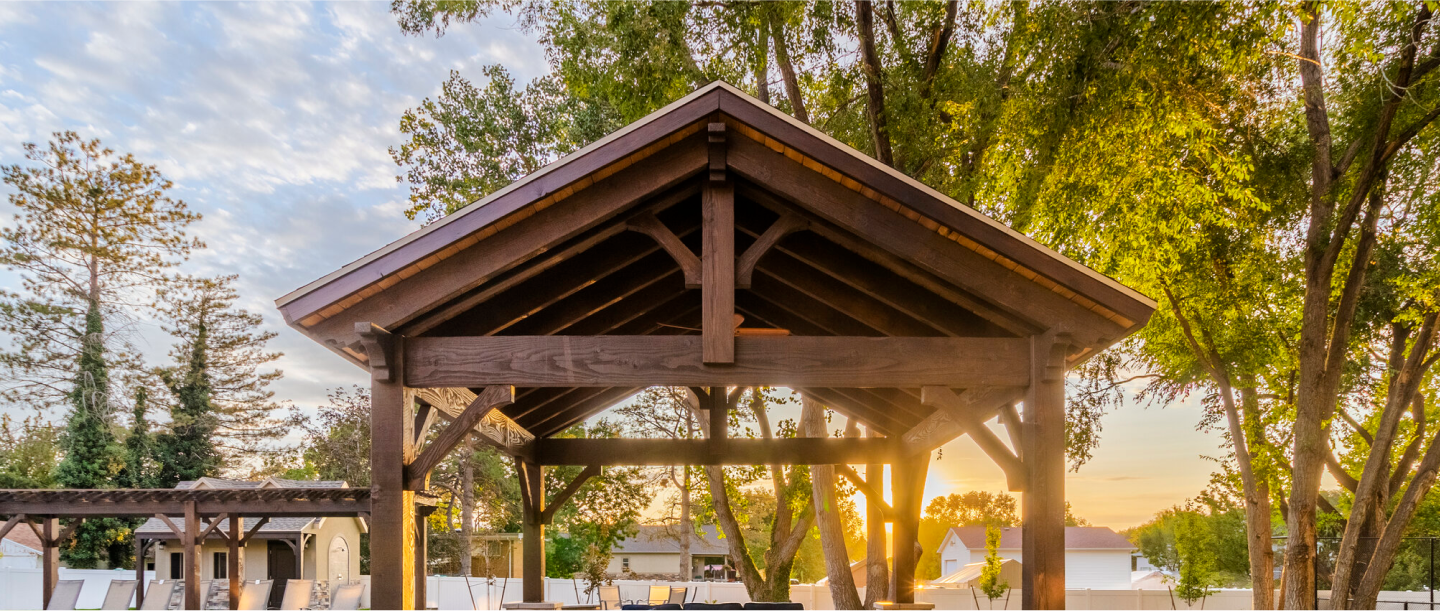
A pavilion roof uses solid decking: typically metal roofing, shingles, or timber planking over a ridge beam. No precipitation gets through. No UV reaches the surface below. Consequently, everything underneath stays dry and protected regardless of the conditions outside.
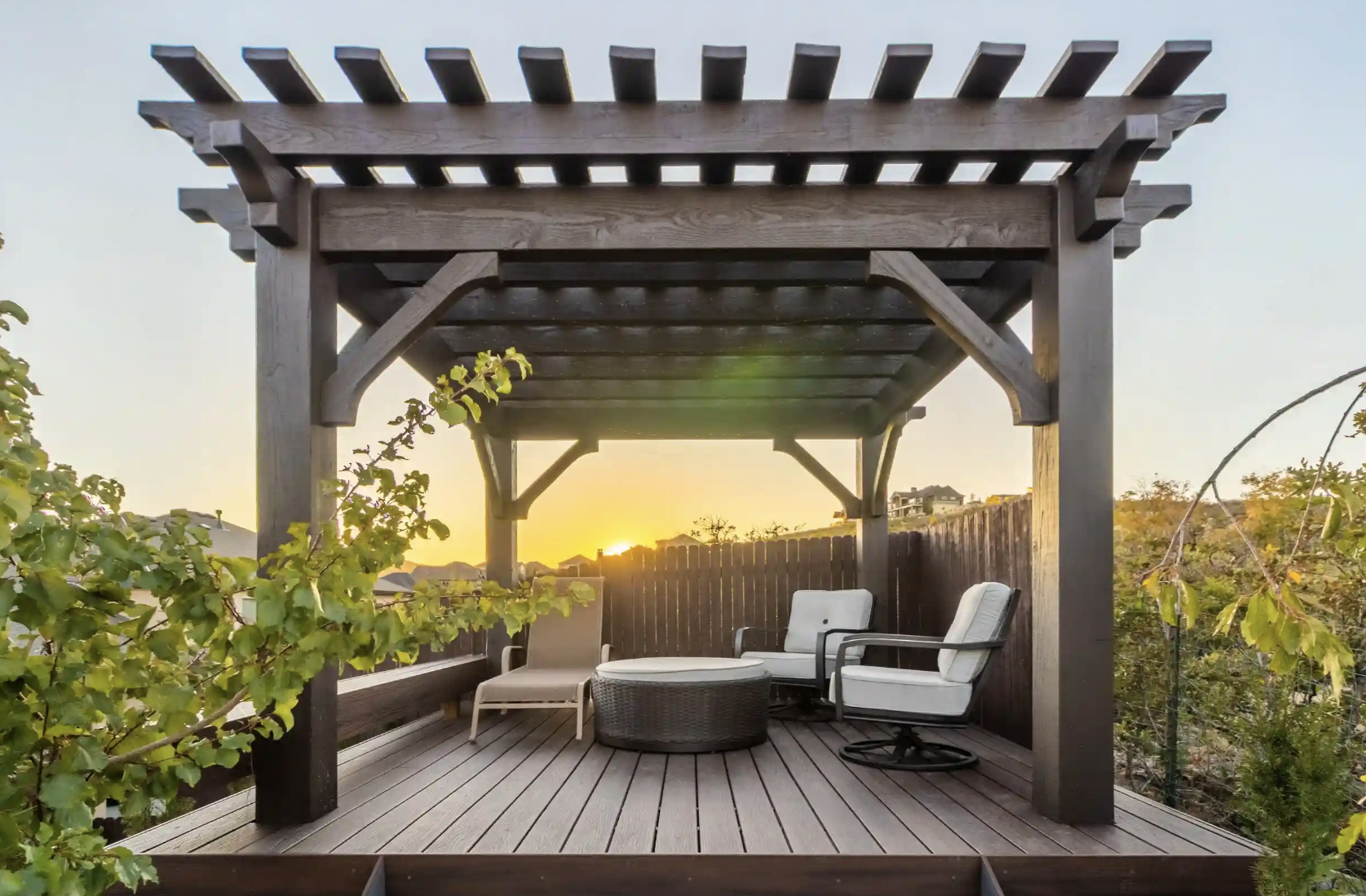
A pergola roof uses open rafters, a lattice grid, or spaced purlins. As a result, light filters through at angles that shift throughout the day. Rain passes through freely. That openness is the point for some homeowners and a dealbreaker for others.
Pro Tip: Before choosing a roof style, list the three activities you most want to do in the space. If any involve cooking, electronics, or guests staying put regardless of weather, a solid roof wins automatically. Pergolas reward flexibility. Pavilions reward commitment to year-round use.
What a Full Shelter Outdoor Structure Actually Gives You
A pavilion works as a genuine outdoor room. Because the solid roof completely seals out the elements, you are no longer dependent on the weather to use the space. That single fact changes how you plan, invest, and enjoy your backyard.
All-weather use from spring through winter
Utah’s climate is more varied than many homeowners expect. Summer afternoons push past 100 degrees Fahrenheit along the Wasatch Front. Winter brings snow. Spring arrives with brief afternoon thunderstorms.
Furthermore, a full shelter outdoor structure protects your furniture investment. Cushions, rugs, and outdoor kitchen appliances last significantly longer when they live under a solid roof rather than through seasonal exposure.
An infrastructure that an open structure cannot match
A solid roof creates a structural platform for ceiling fans, recessed lighting, outdoor heaters, and mounted speakers. Each of those items requires either a solid attachment point or protection from rain. Therefore, homeowners who want a truly functional outdoor entertaining space consistently choose the pavilion.
Additionally, pavilions support hot tub enclosures more effectively. You get overhead protection from snow and rain, a mounting point for lighting, and a structure built to handle moisture load over many years.
Pro Tip: When planning a pavilion over a hot tub, ask your builder about vapor-resistant ceiling materials and proper ridge ventilation. Moisture from a hot tub accumulates overhead and can cause long-term wood degradation if the roof design does not account for it.
What an Open Pergola Gives You Instead
A pergola offers something a pavilion cannot: the feeling of being outdoors while still having structure above you. The open-rafter overhead lets natural light play across the space all day. As a result, the area never feels enclosed or disconnected from the sky.
Light, airiness, and plant support
If your goal is a garden destination or a morning reading nook, a pergola achieves that feeling more naturally. Climbing roses, wisteria, jasmine, or hops can weave through the beams over a season or two. Over time, the pergola becomes its own organic canopy.
Notably, a pergola also defines zones within a larger yard without enclosing sightlines. A well-proportioned timber pergola anchors a patio, separates a dining area from a lawn, or frames a focal point while keeping the yard feeling open and connected.
According to the American Institute of Architects, outdoor structures that define spaces without enclosing them consistently score high in homeowner satisfaction for garden and landscape integration.
Pro Tip: For pergolas supporting climbing plants, specify wider spacing on the top rails. Tighter spacing restricts sunlight from reaching the plants below, which slows growth and reduces the canopy effect you are working toward.
Shade vs Weather Protection: Why Utah’s Climate Changes the Math
Utah’s elevation and geography create weather patterns that lean toward covered structures for homeowners who want genuine year-round outdoor use. Shade vs weather protection becomes a more urgent question here than it does in milder climates.
Specifically, the Wasatch Front and surrounding Utah communities experience:
- Intense UV exposure. High elevation amplifies sun intensity considerably. Full shade from a solid roof makes a real difference in comfort between 11 a.m. and 4 p.m.
- Afternoon monsoon storms. Brief but heavy July and August storms clear an open pergola immediately. A covered pavilion keeps guests comfortable and furniture dry.
- Snow accumulation. A properly engineered pavilion roof handles Utah’s snow load without issue. An open pergola sheds most snow, but furniture and fixtures below remain exposed to moisture.
- Wind-driven rain. Pergolas offer no meaningful rain protection. Even light wind pushes precipitation horizontally into the structure.
Consequently, homeowners who want a year-round outdoor room consistently find that a covered timber pavilion performs better in Utah’s climate than an open pergola.
The Utah Climate Center documents that the state’s high-elevation zones see over 300 days of sunshine annually alongside significant seasonal temperature swings. That combination rewards structures designed for both shade and weather protection.
Pergola or Pavilion Utah: Which Fits Your Specific Use Case?
Use case matters more than personal preference in most situations. Here is how the two structures map to the most common outdoor living goals for Utah homeowners.
| Your Goal | Best Fit | Why |
|---|---|---|
| Outdoor kitchen and dining | Pavilion | Protects appliances, guests, and furniture. Supports fans and overhead lighting. |
| Hot tub enclosure | Pavilion | Overhead protection from snow and rain. Mounting point for lighting and privacy panels. |
| Garden focal point | Pergola | Supports climbing plants. Keeps the space integrated with the landscape naturally. |
| Patio zone definition | Pergola | Defines the space visually without enclosing sightlines or blocking light. |
| Entertaining and events | Pavilion | Weather-proof year-round. Supports AV, lighting, and heater infrastructure. |
| Morning reading nook | Pergola | Light, open feel in moderate weather without heavy infrastructure required. |
| Year-round outdoor room | Pavilion | Only a solid roof delivers reliable use across Utah’s full seasonal range. |
| Walkway or garden arch | Pergola | Scaled appropriately for a transition space rather than a destination. |
The Hybrid Option: Pergola Attached to a Pavilion
Some of the most functional outdoor living projects combine both structures. A covered pavilion anchors the main living and dining zone. A connected open pergola extends toward the garden or pool, providing a transitional space that feels like a natural extension of the yard.
The pavilion handles weather-dependent activities. The pergola, furthermore, gives climbing plants a framework and keeps a portion of the yard feeling open and light. Together, they resolve the either-or problem entirely.
This combination requires more planning and a larger budget. However, for larger properties where both use cases genuinely apply, it is the most versatile option available. Our timber frame pavilion vs. pergola guide covers the structural considerations for connecting the two.
Cost Comparison: Which Structure Costs Less to Build?
A pergola typically costs less upfront than a pavilion of comparable size and timber quality. The primary reason is the roof structure. Open rafters require less material and labor than solid decking, roofing substrate, and weatherproof finishing.
- Simpler roof structure
- Less roofing material required
- Faster install timeline
- Limited infrastructure potential
- Seasonal use in Utah’s climate
- Furniture exposed to weather
- Solid roof adds material and labor
- Supports fans, lights, and heaters
- Protects your furniture investment
- Year-round usability
- Higher resale value contribution
- Outfitting costs spread over more months
However, the right comparison is not initial price. It is value delivered per dollar over the life of the structure. A pavilion used ten months a year returns more value per square foot than a pergola used four or five months a year.
Additionally, the furniture and appliances you invest in last significantly longer under a solid roof. Factor that in and the price gap narrows considerably over a ten-year window.
For exact pricing on your specific size, site, and timber specification, contact the team directly. Every project differs, and estimates without a site assessment are rarely accurate. Visit our project inquiry page to start the conversation.
Pro Tip: When comparing quotes, ask each builder to include estimated furniture replacement and seasonal maintenance costs over five years. That number often narrows or eliminates the upfront price difference between the two structures.
Utah’s Trusted Builder of Custom Timber Outdoor Structures
Wright Timberframe has spent over a decade building custom timber pergolas and pavilions for Utah homeowners. Every structure is hand-cut using Douglas Fir or Cedar, joined with mortise and tenon joinery, and designed specifically for your space. No cookie-cutter kits. No pressure-treated shortcuts.
Whether you choose a covered pavilion or an open pergola, the build quality determines how long it lasts and how good it looks ten years from now. That is the difference between a structure you are proud of and one you merely tolerate.
- Over 10 years of Utah timber frame experience
- Hand-cut Douglas Fir or Cedar only
- Mortise and tenon joinery
- Custom-designed for your specific yard
- Local team handles design, cut, and install
- Built for Utah’s full seasonal range

Frequently Asked Questions about Covered Pavilion vs Open Pergola
What is the main difference between a covered pavilion and an open pergola?
A covered pavilion has a solid roof that blocks rain, snow, and sun completely. An open pergola has a lattice or open-rafter top that allows light and rain to pass through. That single difference determines how you can use each structure across Utah’s seasons.
Is a pergola or pavilion better for Utah’s weather?
For year-round use in Utah, a covered pavilion performs better. The state’s intense UV, afternoon monsoon storms, and winter snow make a solid roof significantly more practical for most homeowners who want to use the space beyond spring and fall.
Can I add a roof to a pergola later to convert it into a pavilion?
In some cases, yes. However, a pergola is typically not engineered to handle the added weight of a solid roof. Retrofitting often requires reinforcing posts, footings, and beam connections. Building a pavilion from the start is generally more cost-effective than upgrading later.
Which structure adds more resale value to a home?
Both add property value when built with quality materials and proper permits. A covered pavilion tends to contribute more because it functions as usable square footage in all seasons. Buyers respond to outdoor spaces they can actually use year-round.
How long does a timber frame pergola or pavilion last?
A properly built timber frame structure using Douglas Fir or Cedar with traditional joinery can last 30 to 50 years or more. The key variables are wood species, joinery method, finish quality, and regular maintenance. Metal bracket connections typically fail well before the timber does.
Covered Pavilion vs Open Pergola: Which One Belongs in Your Yard?
The covered pavilion vs open pergola decision ultimately comes down to how you plan to use the space and how seriously Utah’s weather factors into that plan. If you want a year-round outdoor room for cooking, entertaining, or relaxing without watching the forecast, a pavilion is the right call. If you want a garden-integrated, light-filled space for mild-weather moments, a pergola delivers that better.
Additionally, both structures are available in the same premium timber and joinery that makes Wright Timberframe builds last decades rather than years. The structure is the investment. The roof style is the variable. Therefore, choose the one that fits how you actually live.
Still weighing the construction details? Our guide to timber frame pavilion vs. pergola builds covers materials, engineering, and what to ask your builder before signing anything.
Ready to build? Start with a conversation.
Our design consultants will help you choose the right structure and get you a custom quote for your specific space.

