
What Every Timber Frame Pavilion Foundation Actually Needs
A timber frame pavilion foundation is the part of the project most people think about last, but should plan for first. Get this right, and everything else follows. Get it wrong, and a beautiful structure built from Douglas Fir and traditional joinery will shift, settle, or require costly correction down the road.
This guide covers the four main foundation types used for timber pavilions, how Utah’s freeze-thaw cycles affect your decision, where permits come into play, and the specific approach Wright Timberframe takes when sizing up a new site.
Does a Timber Pavilion Actually Require a Foundation?
Short answer: it depends on size, intended use, and your local code.
A small, freestanding pavilion under 200 square feet sitting on compacted gravel or pavers may not require a formal foundation in many jurisdictions. But a larger timber frame pavilion with a fully sheathed roof, electrical, or permanent fixtures almost always triggers a permit requirement, and with that comes specific foundation standards.

Beyond permits, there is the practical side. Timber framing uses heavy materials. A Douglas Fir or Cedar post system with a gabled or hipped roof transfers significant load to the ground. Without adequate footing, posts can shift seasonally, joints can open up, and a structure you spent real money on begins to look like a problem rather than an asset.
The factors that push a pavilion into “you need a real foundation” territory:
- Footprint over 200 square feet
- A fully enclosed or solid roof (not open lattice)
- Electrical, plumbing, or gas connections
- Location in a high-wind or heavy-snow zone
- A site with unstable or expansive soil
- Any structure that will be classified as permanent by your county
The Four Foundation Types for Timber Pavilions
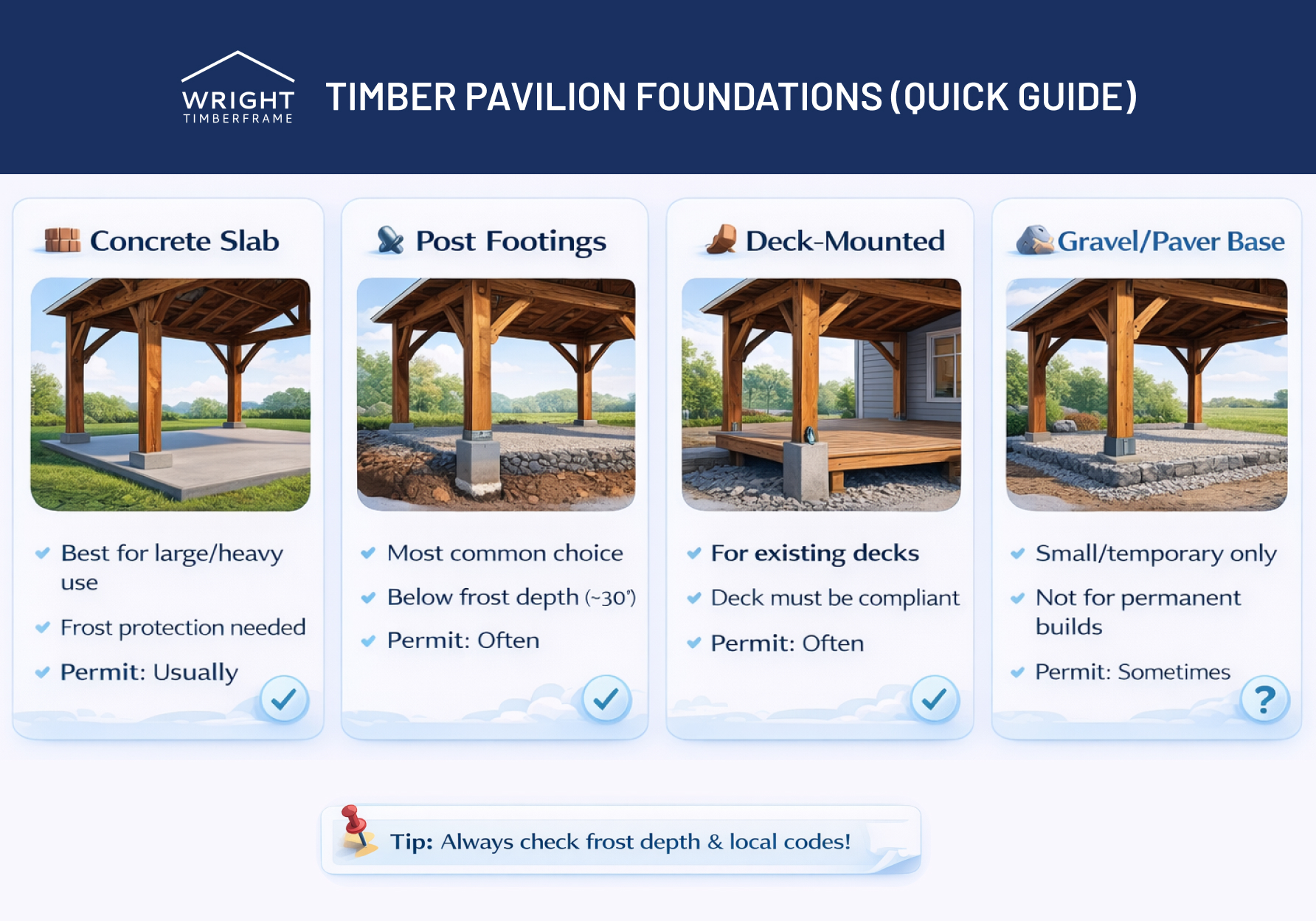
Each option suits different site conditions, budgets, and intended uses. Here is how they compare.
| Foundation Type | Best For | Utah Frost Notes | Permit Likely? |
|---|---|---|---|
| Concrete Slab | Large pavilions, outdoor kitchens, heavy-use spaces | Slab edges must account for frost heave; thickened edges are recommended | Usually yes |
| Concrete Post Footings | Most residential timber pavilions | Must extend below frost depth (typically 30″ in Salt Lake Valley) | Often yes |
| Deck-Mounted Posts | Pavilions built over an existing deck | Host deck footings must already be frost-depth compliant | Often yes |
| Paver or Gravel Base | Smaller, non-permanent structures | Not code-compliant for larger or permanent structures | Sometimes no |
Concrete Slab
A poured concrete slab is the most familiar foundation option and works well for larger pavilions or spaces doubling as outdoor kitchens or entertainment areas. Posts are typically set into Simpson-style post bases anchored into the slab before or after the pour, depending on your approach.
In Utah, frost heave is a real concern. A standard 4-inch residential slab without thickened edges can crack and shift after a few freeze-thaw cycles. A structural slab with thickened perimeter edges (typically 12 inches or more at the beam lines) distributes load more evenly and resists movement. If you are pouring new concrete anyway, this is worth doing correctly from the start.
Concrete Post Footings
Drilled and poured concrete footings are what Wright Timberframe most often recommends for standard residential timber frame pavilion installations in Utah. The process involves drilling down to below the frost line, setting a tube form, and pouring concrete with either a post bracket embedded at the top or a threaded rod for a standoff base.
This method is structurally sound, code-compliant in virtually all Utah municipalities, and does not require pouring an entire slab. It is also easier to execute on sloped or irregular terrain where a flat slab would be expensive and difficult to form.
Deck-Mounted Posts
If you have an existing deck, it is tempting to simply bolt pavilion posts to the deck framing. This can work, but only if the deck itself has footings that already meet current frost depth requirements. Many older Utah decks were built before stricter code interpretations were applied, so this is something to verify before assuming your deck can carry a timber pavilion load.
The pavilion posts transfer vertical load and lateral wind load down into the deck, which passes it to the footings. If those footings are undersized or too shallow, the entire system is compromised. A structural inspection of the existing deck by a qualified contractor is worth the investment before proceeding.
Paver or Gravel Base
Pavers and compacted gravel are popular because they are lower cost and do not require concrete work. For a small, light-duty pavilion on relatively stable soil, this can be adequate. The post bases rest on concrete blocks or pins set into the compacted base.
The honest limitation: frost heave will still affect this system over time. Pavers shift. If a post corner rises even half an inch relative to the others, you will notice it in the joinery. This is generally better suited to timber frame kit pavilions that are intended to be semi-permanent or relocated, rather than a fully installed, custom timber structure.
How Foundation Choice Affects Permits
In Utah, most cities and counties require a building permit for any permanent outdoor structure over a certain size, and the foundation type you choose directly affects how your project is classified.
A pavilion with concrete footings drilled to frost depth is almost always treated as a permanent structure. That means it will need to be permitted, and your plans may need to show footing depth, post size, beam span, and roof load calculations. Engineered plans stamped by a licensed professional may be required for larger structures or in stricter jurisdictions.
A pavilion on a paver base may fall into a gray area. Some counties will let this slide if the footprint is small; others will still require a permit regardless of foundation type because the structure has a solid roof.
The safest path is always to check with your local planning department before breaking ground. If you are working with Wright Timberframe on a full installation in Utah, they handle this coordination as part of the process.
For a detailed breakdown of what to expect when pulling permits in Utah, see the Wright Timberframe guide to pavilion building permits in Utah.
Wright Timberframe’s Approach to Foundation Planning
When Wright Timberframe visits a site, the conversation about foundation usually starts with three questions: What is the pavilion being used for? What is currently on the ground? And what do local code requirements look like for this address?
For most Utah residential jobs, the recommendation is drilled concrete footings at or below frost depth, with post standoff bases to keep timber ends off the ground and allow drainage. This protects the Douglas Fir or Cedar post from moisture wicking and extends the life of the structure significantly.
For clients who already have a concrete patio, the team evaluates whether the slab is structurally sound enough to use as-is or whether additional footings need to be drilled through or alongside it. For deck-mounted projects, they review the existing deck’s footing depth before committing to a design.
Wright Timberframe does not upsell foundation work for its own sake. If the site is straightforward and a paver base is genuinely suitable for the structure size and use case, that gets communicated plainly. The goal is a structure that performs well and looks good decades from now, not one that generates a callback in year three because a post has shifted.
All of their custom pavilion builds in Utah include a site assessment conversation before any design work begins. You can see the types of pavilions they build and the range of options available on the timber frame pavilion page.
DIY Foundation Prep vs. Hiring a Contractor
If you are purchasing a timber frame pavilion kit from Wright Timberframe and planning to handle installation yourself, foundation prep is the one area where professional help most often pays off.
Drilling footings to the correct depth requires the right equipment. Renting a towable auger is doable for most homeowners, but soil conditions in Utah can vary significantly, from sandy fill to hard caliche or river rock, which can make consistent hole depth difficult without experience.
If you choose to DIY the foundation, here is what matters most:
- Confirm your local frost depth with the county building department or a local contractor before determining footing depth.
- Use a string line and batter boards to lay out post locations precisely. Errors here compound through the entire timber frame.
- Use tube forms (Sonotubes) sized to your post base requirements, typically 10 to 12 inches in diameter for residential pavilions.
- Place post brackets while the concrete is still wet and check for square before it sets. Adjustments after curing are painful.
- Let the concrete cure for a minimum of 48 to 72 hours before applying any structural load.
The custom pavilion ultimate guide from Wright Timberframe covers build sequencing in more detail, including how foundation work sets up the timber frame installation.
According to the Family Handyman’s guide to concrete footings, accurate layout and proper curing time are the two areas where DIY projects most commonly fall short, and both directly affect how your pavilion posts sit and perform over time.
Frequently Asked Questions about Timber Frame Pavilion Foundation
Does a timber frame pavilion need a concrete foundation?
Not always, but larger pavilions with solid roofs, electrical connections, or permanent fixtures typically do. In Utah, any structure over roughly 200 square feet will usually require a permit that mandates a code-compliant foundation. For smaller structures on stable soil, pavers or compacted gravel can be adequate, though they are less durable over time.
How deep should post footings be for a timber pavilion in Utah?
In the Salt Lake Valley, footings should generally extend at least 30 inches below grade to clear the frost line. In higher-elevation areas such as Park City or the Wasatch Back, 36 inches is more appropriate. Footings shallower than the local frost depth risk heaving and shifting during freeze-thaw cycles, which damages joinery and post alignment.
Can a timber pavilion be built on an existing concrete patio?
Yes, but the existing slab needs to be evaluated first. A 4-inch residential slab that was not designed with post loads in mind may not have the structural capacity to anchor a heavy timber frame without cracking. Options include drilling new footings through or adjacent to the slab, or pouring thickened pads at post locations. A site assessment helps determine the right approach.
What happens if you build a pavilion without proper footings?
Without adequate footings below the frost line, posts will shift seasonally as the ground freezes and thaws. This opens up mortise and tenon joints, causes the structure to rack slightly out of level, and can eventually compromise the roof system. Retrofitting footings after the fact is significantly more difficult and expensive than doing it correctly the first time.
Do I need a permit to build a timber frame pavilion in Utah?
In most Utah municipalities, yes, if the structure has a solid roof and exceeds your county’s size threshold. The permit process typically requires site plans showing footing depth, post layout, and roof structure. Some jurisdictions also require engineered plans for larger structures. Requirements vary by city, so checking with your local planning department first is always worth the call.
Can I install my own timber pavilion foundation if I order a kit?
Yes. Wright Timberframe ships pre-cut timber frame kits nationwide that are designed for DIY or contractor assembly. Foundation prep is typically done before the kit arrives. If you are handling it yourself, the most important factors are accurate layout, correct footing depth, and allowing adequate concrete cure time before placing the timber posts.
What is the difference between a concrete slab and post footings for a pavilion?
A concrete slab covers the entire footprint of the structure and serves as both the floor surface and the foundation. Post footings are individual poured concrete cylinders drilled into the ground at each post location. Post footings are more economical, work well on sloped terrain, and are the most common choice for residential timber pavilions. Slabs are better suited for large pavilions with outdoor kitchens or high-traffic surfaces.
Plan Your Timber Frame Pavilion Foundation the Right Way
The right timber frame pavilion foundation is not a one-size answer. It depends on your specific site, soil conditions, the pavilion’s footprint and use, and local code requirements in your Utah municipality. Getting these details sorted before design work begins saves time, money, and frustration later.
Whether you are comparing foundation options for a site you are already excited about, or you are still deciding between a full install and a timber frame kit, having a conversation with a builder who has done this work across Utah for over a decade is a good place to start.
Wright Timberframe has built everything from small backyard pavilions on paver bases to large event structures on engineered slabs. They will tell you plainly what your site needs and what it does not. No overselling, no guesswork.