
Choosing the best wood for pergola is one of the most important decisions you’ll make before selecting a design or finish. Different wood species vary in strength, durability, maintenance requirements, and long-term appearance, especially in Utah’s hot summers, dry climate, and heavy mountain snow. Homeowners planning a custom pergola, a DIY project, or a pre-cut kit often ask which wood offers the best balance of longevity, cost, and appearance. This guide compares Douglas Fir, Western Red Cedar, redwood, pine, and pressure-treated lumber to help you choose the right timber for your climate, budget, and outdoor living goals.
Quick Answer: For most pergola projects, Douglas Fir and Western Red Cedar are the best overall wood choices because they provide the ideal balance of structural strength, durability, and long-term performance. Douglas Fir offers exceptional strength and value for heavy timber construction, while Western Red Cedar naturally resists rot, insects, and moisture with less maintenance. The right choice depends on your budget, desired appearance, and the level of maintenance you’re willing to perform.
What to Look for in Pergola Timber
The best pergola timber balances three things: natural resistance to rot and insects, enough strength and stiffness for post-and-beam spans, and workability for clean mortise-and-tenon joints. We’ve spent more than 10 years hand-cutting timber-frame pergolas across Utah, work that Google reviewers rate 4.9 stars, and this guide reflects what actually holds up on a job site, not a marketing claim.
Durability matters most where the wood sits closest to the ground or holds moisture, like post bases and footing connections. Strength and stiffness matter for the beams and rafters that carry snow load in a Utah winter and wind load in a spring storm. Workability matters because a mortise-and-tenon joint depends on clean, splinter-free cuts; a timber that tears out around the joint weakens the whole frame.
Finish compatibility rounds out the list. A species that takes stain evenly, like Douglas Fir or Cedar, holds its color longer and needs fewer touch-ups. We route the exact footing depth, post spacing, and load calculations for your site to our design team rather than publish a one-size-fits-all number, since snow and wind loads vary by Utah county and elevation.
Grain and grade matter too. A grading stamp on structural lumber tells you the species, moisture content, and strength grade before you ever pick up a saw. We buy select-grade Douglas Fir and heartwood-grade Cedar rather than mixed lumber, so every post and beam that reaches a job site has already been sorted for the qualities a pergola frame needs.
Timber for a Pergola: Matching Species to Utah’s Climate
Utah’s dry summers and strong UV exposure bleach unfinished wood fast, while freeze-thaw cycles in the mountains and benches stress any joint that relies on glue or hardware instead of solid wood-to-wood contact. Douglas Fir and Western Red Cedar both handle this swing well once finished, which is why they remain our standard offerings for both site-built installs and nationwide kits. A species that performs well in the Pacific Northwest, where it’s often grown, needs the same UV-rated finish here that it would along the coast, just reapplied on a schedule that matches Utah’s stronger sun.

Douglas Fir: Strength, Cost, and Why We Build With It
Douglas Fir is the standard structural timber we use at Wright Timberframe because it delivers high strength and stiffness relative to its cost. It’s one of the stronger softwoods available for post-and-beam construction, which lets us cut generous timber sizes for a pergola’s posts and beams without over-building the frame.
The heartwood of Douglas Fir also carries above-average natural decay resistance for a softwood used above ground, according to durability research from the USDA Forest Products Laboratory. That resistance, combined with a UV-rated finish, is why we don’t need pressure-treatment chemicals to make it last outdoors.
Douglas Fir takes Behr stain evenly and holds a tight, straight grain that’s easier to hand-cut into a mortise-and-tenon joint than a knottier or softer species. It’s also the more budget-friendly of our two standard species, which is part of why it remains the default choice for both Utah installs and our pre-cut kits.
Structural lumber grading, the system that sorts Douglas Fir into select structural, No. 1, and No. 2 grades based on knots, grain slope, and strength, follows standards maintained by agencies such as the Western Wood Products Association (WWPA). We specify select-grade timber for visible posts and beams so the frame is both strong and clean to look at.
We size Douglas Fir posts and beams to the specific spans and site conditions on every project rather than using a single stock dimension for every yard. The same select-grade Douglas Fir ships in our pre-cut kits, so a homeowner assembling a kit in another state gets the same species and the same mortise-and-tenon joinery we use on a Utah install.
Western Red Cedar: Natural Oils, Beauty, and Longevity
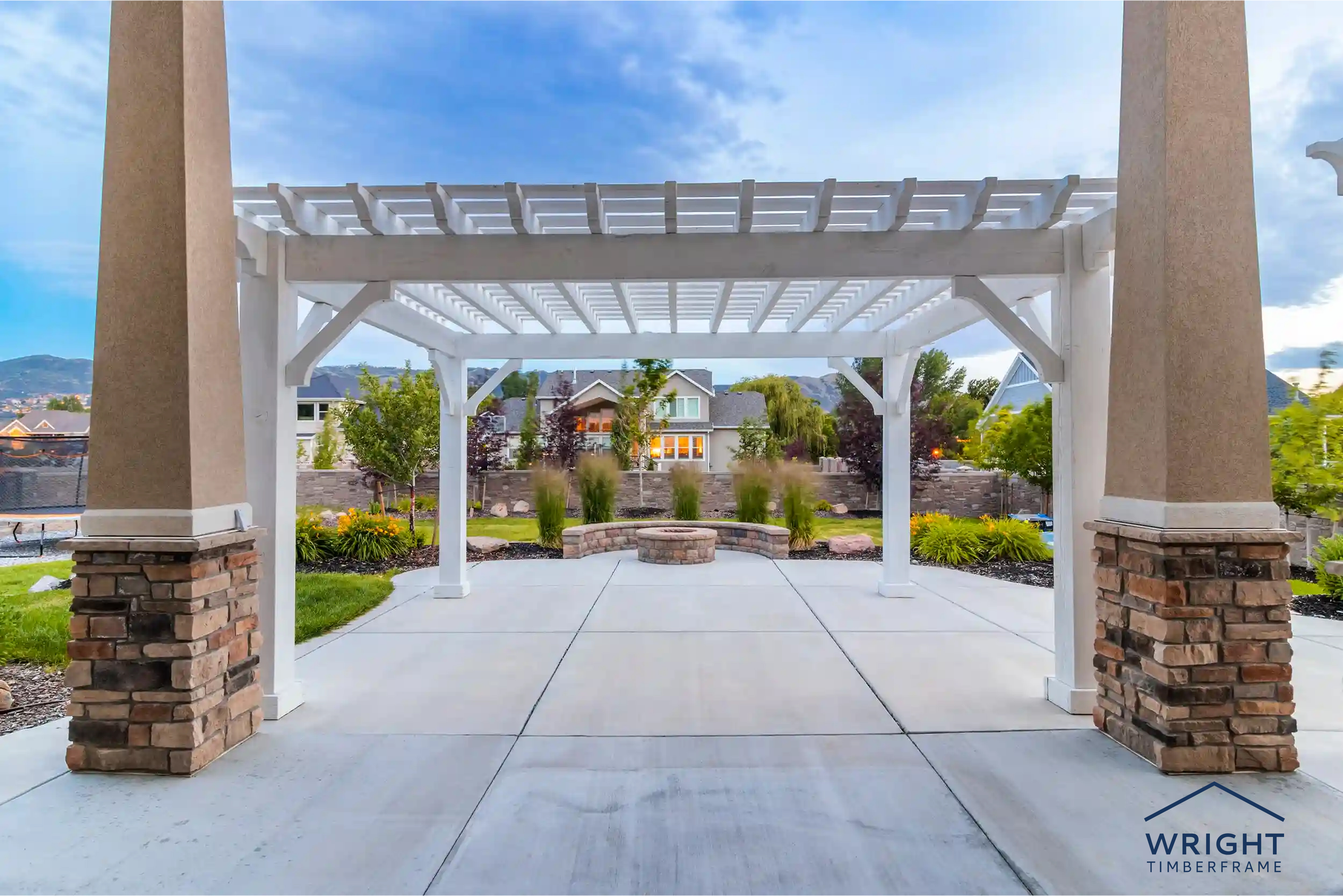
Western Red Cedar resists decay and insects on its own, without chemical treatment, because its heartwood contains natural oils called thujaplicins. That built-in resistance is documented by the Western Red Cedar Lumber Association, and it’s the main reason we offer Cedar as an upgrade species.
Cedar also has a lower shrinkage factor than most softwoods, so it resists the warping and twisting that show up in cheaper lumber as it dries. That stability matters for a pergola frame, where a warped rafter can throw off the fit of every joint around it.
Beyond performance, Cedar’s warmer, reddish tone and straight grain give a pergola a different look than Douglas Fir’s tighter, paler grain. Cedar is lighter and slightly softer to work with, which our crew accounts for when hand-cutting joints, and it takes stain and oil finishes well if you’d rather preserve than change its natural color.
Cedar’s lower density also gives it a modest insulation advantage over denser softwoods, though that matters less for an open pergola than it would for an enclosed pavilion. We still note it because homeowners comparing Cedar for a pergola today often come back for a Cedar pavilion or trellis later.
Redwood, Pine, and Pressure-Treated Lumber: Where They Fall Short
Redwood, standard pine, and pressure-treated pine are common pergola materials on the market, but each carries a tradeoff that Douglas Fir and Cedar avoid. We lay these out as general market options; they aren’t species we build with.
Redwood shares some of Cedar’s natural decay resistance, but old-growth, naturally durable redwood is limited in supply and typically carries a higher price than either of our standard species. Much of the redwood sold today is younger, faster-grown stock with less of the heartwood that gives the species its reputation, so the natural durability you get can vary from board to board.
Untreated pine is inexpensive but has little natural decay resistance, so it depends on a chemical treatment or a heavy maintenance schedule to hold up outdoors. Pressure-treated pine solves the durability problem by infusing preservatives into the wood, but that creates a different set of tradeoffs.
Treated lumber tends to warp and check more as it dries after installation; its chemical content can complicate a clean glue or stain finish, and manufacturers typically pair it with metal brackets and bolts rather than traditional joinery. A bracket-and-bolt frame is faster and cheaper to mass-produce, but a hand-cut, wood-to-wood mortise-and-tenon joint in real timber is what actually ages well over decades.
| Species | Natural Decay Resistance | Cost vs. Douglas Fir | Works With Mortise-and-Tenon | Used by Wright Timberframe |
| Douglas Fir | Moderate to good (heartwood) | Baseline | Yes | Yes, standard |
| Western Red Cedar | High (natural oils) | Higher | Yes | Yes, upgrade option |
| Redwood | High (old-growth heartwood) | Higher, limited supply | Yes | No, market option only |
| Untreated Pine | Low | Lower | Yes, but softer | No |
| Pressure-Treated Pine | Chemically treated, not natural | Lower upfront | Typically bracket-and-bolt | No |
Pressure treatment pushes chemical preservatives into the wood under pressure, and that same process leaves the lumber wetter than kiln-dried Douglas Fir or Cedar. As treated pine dries in place, it moves more, which opens gaps around a joint that depends on a tight, dry fit. That’s a structural reason, not just an aesthetic one, why we build with real Douglas Fir and Cedar instead.
Hardwood vs. Softwood for Pergolas
Almost every timber-frame pergola, including ours, is built from softwood rather than hardwood, because species like Douglas Fir and Cedar combine strength, workability, and natural weather resistance in a package that suits large structural timbers.
Hardwoods such as oak are dense and strong, but that density makes them heavier to handle on site and harder to hand-cut into a clean mortise-and-tenon joint at the scale a pergola needs. Hardwood also tends to cost more per board foot and can move more with humidity changes than a properly dried softwood timber.
Oak and other hardwoods do show up in traditional barn framing and some high-end interior timber work, where their density and figure are the point. For an outdoor, weather-exposed pergola, though, the weight and cost rarely pay off compared to a well-finished softwood frame.
Grading standards from organizations such as the Western Wood Products Association (WWPA) cover much of the structural lumber industry’s quality benchmarks. Most post-and-beam pergola construction in North America uses graded softwood for exactly these reasons: availability, workability, and a strength-to-weight ratio suited to open, overhead structures.
How to Finish and Protect Your Pergola Timber
A UV-rated finish protects pergola timber from sun bleaching and moisture cycling, and it’s the single easiest way to extend the life of any wood species. Our kits ship pre-cut and pre-stained in any Behr stain color, so the finish is already on the wood before it leaves for assembly.
For Utah installs, we finish on-site to match the timber to your home and to the sun exposure of your yard. A south-facing pergola in full sun needs the same reapplication attention as one under partial shade, just on a shorter cycle, since UV exposure is what breaks a finish down fastest.
Recoating frequency depends on the finish, sun exposure, and local climate more than on the wood species itself, so the appropriate maintenance schedule should be based on your site’s conditions rather than a fixed timeline. What we can say is that a maintained finish, checked and refreshed before it fully wears through, protects the wood far better than one applied once and left alone.
Checking vs. Cracking: What to Expect From Real Timber
Real timber checks, meaning it develops small surface splits as it releases moisture and continues drying after installation. Checking is a cosmetic, expected part of how solid wood behaves; it isn’t the same as a structural crack, and it doesn’t weaken a properly sized mortise-and-tenon joint. We explain this up front because a first-time timber-frame owner who has only seen engineered lumber can mistake normal checking for a defect.
Cost and Longevity: What to Expect
Pergola pricing is quoted individually because it depends on species, size, and design, so we don’t publish a fixed pergola price list. The wood you choose still shapes the number: Cedar typically costs more than our standard Douglas Fir, and either one costs more than an unfinished, untreated pine option you might find elsewhere.
Because every one of our projects is custom, pergola pricing depends on factors such as timber species, size, design, and site conditions. A pergola is typically a smaller, lighter structure than a pavilion, so the most accurate way to determine project cost is to request a custom quote.
| Species | Relative Project Cost | Typical Lifespan Range | Maintenance Needs |
| Douglas Fir | Baseline | Varies with finish, maintenance, and climate | Periodic staining, standard |
| Western Red Cedar | Higher | Varies with finish, maintenance, and climate | Periodic staining, standard |
| Redwood (market option) | Higher, limited supply | Varies with wood quality, finish, maintenance, and climate | Periodic staining, standard |
| Pressure-Treated Pine (market option) | Generally lower upfront | Varies with treatment quality, maintenance, and climate | More frequent sealing and inspection |
Longevity depends as much on your finish schedule and site drainage as it does on species. A well-finished Douglas Fir pergola with good footing drainage will often outlast a neglected Cedar one, so ask about maintenance during your quote, not just about the species.
Permit requirements for a pergola also vary by city and county in Utah, and they’re separate from the wood species question. Confirm setback and permit thresholds with your local building department before finalizing a design; we can route structural specifics to our team once you request a quote.

Frequently Asked Questions
What is the best wood for pergola in Utah’s climate?
Douglas Fir and Western Red Cedar are the best choices for Utah’s dry summers, strong sun, and freeze-thaw winters, since both take a UV-rated finish well and resist warping better than untreated softwoods. Wright Timberframe builds every custom pergola from one of these two species.
Is Douglas Fir or Cedar better for a pergola?
Neither species is universally better. Douglas Fir offers more strength per dollar, while Cedar offers natural rot resistance and a warmer color without staining. Wright Timberframe uses Douglas Fir as its standard and offers Cedar as an upgrade based on your budget and style preference.
Do I need to treat or seal pergola timber?
Yes, both Douglas Fir and Cedar need a UV-rated finish to slow sun bleaching and moisture cycling, even though both resist decay naturally. Wright Timberframe’s kits ship pre-stained in any Behr color, and its Utah installs are finished on site to match your home.
Can I get a pressure-treated pergola from Wright Timberframe?
No. Wright Timberframe builds exclusively with select Douglas Fir and Western Red Cedar, joined with mortise-and-tenon joinery instead of metal brackets. Pressure-treated pine isn’t used because it tends to warp more as it dries and doesn’t pair as cleanly with traditional joinery.
How long does a timber-frame pergola last?
Lifespan depends on the timber species, finish maintenance, drainage, and site conditions, so there is no single lifespan that applies to every pergola. A well-finished, well-drained pergola built with Douglas Fir or Western Red Cedar can provide many years of service when inspected regularly and maintained with periodic staining.
Do your pergola kits ship in both wood species nationwide?
Yes, Wright Timberframe’s pre-cut, pre-stained kits ship nationwide and use the same select Douglas Fir or Western Red Cedar used on its Utah installs, so an out-of-state buyer gets the same species and the same mortise-and-tenon joinery as a local one.
Choosing Your Best Wood for Pergola and Getting a Quote
The timber you choose will influence your pergola’s strength, appearance, durability, and long-term maintenance, so it’s worth taking the time to compare your options before building. Whether you’re planning a custom pergola in Utah or a pre-cut kit shipped nationwide, our team can help you understand the tradeoffs between Douglas Fir and Western Red Cedar based on your project, budget, and goals.
When you’re ready to move forward, request a free, no-obligation quote. If you’d like to explore more before deciding, you can browse our project gallery, learn about our custom timber pergolas, or see how our traditional timber frame joinery is crafted. For homeowners considering a kit, our DIY pergola kit and timber frame pergola kit guides explain what to expect before you order.

