

From our experience building timber frame pergolas, we know that choosing the right wood is only part of the equation. A pergola’s true lifespan depends on how the material performs after years of sun, moisture, seasonal movement, and outdoor exposure. Understanding the differences between wood species, joinery methods, and construction details helps homeowners invest in a structure designed to last instead of one that requires early repairs or replacement.
Quick Answer: A wood pergola typically lasts 20 to 50+ years, depending on the wood species, craftsmanship, climate, and maintenance. Premium woods such as Western Red Cedar and Douglas Fir generally outperform lower-cost materials when properly finished, maintained, and built with durable joinery. If you’re investing in a pergola, understanding what affects its lifespan helps you choose a structure that delivers long-term value instead of requiring early repairs.
Average Pergola Lifespan by Wood Type
Western Red Cedar and Douglas Fir are two of the most trusted wood species for outdoor pergolas because of their strength, durability, and performance above ground when properly finished and maintained. The table below summarizes published durability data by species. Structure-specific lifespan always depends on joinery, footing design, climate, and ongoing maintenance, so treat these as material baselines, not guarantees.
| Wood Species | Typical Above-Ground Lifespan | Decay Resistance | Notes |
| Western Red Cedar | 30 to 50+ years | Naturally resistant | Our premium upgrade species. Low shrinkage, resists warping and checking. |
| Douglas Fir | 20 to 40+ years | Performs well above ground when properly finished and maintained | Our standard species. Strong, straight-grained, and widely available. |
| Pressure-Treated Pine | 15 to 25 years | Depends on chemical treatment, not natural | General market option only. We do not build with pressure-treated pine. |
| Tropical Hardwood (e.g. Ipe, Teak) | 40 to 75+ years (depending on species) | Often resistant, species-dependent | General market option only. Heavy, costly, not used by us. |
Douglas Fir Pergola Lifespan
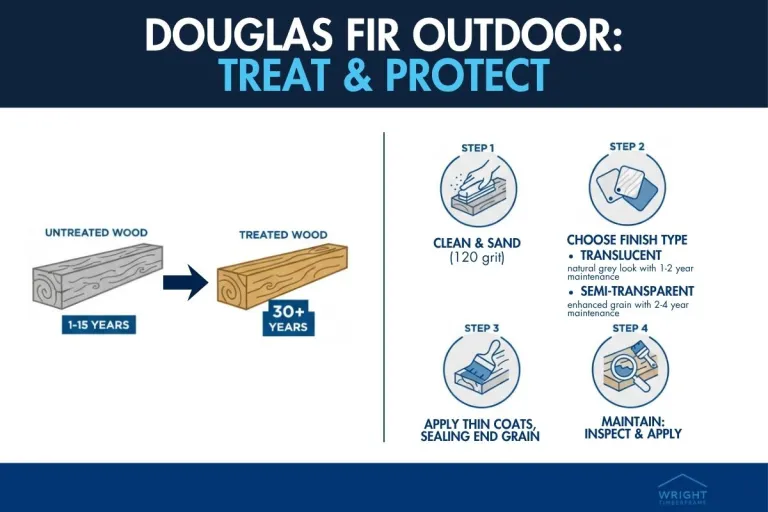
Douglas Fir is the standard species we build with, and it earns that spot honestly. The USDA Forest Products Laboratory reports that Douglas Fir heartwood carries moderate natural decay resistance and considerably outperforms other structural softwoods such as spruce and true fir in above-ground exterior use. That is exactly where a pergola lives above the ground, exposed to sun and weather rather than buried in soil. Paired with mortise-and-tenon joinery and a UV-rated finish, Douglas Fir provides Utah homeowners with a strong, straight-grained frame at a lower material cost than cedar. Learn more about Douglas Fir outdoor structures and why it remains our preferred choice for durable timber frame construction.
Western Red Cedar Pergola Lifespan
Western Red Cedar is our premium upgrade, and it is the species many owners choose when they want to minimize refinishing over time. According to the Western Red Cedar Lumber Association, cedar has a very low shrinkage factor and outperforms many other coniferous woods in resistance to warping, twisting, and checking. When properly finished, cedar can deliver decades of reliable outdoor performance. That low-shrinkage behavior is why cedar pergolas tend to maintain tighter joints longer than faster-drying softwoods. For homeowners comparing options, our timber species guide for building a pergola explains how different wood species perform in outdoor timber construction.
Pressure-Treated Pine and Tropical Hardwood: The Market Alternatives
Pressure-treated pine and imported tropical hardwoods show up in a lot of big-box pergola kits, so it is worth knowing where they fit. Pressure-treated pine gets its resistance from chemical treatment rather than the wood itself, and that treatment fades over time, which is why it may require replacement sooner than naturally durable species depending on treatment quality and exposure. Tropical hardwoods like Ipe or teak can be durable, but they are heavy, expensive, and harder to source responsibly. We do not build with either. Every Wright Timberframe structure is Douglas Fir or Western Red Cedar, never pressure-treated pine.
What Shortens a Pergola’s Lifespan
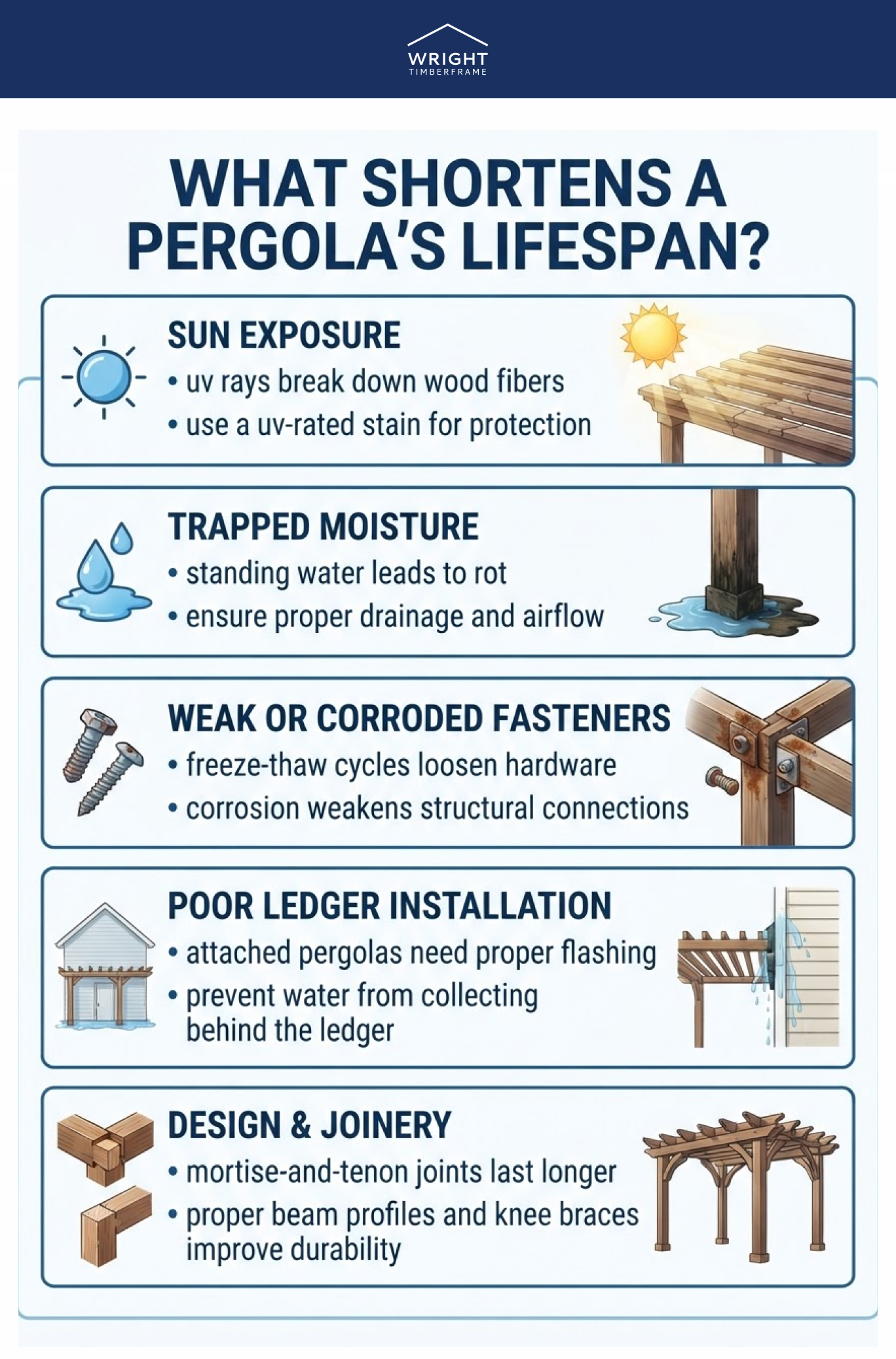
Sun exposure, trapped moisture, and weak fasteners shorten a pergola’s life faster than the wood itself wears out. Utah’s intense summer UV breaks down unprotected wood fibers and fades finish, which is why we specify a UV-rated Behr stain rather than a clear sealer that offers little sun protection. Moisture becomes a problem when it gets trapped rather than when it simply falls as rain. A post base sitting in standing water, a joint packed with debris, or a horizontal beam with no slope to shed water will all hold moisture against the grain long enough to invite rot, even in naturally resistant species.
Fasteners matter just as much as the wood. Bolts, lag screws, and metal brackets expand and contract at a different rate than wood, and Utah’s freeze-thaw cycles work those connections loose year after year. Cedar’s natural extractives also react with some unprotected metals, causing staining and accelerated corrosion at the fastener. A structure that relies on hardware to hold its frame together is only as strong as its weakest bolt. A structure joined by wood-to-wood mortise-and-tenon connections does not have that weak point.
Where the pergola sits also matters. An attached pergola, built off the house or an existing patio roofline, has one more moisture path to manage: the ledger connection where the structure meets the building. That joint needs proper flashing and a slight gap for airflow, or water works its way behind the ledger and sits against both the pergola and the house siding. A freestanding pergola skips that risk entirely, since every post stands clear of the building on its own footing. Neither style is automatically longer-lived. The ledger connection on an attached build just needs more attention during design and periodic inspection afterward.
Beam profile and knee brace choice play a smaller but real role too. A heavier beam profile sheds water faster off its top face than a thin, flat-topped beam, and a knee brace that carries load down into the post, rather than hanging off a bracket, keeps the connection working the way mortise-and-tenon joinery is meant to work. These are exactly the choices we walk through with every Utah client and every kit buyer before cutting a single piece.
Checking vs. Cracking: Is Splitting Wood a Problem?
The surface splits you see in a drying beam are checking, not structural cracks, and they are a normal part of how solid timber ages. Real wood releases moisture as it dries and adjusts to Utah’s low humidity, and that movement shows up as shallow splits along the grain on the surface of a post or beam. Checking does not run through the full cross-section of the timber, and it does not weaken a properly sized, mortise-and-tenon joint.
We explain the difference in detail, including when a split actually does need attention, in our guide to understanding checking and cracking in timber. Most new owners worry the first time they see it. In most cases, checking is cosmetic rather than a sign of structural failure.
Why Mortise-and-Tenon Joinery Outlasts Bracket-Built Kits
Mortise-and-tenon joints outlast metal brackets because a wood-to-wood connection moves with seasonal shrinkage while bolted hardware works loose and rusts. Every structure we build uses mortise-and-tenon joinery with no metal brackets, a technique that has held timber frames together for centuries. Our guide to traditional timber frame joinery covers how the joint is cut and fitted. The comparison below shows why it holds up longer than a bracket-and-bolt build, whether that build is site-assembled or ordered as a mass-market kit.
| Joinery Type | How It Typically Fails | Maintenance Needed | Longevity Impact |
| Mortise-and-tenon (our standard) | Wood checks at the surface but the joint stays engaged | Periodic restraint; no hardware to tighten | Ages with the structure, not against it |
| Bolted metal brackets | Bolts loosen with freeze-thaw cycling; metal corrodes against wood | Periodic bolt inspection and re-tightening | Hardware failure often precedes wood failure |
| Nailed or screwed butt joints | Fasteners back out; end grain absorbs moisture | Frequent fastener replacement | Shortest expected service life of the three |
Nationwide kit buyers receive the same craftsmanship as local installations. Our pre-cut kits use the same mortise-and-tenon joinery as a Utah-built pergola, with each component prepared and pre-stained for easier DIY assembly. Learn more about how the pieces come together in our DIY pergola kit guide and what makes our pre-cut timber frame approach different from standard pergola kits.
Signs Your Pergola Is Nearing End of Life vs. Just Needs Refinishing
Graying wood, a chalky or peeling finish, and shallow surface checking are cosmetic and mean it is time to restain, not replace. These are the most common complaints we hear, and almost all of them clear up with a proper strip, sand, and recoat.
Soft or spongy wood when you press a screwdriver into it, a post base that has darkened and crumbled at the soil line, and joints that visibly shift or rack under load are different. Those are structural warning signs, most often caused by long-term moisture trapped at a post base or a fastener connection that has failed. A structure showing any of those signs needs an in-person evaluation before another season, not just a fresh coat of stain.
A useful annual check takes ten minutes. Walk the perimeter and press a screwdriver tip into the base of each post, right at and just below grade, since that is where moisture collects first. Look at each knee brace and mortise-and-tenon joint for daylight gaps that were not there the year before, which can signal the timber has shrunk more than expected or a joint was not seated fully during install. Check the top of every beam for standing water or debris after a storm. Catching a small issue at year eight is a stain touch-up. Catching the same issue at year fifteen can mean replacing a post.
How to Extend Your Pergola’s Lifespan
Regular staining, good drainage at the post base, and keeping wood off wet soil are the three things that add the most years to a pergola. A UV-rated Behr stain protects the surface from sun damage and slows moisture cycling, and reapplying it before the old coat fully fails matters more than the exact interval. Post bases set on proper footings, rather than buried directly in soil, keep end grain from sitting in standing water. For the full maintenance schedule, see our guide on pergola maintenance and our seasonal weatherproofing tips.
Species choice is itself a maintenance decision. If a pergola sits in full, unobstructed south-facing sun for most of the day, the extra checking resistance of a Western Red Cedar upgrade can stretch out the interval between refinishing jobs compared to standard Douglas Fir. A garden pergola tucked under partial shade from existing trees rarely needs that upgrade to reach the same lifespan, since it faces less direct UV load to begin with. This is one of the first questions we ask during a design consultation, because the right species for a full-sun patio pergola is not always the right species for a shaded garden structure.
Footing depth and post base detailing are the other lever most homeowners never think about until something fails. A post set directly in soil, or in a footing that traps water instead of draining it, tends to show rot at the base years before the rest of the structure shows any wear. A post base that lifts the timber slightly above the footing and sheds water away from the end grain protects the single most vulnerable point on the entire structure. We size and detail every footing to the site during the quote process rather than using one generic detail for every yard.
Real Lifespan Expectations for Utah’s Climate
Utah’s dry air and lower average humidity actually favor wood longevity compared to a humid coastal climate, since drier conditions slow the fungal decay that shortens a pergola’s life elsewhere. That said, Utah brings its own two challenges: intense high-elevation UV that fades and dries unprotected wood faster, and seasonal snow load that puts real weight on the frame every winter. We design and cut every structure to fit the site and the load it will carry, but exact snow load and span figures are engineering specifics that vary by elevation, county, and roof design. We handle that as part of a project quote rather than publishing a universal number here. Permit thresholds also vary by Utah city and county, so we tell every homeowner to confirm requirements with their local building department before finalizing a design.
Elevation makes a real difference within Utah itself. A bench-front lot in Murray or Sandy sees a different snow load than a mountain valley property at higher elevation, and a south-facing patio in St. George bakes in more direct summer sun than a shaded yard in the Salt Lake Valley. None of that changes the underlying species durability numbers, but it does change how often a structure needs restraining and how conservatively we detail the frame. We collaborate with homeowners, builders, and architects on this exact planning step, working from a sketch or stamped plans, before any timber gets cut.
Frequently Asked Questions about How Long Do Wood Pergolas Last
How long does a Douglas Fir pergola last outdoors?
Douglas Fir heartwood is moderately decay-resistant in above-ground use and considerably outperforms other structural softwoods, according to USDA Forest Products Laboratory research. In practice, a well-built, well-maintained Douglas Fir pergola commonly lasts 20 to 40+ years, depending on climate, finish, and craftsmanship.
Is cedar better than pressure-treated pine for a pergola?
Western Red Cedar carries natural decay and warping resistance that pressure-treated pine relies on chemical treatment to approximate. Wright Timberframe builds with Western Red Cedar as a premium upgrade and does not use pressure-treated pine.
Do pergola kits last as long as a custom-built pergola?
A Wright Timberframe kit uses the same mortise-and-tenon joinery, Douglas Fir or Western Red Cedar, and Behr stain as our on-site Utah installs. The wood and joinery are the same; only the assembly location changes.
How often should I restain my pergola?
Restaining frequency depends on sun exposure, wood species, and the original finish, so we recommend watching for graying or a chalky surface rather than following a fixed calendar.
Does snow load in Utah shorten a pergola’s lifespan?
Snow load itself does not decay wood, but an undersized frame under repeated heavy load can loosen joints over time. We size every structure to its site during the quote process rather than applying a one-size figure.
Does an attached pergola last as long as a freestanding one?
Both styles can reach the same lifespan when built correctly. An attached pergola has one extra detail to manage, the ledger connection at the house, while a freestanding pergola relies entirely on its own posts and footings. Neither structure type is inherently shorter-lived than the other.
Get a Pergola Built to Last
We’ve built timber structures across Utah for more than 10 years, earning a 4.9 Google rating through hundreds of completed projects. Every pergola we build, whether installed locally or shipped as a pre-cut kit nationwide, is crafted from Douglas Fir or Western Red Cedar using traditional mortise-and-tenon joinery and finished with UV-rated Behr stain. We never rely on metal brackets or pressure-treated pine.
If you’re looking for a pergola designed to last for generations, our team can help you choose the right timber species, joinery style, and size for your space. Request a free quote today and start planning a custom timber frame pergola built around your home and your needs.

