

Why Traditional Woodworking Joints Matter for Lasting Timber Structures
Traditional woodworking joints are wood-to-wood connection methods that create strength through geometry, tight fit, and long-grain contact, not just metal hardware or glue. In timber framing, that difference is what helps a structure stay tight, resist racking, and age gracefully as the wood moves through Utah’s seasons. When we talk about traditional joinery, we are referring to a legacy of engineering that predates modern fasteners by centuries. These methods rely on the inherent properties of the wood itself to create a unified, structural whole.
In this guide, we explain the joinery we rely on when building timber pergolas, pavilions, and trellises, and how these joints work in real structures. Our goal is to provide an expert perspective on why these connections are superior for heavy timber applications.
Key Takeaways
- Structural Integrity: Traditional joints maximize long-grain contact, which is the strongest part of the wood fiber for bonding and bearing.
- Mechanical Interlock: Many joints, like the pegged mortise and tenon, provide strength through their physical shape, meaning they stay together even if the adhesive fails.
- Movement Management: Wood is a living material that expands and contracts. Traditional joinery is designed to accommodate this movement without compromising the frame’s stability.
- Longevity: By avoiding metal fasteners that can corrode or cause wood rot through condensation, traditional joinery extends the lifespan of outdoor structures.
- Aesthetic Excellence: These joints showcase the skill of the craftsman and the natural beauty of the timber, creating a clean, hardware-free appearance.
Traditional joints work best when they maximize long-grain-to-long-grain bearing and glue area. In structural joinery, the goal is also to control how forces travel through the frame so members share load instead of concentrating stress at a few fasteners. At Wright Timberframe, we build outdoor timber structures with this mindset. Our focus is precise, traditional joinery that stays strong and good-looking for the long haul.
_compressed.jpg?alt=media&token=bd61bcce-5bd3-44ef-a84b-50c720b40abb "Why We Use Traditional Woodworking Joints")
Overview: Types of Traditional Woodworking Joints
Traditional woodworking joints fall into a few practical categories. Each category solves a different problem: resisting pull-apart, preventing racking, creating clean corners, or keeping boards aligned as they expand and contract. Understanding these categories is essential for anyone looking to evaluate the quality of a timber structure. We categorize these joints based on their mechanical function and the specific stresses they are designed to withstand.
In our timber work, we choose joints that provide predictable load paths and that tolerate seasonal movement. Wood species selection matters here because grain structure and stability affect how cleanly a joint can be cut and how it will hold over time. For instance, the cellular structure of softwoods like Douglas Fir allows for a certain amount of compression in a joint, which can actually help create a tighter seal when pegged.
We commonly work with Douglas Fir and Western Red Cedar for their strength-to-weight ratio and workability. You can see examples of our approach on our page about Traditional Timber Frame Joinery.
Joint Families and Their Functions
- Overlapping and Open-Ended Frame Joints (Lap, Bridle): These are useful for right angles and light-to-moderate framing where long-grain contact is easy to achieve. They are often used in decorative trellises or secondary framing members.
- Structural Frame Joints (Mortise and Tenon): This is the primary joint for posts, beams, and braces in timber frames. It is the workhorse of the industry, capable of carrying immense vertical and lateral loads.
- Board-to-Board Alignment Joints (Tongue and Groove): These are designed to keep faces flush while boards move across the grain. We use these frequently in pavilion ceilings and privacy screens.
- Housing Joints (Dado, Rabbet): These are grooves and ledges that locate parts and increase glue area. In timber framing, a “housing” is often cut into a post to provide a bearing ledge for a beam.
- Splice Joints (Scarf): These are used when a longer member is needed or when material efficiency is important. A well-cut scarf joint can maintain the structural integrity of a continuous beam over a long span.
When we pick a joint, we look at a few realities that matter outdoors: the direction of the load, the exposure to the elements, and the expected movement of the wood. For general background on the most common joint types and how they are classified, the Woodwork Institute provides a clear overview.
Lap and Bridle Joints: Framing Essentials
Lap and bridle joints are fundamental traditional woodworking joints for creating strong, right-angle frames. These joints are particularly effective because they maximize long-grain-to-long-grain contact, which is where glue performs best. In timber framing, we often use these for rafters or decorative elements where the load is distributed across a wide area.
A lap joint is one of the simplest traditional methods, involving two pieces of wood overlapping each other. While straightforward, it provides a surprisingly strong connection for many framing applications, especially when reinforced with glue and mechanical fasteners if needed for specific loads. There are several variations, including the half-lap, where each piece is notched to half its thickness, and the cross-lap, used when two members intersect in the middle of their spans.
Bridle joints, on the other hand, offer a more robust solution. They are essentially an open-ended mortise and tenon, where the tenon is cut on the end of one piece and fits into a corresponding slot (mortise) cut into the end of the other. This design provides a larger gluing surface area and increased mechanical strength compared to a simple lap joint. Bridle joints are commonly seen in the construction of face frames, door frames, and other structural components where clean lines and superior stability are required. They are a stronger alternative to basic butt joints, which are the weakest of typical wood joints because they rely entirely on end-grain contact, which does not hold glue or fasteners well.
Mortise and Tenon: The Foundation of Timber Framing
The mortise and tenon joint is the core structural connection in many traditional frames. We rely on it because it handles real-world forces well: downward load, lateral racking from wind, and the small twists that happen as timbers dry and seasons change. This joint has been used for thousands of years, from ancient Egyptian furniture to the massive cathedrals of Europe, because its engineering is fundamentally sound.
The joint has two parts:
- Tenon: The shaped projection on the end of a timber, often referred to as the “male” end.
- Mortise: The matching pocket cut into the receiving timber, or the “female” end.
A good fit matters. Too tight and the joint can split during assembly as the wood fibers are over-compressed. Too loose and the joint can pump under load, which speeds up wear and allows moisture to enter the joint. We aim for a “piston fit,” where the tenon slides in with firm hand pressure but does not fall out under its own weight.
Enhancing Mortise and Tenon with Draw Boring and Pegs
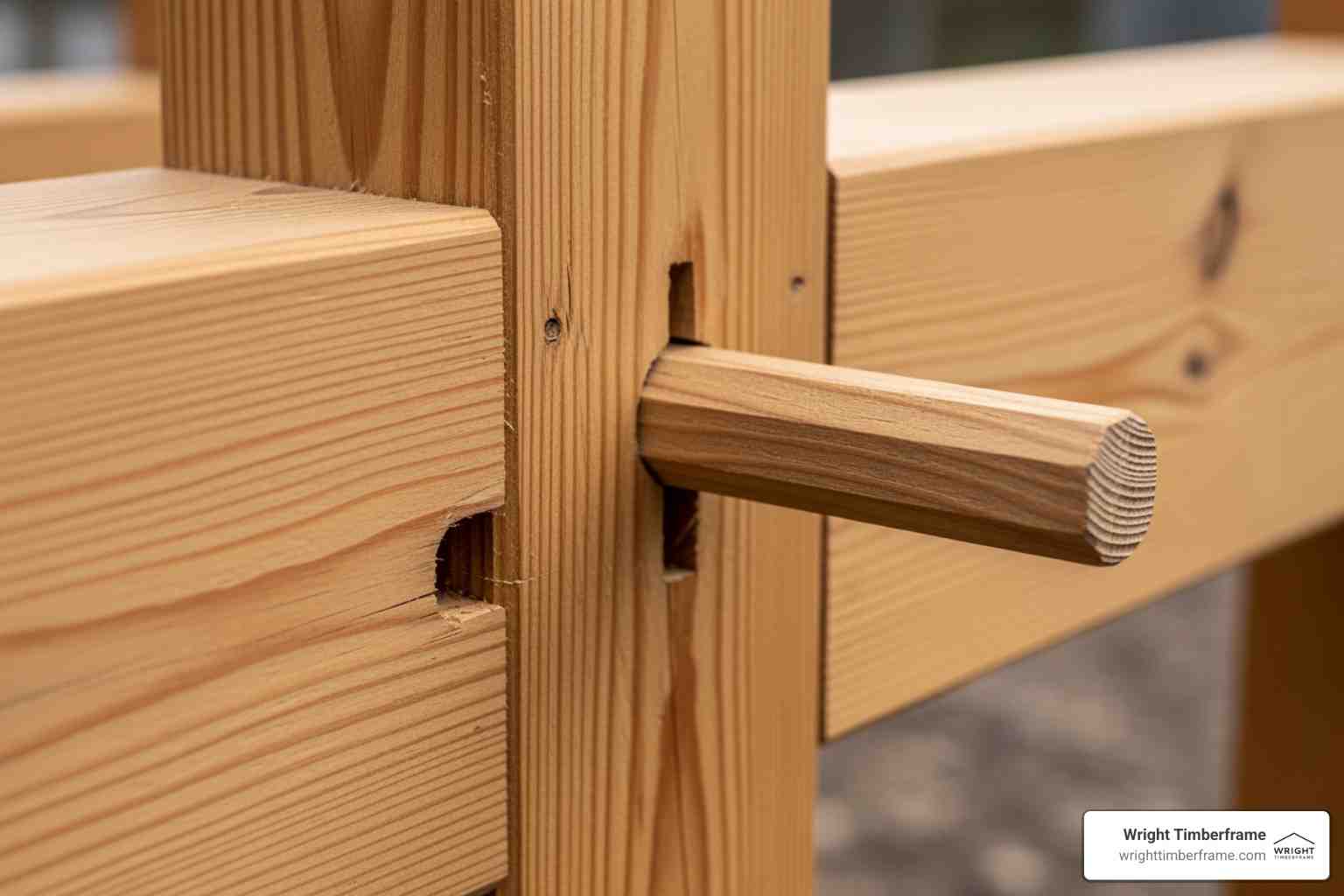
A pegged mortise and tenon can be strong even without relying entirely on glue. One classic method is draw boring, where the peg holes are intentionally offset. We drill the hole through the mortised member first, then mark the tenon, and drill the tenon hole slightly closer to the shoulder. When the tapered wooden peg is driven through, it pulls the tenon deeper into the mortise, locking the shoulders tight against the post.
This helps in outdoor structures because the joint stays seated as timbers cycle through moisture changes. The result is a connection that remains tight even when the wood wants to move. For readers who want a neutral reference on why this joint is so widely used historically, see: Mortise and tenon.
Tenon Variations We Use
- Through Tenons: These extend all the way through the mortised member and are often wedged from the outside for a permanent mechanical lock.
- Haunched Tenons: These include a small “step” or haunch that adds extra bearing surface and prevents the timber from twisting, especially useful at the corners of frames.
- Stub (Blind) Tenons: These stop short of the outside face, protecting the end grain from weather exposure and providing a cleaner look.
- Twin or Double Tenons: By splitting a wide tenon into two, we increase the glue surface area and maintain more structural integrity in the mortised member.
Traditional Joinery vs. Modern Fastening Methods
When designing and building timber structures, we often compare traditional woodworking joints with modern fastening methods like pocket holes, biscuit joints, and metal connectors. While modern techniques offer speed and convenience, they often fall short in terms of long-term strength, durability, and aesthetic value compared to time-honored joinery. In our experience, the reliance on metal in outdoor wood structures often leads to premature failure due to the different expansion rates of metal and wood.
Modern fasteners, such as screws or metal plates, can introduce weak points. Metal can corrode, and screws can strip or loosen over time due to wood movement. Furthermore, metal fasteners can act as a thermal bridge, attracting condensation inside the wood which leads to internal rot. Glue-only joints, like simple butt joints, are inherently weak and rely heavily on the adhesive’s integrity, which can degrade with moisture and temperature fluctuations.
| Feature | Traditional Joinery (e.g., Mortise & Tenon) | Modern Fasteners (e.g., Pocket Holes) |
|---|---|---|
| Strength | Excellent (mechanical lock, large glue surface) | Good (relies on screws, can loosen) |
| Durability | Exceptional (lasts generations, adapts to wood movement) | Moderate (can corrode, degrade over time) |
| Appearance | Beautiful (exposed craftsmanship, no visible fasteners) | Concealed (screws hidden, less refined) |
| Skill Level | High (precision cutting, hand tools) | Low to Moderate (jigs, power tools) |
| Longevity | Heirloom quality, permanent | Can be temporary, susceptible to failure |
For us, prioritizing strength and craftsmanship means traditional woodworking joints are the clear winner. They become an integral part of the structure, offering superior structural integrity and a timeless aesthetic that modern methods simply cannot replicate. While pocket hole joints have become increasingly popular among DIY enthusiasts, they generally cannot compare to the resilience of a properly executed traditional joint in a heavy-duty timber frame.
Why We Choose Traditional Woodworking Joints for Timber Frames
Our commitment at Wright Timberframe is to build structures that last for generations, standing strong against the elements in places like Murray, UT, and beyond. This commitment is why we exclusively choose traditional woodworking joints for our custom timber frame pergolas, pavilions, and trellises. We believe in building strong and smart, and our guide to Building Strong, Building Smart: Your Guide to Engineered Timber Structures further elaborates on this philosophy.
Here is why traditional joinery is indispensable to our craft:
- Superior Strength and Durability: As highlighted, mortise and tenon joints are among the strongest mechanical joints in woodworking. When properly cut, they resist tension, shear, and twisting forces far better than most other joints. This inherent strength is crucial for large outdoor structures that bear significant loads from snow, wind, and seismic activity.
- Adaptation to Wood Movement: Wood is a natural material that expands and contracts with changes in humidity. Unlike rigid metal fasteners that can cause wood fiber crushing over time, traditional joints are designed to accommodate this movement. Joints like the wedged through mortise and tenon create a mechanical lock that remains tight through all seasons.
- Heirloom Quality and Aesthetic Value: Traditional joinery is a testament to skilled craftsmanship. The absence of unsightly metal connectors allows the natural beauty of the timber to shine through, creating an heirloom-quality structure that is both functional and a work of art.
- Longevity and Resilience: Structures built with these joints have proven to last for centuries. This enduring quality is not just about resisting decay: it is about the joint’s ability to maintain its integrity under stress and environmental exposure. Traditional timber frames are more resistant to powerful storms and heavy snows, making them exceptionally durable for any location.
By choosing traditional woodworking joints, we eliminate concerns about glue degradation, metal fatigue, or the eventual failure of modern fasteners. We build with the confidence that our structures will not only stand the test of time but will also continue to inspire and provide enjoyment for future generations.

Frequently Asked Questions about Traditional Woodworking Joints
What is the strongest traditional woodworking joint for timber frames?
A wedged through mortise and tenon is often considered the strongest because it combines long-grain bearing with a mechanical wedge lock. This ensures that even if the wood shrinks, the wedge can be driven further to maintain a tight connection.
Why do traditional woodworking joints work well in Utah weather?
Utah’s climate features extreme swings in humidity. Traditional joints tolerate seasonal wood movement better than rigid metal-only connections, helping joints stay tight through dry summers and snowy winters without splitting the timber.
Do pegged joints loosen over time outdoors?
They can if the fit and detailing are poor, but a properly fitted, draw-bored peg helps keep shoulders seated as the timber moves. The peg itself acts as a spring, maintaining tension within the joint.
What joint should we look for in a quality pergola or pavilion?
Look for clean mortise-and-tenon joinery at post-to-beam connections, with tight shoulders and consistent peg placement. There should be no visible gaps where the two timbers meet.
Which species are best for traditional woodworking joints in outdoor structures?
Douglas Fir and Western Red Cedar are common choices because they are workable, stable, and perform well when detailed correctly. Douglas Fir offers superior strength for structural members, while Cedar provides excellent rot resistance.
Why Traditional Woodworking Joints Define Lasting Craftsmanship
Traditional woodworking joints are not just a historical curiosity: they are practical engineering solutions that use fit, geometry, and wood fiber direction to create strong connections that age well. When we design and build timber pergolas, pavilions, and trellises at Wright Timberframe in Murray, UT, we choose joinery that carries load cleanly and stays stable as the seasons change.
For homeowners, the takeaway is simple: when you understand traditional woodworking joints, you can evaluate craftsmanship quickly. Tight shoulders, good bearing, and thoughtful reinforcement usually matter more than hidden hardware. We invite you to explore our work and see the difference that traditional joinery makes in creating a lasting outdoor legacy.

