Why Choosing the Right Wood for Your Pavilion Matters

The best wood for timber frame pavilion construction depends on balancing four critical factors: durability, structural strength, aesthetic appeal, and cost-effectiveness. Here are the top choices:
Top 3 Woods for Timber Frame Pavilions:
- Douglas Fir – Exceptional strength-to-weight ratio, ideal for large spans and heavy loads, most popular choice in North America
- Western Red Cedar – Naturally resistant to rot and insects, beautiful reddish-brown color, requires less maintenance
- White Oak – Extremely durable hardwood, superior moisture resistance, timeless rustic appearance
When you’re planning a timber frame pavilion, the wood you select becomes the foundation of everything that follows. It determines how well your structure withstands decades of rain, snow, and sun. It influences the design possibilities, from the spans you can achieve to the joinery techniques we can employ.
A pavilion built with the right wood becomes a gathering place that lasts for generations, while the wrong choice can lead to premature decay, warping, or structural issues. The decision isn’t just about picking something that looks good today—it’s about crafting an outdoor space that becomes more beautiful with age.
At Wright Timberframe, we’ve helped countless homeowners and property owners choose the best wood for timber frame pavilion projects across Utah and beyond. Our experience with hundreds of custom structures has taught us exactly which woods perform best in different climates and applications, and we’re here to share that knowledge with you.
What Makes the Best Wood for a Timber Frame Pavilion? Key Factors to Consider
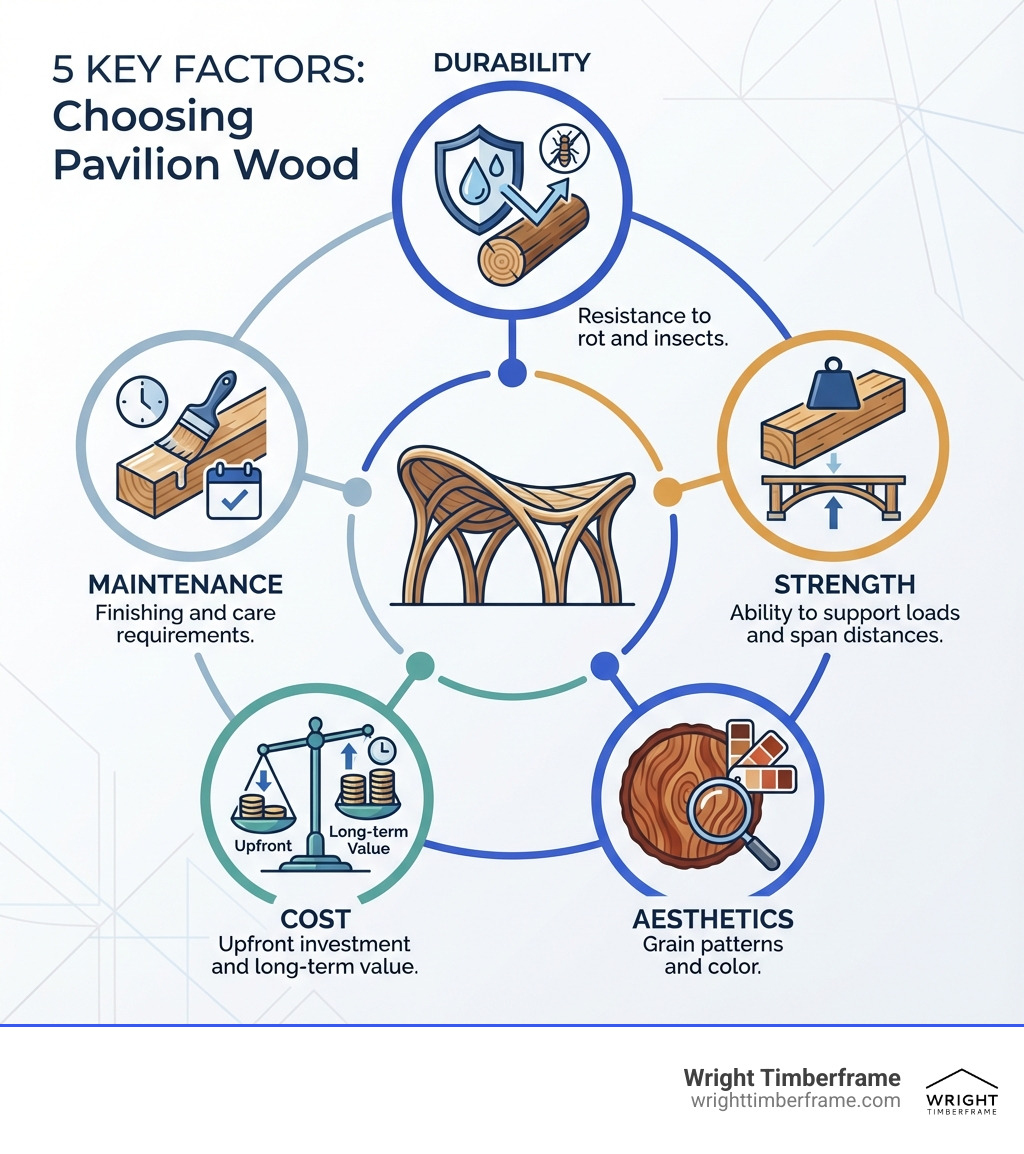
Choosing the best wood for timber frame pavilion construction is a decision that blends art and science. It requires a thoughtful evaluation of several key factors to ensure your outdoor oasis is not only beautiful but also built to last. Our goal is always to create handcrafted outdoor structures using premium timbers, ensuring timeless design and lasting strength for our clients in Utah and nationwide.

The primary factors we consider when selecting wood for a timber frame pavilion are:
- Durability and Resistance to the Elements: How well the wood stands up to nature’s challenges.
- Strength and Structural Integrity: Its ability to bear loads and maintain form.
- Aesthetic Appeal: The visual character it brings to your outdoor space.
- Cost-Effectiveness and Long-Term Value: Balancing upfront investment with enduring quality.
- Local Availability and Sustainability: Practical considerations for sourcing and environmental impact.
For our clients in Utah, understanding the local climate is particularly important. Our region experiences significant temperature fluctuations, dry periods, and substantial snowfall in winter. This means the chosen wood must be exceptionally stable and durable to prevent issues like excessive checking, warping, or premature decay.
Durability and Resistance to the Elements
When we talk about durability for an outdoor structure like a timber frame pavilion, we’re primarily focused on how well the wood resists nature’s relentless forces. This includes natural resistance to rot, insect infestations, and the constant battering of sun, rain, and snow.
Certain wood species possess natural oils and tannins that act as built-in preservatives. For instance, Western Red Cedar is lauded for its very low shrinkage and natural fungicidal properties, significantly increasing its durability. Its heartwood, in particular, is very resistant to decay because it contains a chemical substance called Thujaplicin, a natural fungicide. This makes Western Red Cedar naturally resistant to the elements and incredibly rot-resistant. Redwood also boasts a resistance to decay and insects due to its natural tannins. Even Douglas Fir, while not as naturally rot-resistant as cedar or redwood, is still a strong contender for durable outdoor use, especially when properly treated and maintained.
It’s crucial to differentiate between heartwood and sapwood. Heartwood, the denser, darker wood from the center of the tree, generally offers superior resistance to decay and insects compared to the lighter sapwood. When selecting timbers, we prioritize heartwood content for optimal longevity.
The ability of a wood to withstand moisture and prevent water infiltration is also key to its longevity. Western Red Cedar, for example, is naturally water-resistant, helping to prevent the kind of moisture absorption that leads to rot and decay. By choosing woods with these inherent qualities, we ensure your pavilion remains a sturdy and beautiful fixture for years to come.
Strength and Structural Integrity
A timber frame pavilion is a substantial structure, designed to provide shelter and support for years. This means the wood’s strength is paramount, directly impacting the design possibilities and the overall structural integrity of the pavilion. We need wood that can confidently support heavy snow loads common in Utah winters and span long distances without excessive deflection.
Douglas Fir stands out in this regard. It rates the highest of any western softwood in strength, boasting an unparalleled strength-to-weight ratio. This makes it ideal for large spans and heavy loads, allowing for more open and expansive pavilion designs. Its modulus of elasticity, shear, compression, and tension laterally to grain are all exceptionally high, making it a favorite among engineers and timber framers. For instance, Douglas Fir ranks 600 pounds of force for the Janka hardness test, a measure of wood’s resistance to indentation. This strength is why Douglas Fir can be sourced in higher quality, huge timbers, sometimes up to 60 feet long, which is a significant advantage for large-scale timber framing.
The greater density of Douglas Fir also means it’s less likely to warp or crack when compared to other softwoods, contributing to its dimensional stability and structural reliability. While other woods like Oak offer incredible density and hardness, Douglas Fir provides an excellent balance of strength, workability, and availability for the large timbers required in timber framing.
The strength of the wood directly influences the type of joinery that can be effectively used. Stronger woods allow for more robust and precise traditional joinery, which is a hallmark of our craftsmanship at Wright Timberframe. To understand more about how we build structures that last, visit our page on our traditional joinery techniques.
Aesthetics: Grain, Color, and Style
Beyond its structural capabilities, the wood you select for your timber frame pavilion significantly contributes to its overall aesthetic appeal. Each wood species offers a unique palette of grain patterns, natural color variations, and an inherent character that evolves over time. This visual impact is crucial, as your pavilion is not just a structure but a focal point in your outdoor living space.
For example, Western Red Cedar is cherished for its distinctive reddish-brown color, which can gracefully age into a beautiful silvery gray if left untreated, offering a classic, weathered look. Redwood, on the other hand, boasts a vibrant red color that adds a touch of elegance and warmth. Douglas Fir, while often having a more subdued yellow-orange to rusty red hue, features a tight, straight grain that takes stains and finishes exceptionally well, allowing you to customize its appearance to match your home’s style.
Oak, particularly White Oak, offers a rich, attractive grain and a timeless, rustic charm that improves with age. The checking that occurs as oak dries can add to its character, creating a truly authentic timber frame aesthetic. We believe that the aging process of natural wood is part of its beauty, and selecting a wood that patinas gracefully ensures your pavilion becomes a cherished part of your landscape.
Whether you prefer the clean lines of a modern design or the rugged elegance of a traditional timber frame, the right wood species can lift your pavilion from a simple structure to an architectural masterpiece, perfectly complementing your home and personal style.
A Closer Look at Popular Woods for Timber Frame Pavilions
Having explored the critical factors that go into selecting the best wood for timber frame pavilion projects, let’s dig into some of the most popular and effective wood species we frequently use and recommend. Each has its unique characteristics, making it suitable for different designs, budgets, and aesthetic preferences. At Wright Timberframe, we’ve built hundreds of timber structures across Utah and beyond, giving us deep expertise with these top choices.
Here’s a quick comparison of our top three recommendations:
| Wood Species | Strength | Rot Resistance (Natural) | Cost (Relative) | Aesthetics |
|---|---|---|---|---|
| Douglas Fir | Excellent (highest among softwoods) | Moderate | $$ | Straight grain, takes finishes well, yellow-orange to rusty reds |
| Western Red Cedar | Good (softer than Douglas Fir) | Excellent | $$$ | Beautiful reddish-brown, ages to silver, aromatic, distinct grain |
| White Oak | Excellent (very dense hardwood) | Excellent | $$$$ | Rich, attractive grain, classic rustic look, light brown to grey |
Douglas Fir: The Strong and Versatile Workhorse

Douglas Fir is arguably the most popular choice for timber framing in North America, and for good reason. It’s a true workhorse, offering an impressive combination of strength, versatility, and availability, especially for large timber sizes.
Pros of Douglas Fir:
- Exceptional Strength-to-Weight Ratio: Douglas Fir rates the highest of any western softwood in strength. This means it can support significant loads and span long distances, making it ideal for large, open pavilion designs. Its modulus of elasticity, shear, compression, and tension are unparalleled for a wood of its type.
- Available in Long Lengths: We can source Douglas Fir in huge timbers, often up to 60 feet long, which is a major advantage for complex timber frame pavilion plans and expansive structures.
- Straight Grain: Its tight, straight grain contributes to its structural stability and provides a clean, appealing aesthetic.
- Holds Finishes Well: Douglas Fir readily accepts stains and paints, allowing for a wide range of aesthetic customization to match your outdoor décor.
- Dimensional Stability: The greater density of Douglas Fir means it’s less likely to warp or crack when compared to many other softwoods, contributing to a more stable and long-lasting structure.
Cons of Douglas Fir:
- Moderate Natural Rot Resistance: While durable, Douglas Fir is not as naturally resistant to rot and insects as cedar or redwood. For outdoor applications, especially in areas with high moisture, it benefits from proper sealing and maintenance.
- Can Check as it Dries: Like many woods, Douglas Fir can develop surface checks (small cracks) as it dries. While typically not a structural concern, some find it less aesthetically pleasing. This is why understanding wood moisture content is so important.
Overall, Douglas Fir is a fantastic option for clients seeking a robust, structurally sound, and adaptable wood for their timber frame pavilion, particularly for larger projects where strength is paramount.
Cedar (Western Red): The Beautiful and Resilient Choice
Western Red Cedar (often simply referred to as Cedar) is another premium choice, especially when natural resistance to the elements and aesthetic beauty are top priorities. It’s highly favored for outdoor structures due to its inherent properties.
Pros of Western Red Cedar:
- Naturally Resistant to Rot and Insects: This is perhaps its most celebrated quality. Western Red Cedar heartwood contains natural fungicidal properties (Thujaplicin) and oils that deter insects and resist decay, making it incredibly durable in outdoor environments without chemical treatments.
- Water-Resistant: Its low porosity helps it shed water, further enhancing its resistance to rot and fungal growth. Western Red Cedar is water-resistant.
- Low Shrinkage: It exhibits very low shrinkage, which contributes to its dimensional stability and helps maintain tight joinery over time.
- Beautiful Reddish-Brown Color: Western Red Cedar is renowned for its natural beauty. Its distinctive reddish-brown color, often with variations in tone, provides a warm and inviting look that can age gracefully to a silvery-gray patina if left untreated.
- Aromatic: It has a pleasant, distinct aroma that many find appealing.
- Lightweight: Compared to hardwoods like Oak, Cedar is lighter, which can sometimes simplify handling during construction.
Cons of Western Red Cedar:
- Softer and Less Strong than Douglas Fir: While durable, Cedar is a softer wood and has a lower strength-to-weight ratio than Douglas Fir. This means it may not be suitable for the absolute largest spans or highest load-bearing requirements without increasing timber dimensions.
- Higher Cost: Western Red Cedar typically comes at a premium price compared to Douglas Fir or Pines due to its desirable properties and often more limited availability.
For those prioritizing natural resistance, a beautiful appearance, and a lightweight material for their timber frame pavilion, Western Red Cedar is an outstanding choice. You can find more information on wood decay resistance from USDA research.
Oak (White and Red): The Timeless and Durable Hardwood
Oak, with its storied history in timber framing, particularly in Europe, brings a sense of tradition and best durability to any pavilion project. We primarily consider White Oak for outdoor applications due to its superior resistance.
Pros of Oak:
- Extremely Durable: Oak is a hardwood known for its exceptional density and strength, making it incredibly resistant to wear and impact.
- Classic Rustic Look: Its prominent grain patterns and robust character lend a timeless, classic, and rustic aesthetic that many clients adore. The natural checking that occurs as it dries only adds to its charm for many.
- High Rot and Moisture Resistance (White Oak): White Oak is particularly prized for its durability and resistance to moisture and pests, making it highly suitable for exposed outdoor frames. Its cellular structure makes it naturally water-resistant, historically used in shipbuilding.
- Long-Lasting: Properly maintained Oak structures can last for generations, becoming true heirlooms.
Cons of Oak:
- Heavy and Dense: Oak is significantly heavier and denser than softwoods like Douglas Fir or Cedar, which can make it more challenging and labor-intensive to work with during fabrication and installation.
- Higher Cost: Oak is generally more expensive than Douglas Fir or Cedar, reflecting its premium qualities and the effort required to process it.
- Can Cause Corrosion with Metal Fasteners: The tannins in oak can react with ferrous metals, potentially causing staining or corrosion over time. This means we often recommend stainless steel or traditional wood joinery without metal fasteners when working with Oak.
- Red Oak vs. White Oak: While Red Oak is beautiful, it checks and moves considerably more than White Oak as it dries and has less natural resistance to moisture, making White Oak the preferred choice for outdoor applications.
For clients who value a truly traditional, exceptionally durable, and visually striking hardwood pavilion, White Oak is an excellent, albeit more demanding, option.
Other Notable Wood Options
While Douglas Fir, Western Red Cedar, and White Oak are our top recommendations, other woods can be suitable depending on specific project needs, budget, and desired characteristics.
-
Redwood:
- Pros: Redwood boasts a strong natural resistance to decay and insects due to its tannins. It has a beautiful, vibrant red color and a straight grain, which makes it less prone to warping.
- Cons: It can be quite expensive and its availability might be more limited outside its native Pacific Coast region.
-
Cypress (Bald Cypress):
- Pros: Old-growth Bald Cypress is highly resistant to decay, making it extremely durable for outdoor use. It weathers beautifully to a pleasing silver-gray.
- Cons: Old-growth is no longer readily available. Second-growth Cypress is only moderately resistant to decay, requiring more consideration for outdoor applications.
-
Pine (Eastern White Pine, Southern Yellow Pine):
- Eastern White Pine:
- Pros: Features a beautiful light color and subtle grain, is cost-effective, and relatively easy to work with. It darkens over time to a rich golden tan.
- Cons: It’s softer and less strong than Douglas Fir, and typically not found in the very large, long lengths often desired for timber framing. It’s also challenging to obtain graded for structural timber framing.
- Southern Yellow Pine (SYP):
- Pros: Very strong for a softwood, often more affordable and plentiful than other options.
- Cons: It can be prone to warping or twisting if not properly dried. Its resin can also gum up tools, making it harder to work with. SYP also exhibits significant checking as it dries. While it offers good strength, its aesthetic and stability may not always align with the premium look of a timber frame pavilion.
- Eastern White Pine:
These alternative woods can certainly have their place, especially when specific aesthetic goals or budget constraints guide the decision. However, for the enduring strength and beauty that defines a Wright Timberframe pavilion, we typically steer towards the reliability and performance of Douglas Fir, Western Red Cedar, and White Oak.
Technical Considerations: From Drying to Joinery
The journey from a standing tree to a magnificent timber frame pavilion involves more than just selecting the right species. Technical aspects like the wood’s moisture content and how it interacts with traditional joinery techniques are crucial for ensuring the longevity and structural integrity of your outdoor structure. At Wright Timberframe, our commitment to craftsmanship means we pay meticulous attention to these details.
Why Wood Moisture Content Matters for the Best Wood for a Timber Frame Pavilion
The moisture content of timber profoundly affects its behavior, especially in a timber frame structure. Wood is a hygroscopic material, meaning it absorbs and releases moisture, causing it to expand and contract. This natural movement has significant implications for your pavilion.
- Green Timber: This refers to freshly cut wood with a high moisture content. Using green timber in timber framing is a traditional practice. As green timbers dry and reach equilibrium with the surrounding environment, they shrink. This shrinkage can actually be beneficial in timber framing, as it causes the traditional mortise and tenon joints to tighten, creating an incredibly strong and secure connection. However, green timber also experiences more significant checking (surface cracks) and movement as it dries, which some clients might find aesthetically less desirable.
- Air-Dried Timber: Wood that has been left to dry naturally in the open air for an extended period. This process reduces moisture content more slowly and evenly than kiln-drying, resulting in less internal stress. Air-dried timber offers a good balance between the benefits of green timber (joint tightening) and reduced movement compared to freshly cut wood.
- Kiln-Dried Timber: This wood has been dried in a controlled environment (a kiln) to a specific, low moisture content. Kiln-dried timber is very stable and exhibits minimal further shrinkage or checking. However, it is typically more expensive and if the timbers are too dry, the joints might not tighten as much over time.
For structures like our timber frame pavilions, understanding this process is key. For example, the greater density of Douglas Fir means it’s less likely to warp or crack when compared to other softwoods, even as its moisture content changes. We carefully select timbers and manage their moisture content to ensure the best possible outcome for your pavilion.
How Wood Choice Influences Traditional Joinery
The choice of wood species is intimately linked with the effectiveness and longevity of the traditional joinery techniques we employ. These methods, such as mortise and tenon joinery and dovetail joints, rely on the precise fit and inherent strength of the wood itself, rather than metal fasteners, to create incredibly robust connections.
- Hardness and Workability: Softer woods like Eastern White Pine are easier to cut and shape for intricate joints, but they might be more susceptible to compression or damage under heavy loads. Harder woods like White Oak, while more challenging to cut, create incredibly strong and durable joints that resist movement and wear for decades. Douglas Fir offers a good balance, being strong enough to hold precise joinery without being excessively difficult to work with.
- Dimensional Stability: Woods with greater dimensional stability (less shrinkage and swelling) are ideal for joinery, as they help maintain the tight fit of the joints over time. Western Red Cedar’s low shrinkage is a significant advantage here, as is the relative stability of Douglas Fir.
- Resistance to Splitting: Some woods are more prone to splitting when intricate cuts are made or when driven together. We select woods and tailor our joinery techniques to minimize this risk, ensuring each connection is flawless.
Our expertise in traditional joinery, including mortise and tenon and dovetail joints, means we understand how different woods will perform. We handcraft each joint to perfection, knowing that this attention to detail is what gives our timber frame pavilions their exceptional strength and timeless beauty. This meticulous approach ensures that your pavilion, built with the best wood for timber frame pavilion construction, will stand strong for generations.
Frequently Asked Questions about Pavilion Wood
What is the most durable wood for an outdoor pavilion?
For all-around performance, Western Red Cedar is a top contender due to its natural resistance to rot and insects, thanks to its inherent oils and fungicidal properties. For pure structural strength and durability, especially for large spans and heavy loads, Douglas Fir is an excellent and widely used choice.
How much more expensive is Cedar than Douglas Fir for a pavilion?
Cedar is typically more expensive than Douglas Fir, but the price can vary based on grade, dimensions, and market availability. While the upfront cost is higher, Cedar’s natural durability and lower maintenance requirements can sometimes offset long-term costs, offering excellent value over the lifespan of the pavilion.
Can I use pressure-treated pine for a timber frame pavilion?
While pressure-treated pine is a budget-friendly and rot-resistant option for standard outdoor projects like decks, it’s not typically used for traditional timber framing. The large timber sizes and precise joinery of timber framing are better suited to species like Douglas Fir or Cedar that are dimensionally stable, available in high-quality grades, and offer superior aesthetic appeal and structural performance for such grand structures.
Conclusion: Choosing the Best Wood for Your Timber Frame Pavilion
The journey to finding the best wood for timber frame pavilion construction is a nuanced one, guided by a balance of strength, durability, aesthetics, and cost. We’ve explored how factors like natural resistance to the elements, the wood’s inherent strength for structural integrity, its unique grain and color, and even its moisture content and compatibility with traditional joinery all play a pivotal role in crafting a lasting outdoor space.
The “best” wood for your timber frame pavilion isn’t a one-size-fits-all answer. It depends on your specific design aspirations, the environmental conditions of your location (especially here in Utah), and your budget. Whether you lean towards the unparalleled strength of Douglas Fir, the natural resilience and beauty of Western Red Cedar, or the timeless durability of White Oak, each choice brings its own set of advantages.
As local timber experts, we believe that the right material, coupled with our handcrafted approach and traditional joinery, brings your vision to life for generations. At Wright Timberframe, we are dedicated to crafting beautiful, lasting outdoor structures that improve your property and become cherished gathering places. We invite you to begin your journey with us and explore our custom timber frame pavilions to find the perfect blend of strength, style, and durability for your outdoor oasis.