Why Engineered Timber Structures Are Revolutionizing Modern Building

Engineered timber structures are manufactured wood products created by binding together strands, layers, or boards of wood to form composite materials with superior strength and consistency compared to solid timber. Here’s what you need to know:
- What they are: Products like glued-laminated timber (glulam), cross-laminated timber (CLT), and laminated veneer lumber (LVL) that are engineered to precise specifications.
- Key benefits: Higher strength-to-weight ratio, dimensional stability, design flexibility, and a significantly lower carbon footprint than steel or concrete.
- Common applications: From massive commercial buildings and bridges to residential pavilions, pergolas, and outdoor living spaces.
- Sustainability impact: Engineered wood absorbs around 582 kg of CO2/m3 over its lifecycle, while concrete emits 458 kg CO2/m3.
For decades, builders relied on steel and concrete for strength, but these materials have a heavy environmental cost—steel and cement production accounted for about 9% of global CO2 emissions in 2014. Engineered timber is a compelling alternative: it’s renewable, sequesters carbon, and is manufactured to specifications that often exceed traditional materials.
While the technology isn’t new—glulam beams are over a century old—recent manufacturing innovations and updated building codes have opened up new possibilities. Today, mass timber buildings rise as tall as 25 stories, and residential projects enjoy the same benefits: stronger spans, faster construction, and the warmth of beautiful exposed wood.
At Wright Timberframe, we specialize in custom timber frame structures and have seen firsthand how engineered timber is changing what’s possible in outdoor living. The principles of strength, precision, and sustainability in mass timber construction inform how we approach every timber frame pavilion and pergola we build.
What Are Engineered Timber Structures?
Engineered timber structures are one of the most exciting advances in modern building. Unlike traditional timber cut from a log, engineered timber is created by binding wood elements—strands, fibers, veneers, or boards—with adhesives. The goal is to create something stronger and more reliable than nature alone provides.
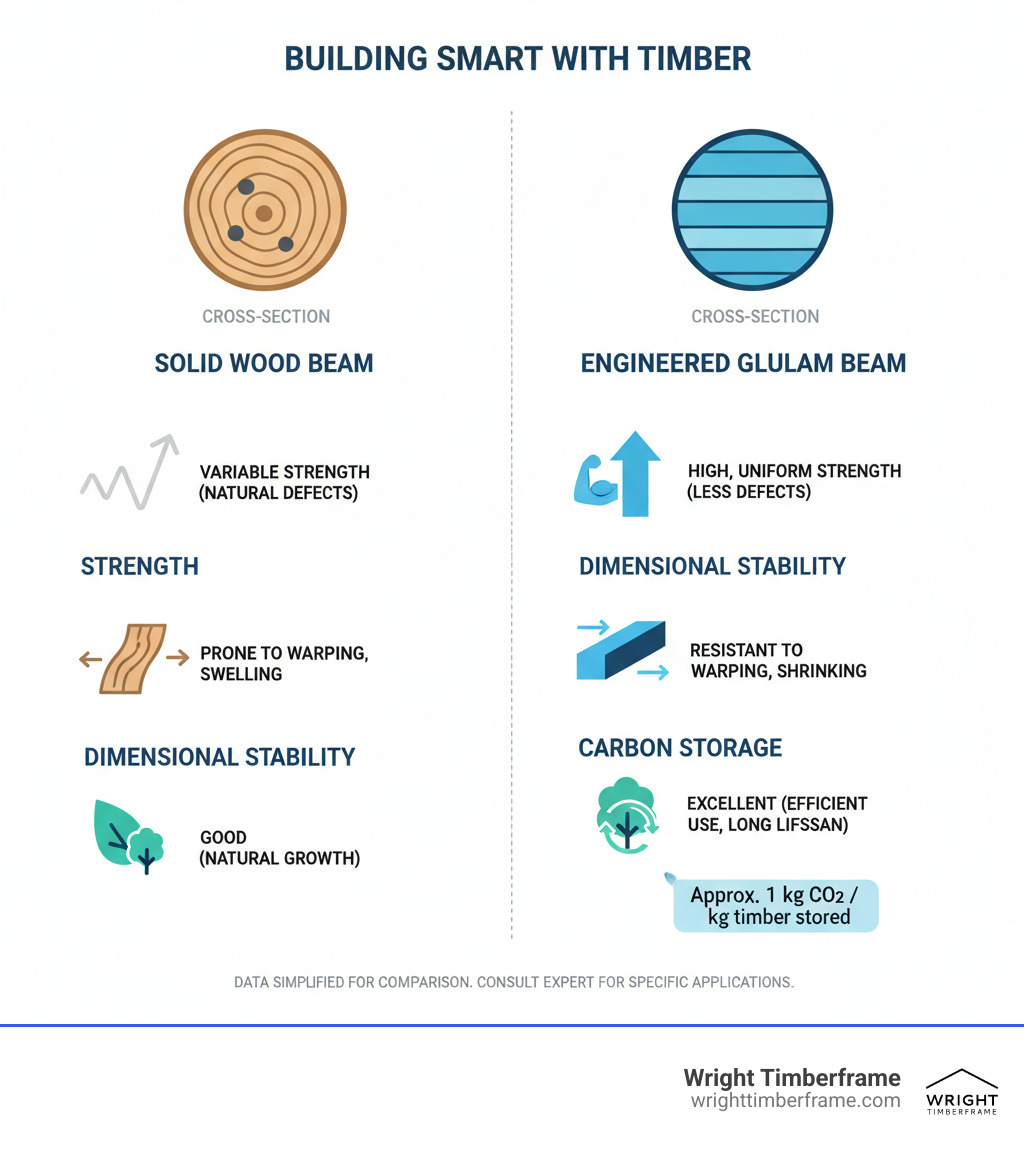
Solid wood has natural limitations. Every tree has knots, grain variations, and defects that affect its strength and predictability. This is the reality of working with a natural material.
The manufacturing process for engineered timber addresses these challenges. By selecting quality wood, removing defects, and bonding pieces in specific orientations, manufacturers create composite materials with consistent, predictable performance. An engineered timber beam behaves exactly as calculated, enhancing wood’s best qualities for modern construction.
This precision means builders can confidently span longer distances, support heavier loads, and create structures not possible with solid timber alone.
Mass Timber vs. Other Engineered Products
You’ll often hear “mass timber” when discussing engineered timber structures, but it’s a specific category within the broader family. Mass timber refers to large-scale structural panels and beams made from layers of solid wood, designed for load-bearing applications like walls, floors, and roofs in multi-story buildings.
The “mass” in mass timber isn’t just marketing; these are genuinely large-format components providing exceptional strength for ambitious architectural projects, changing what’s possible with wood construction.
Beyond mass timber, the engineered wood family includes products like laminated veneer lumber (LVL), parallel-strand lumber (PSL), and I-joists. These components typically serve as replacements for conventional lumber in residential framing and are smaller in scale than mass timber products.
At Wright Timberframe, our work centers on traditional timber framing with solid timbers and handcrafted joinery. While we don’t build high-rises, we appreciate the engineering principles of mass timber. The focus on strength, precision, and longevity in these products aligns with our commitment to creating outdoor structures that serve families for generations.
A Closer Look at Key Types of Engineered Timber
The engineered timber landscape includes several distinct products, each designed for specific structural applications.
Cross-Laminated Timber (CLT) is like giant, structural-grade plywood. It’s created from layers of dimensional lumber stacked perpendicularly and bonded together. This cross-lamination gives CLT remarkable strength, making it ideal for walls, floors, and roof panels while minimizing warping.
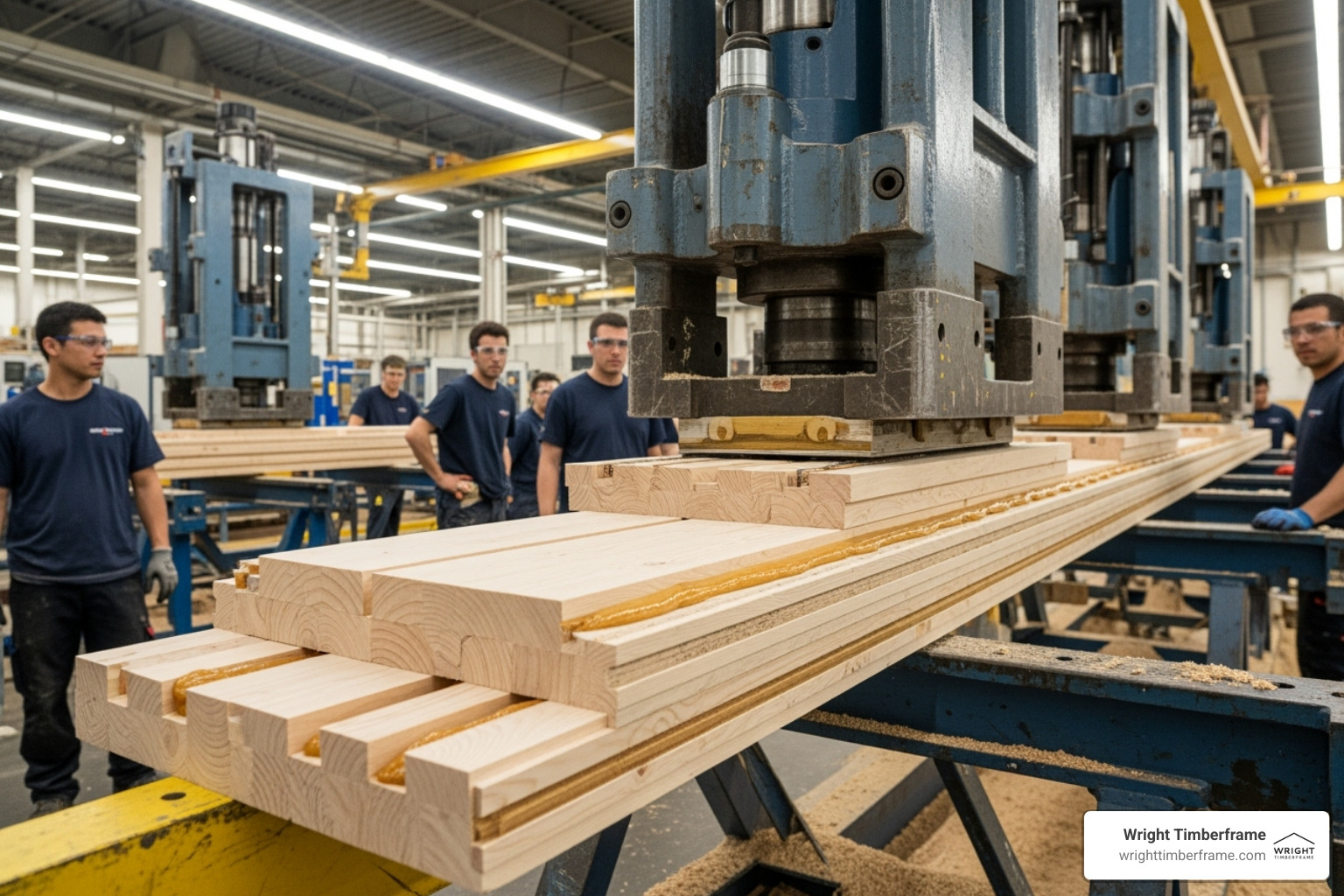
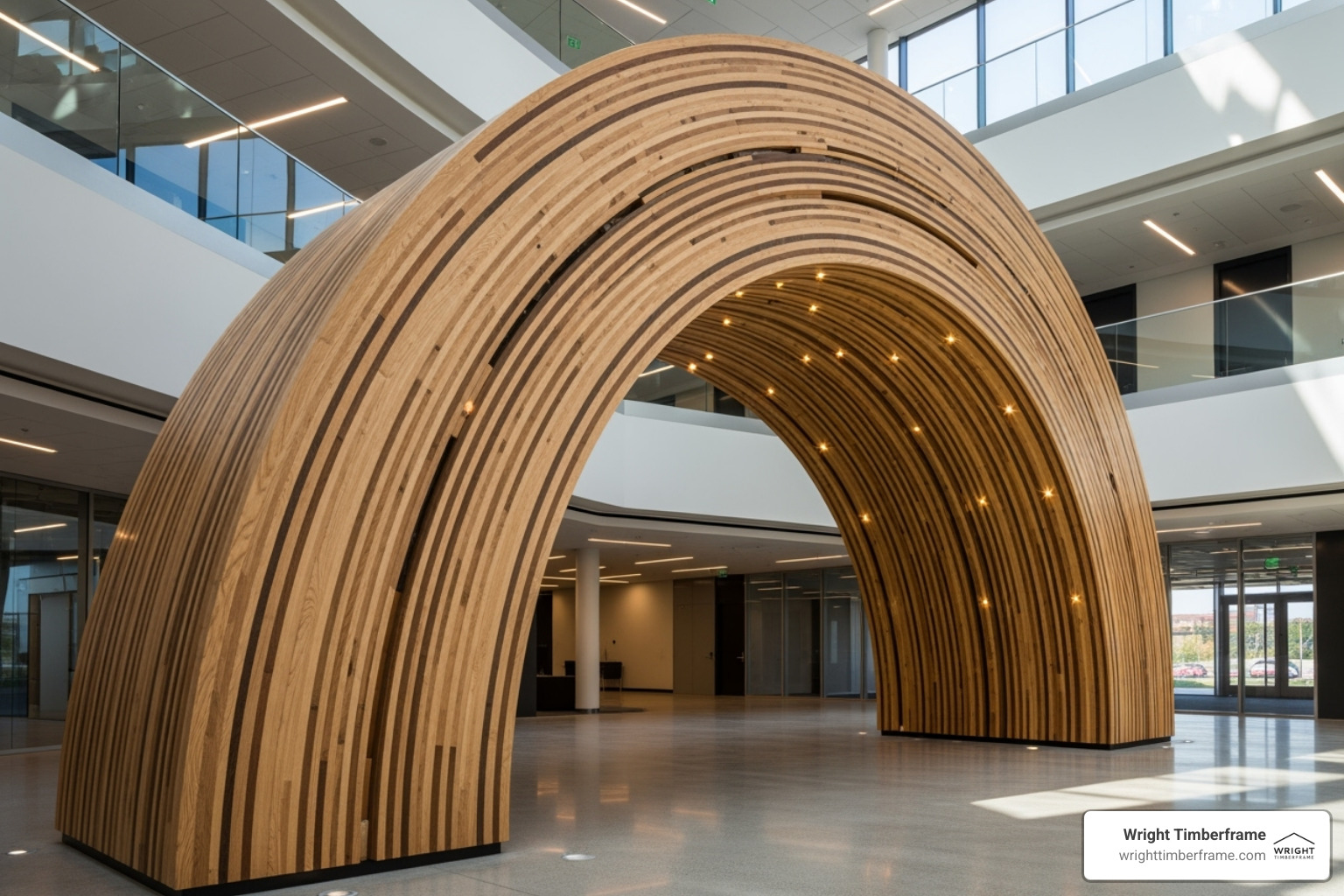
Glued-Laminated Timber (Glulam) takes a different approach. Multiple layers of lumber are glued together with all the grain running parallel, creating beams and columns that can span impressive distances. Because the grain runs one way, glulam can even be manufactured into graceful curved shapes. These strong, long-spanning beams allow us to create the open, airy spaces in our timber frame pavilions and pergolas without sacrificing strength.
Nail-Laminated Timber (NLT) is a simpler, traditional approach seeing renewed interest. Dimensional lumber is stacked on edge and fastened with nails to create solid panels. This century-old technique is cost-effective and uses no adhesives, typically serving as floor and roof decking.
Dowel-Laminated Timber (DLT) takes the adhesive-free concept further. Lumber boards are connected using friction-fit hardwood dowels instead of nails or glue. The result is an all-wood, chemical-free panel, appealing to builders seeking the most sustainable option for floor and roof systems.
The Best Advantages of Building with Engineered Timber
The popularity of engineered timber structures is a fundamental shift in building. These materials answer urgent questions about sustainability while delivering exceptional performance. Whether for a commercial tower or a backyard pavilion, engineered timber offers advantages that are reshaping construction.
Sustainability and Environmental Impact
The carbon footprint of traditional building materials is a major concern. Steel and cement production alone accounted for about 9% of global CO2 emissions in 2014. Engineered timber structures offer a different story, one rooted in natural carbon cycles instead of industrial emissions.
Wood is renewable and stores carbon. As a tree grows, it pulls CO2 from the atmosphere, and that carbon stays locked in the wood for the building’s lifetime. The numbers are striking: laminated wood absorbs around 582 kg of CO2/m3, while reinforced concrete emits 458 kg CO2/m3 and steel emits a whopping 12,087 kg CO2/m3. Using mass timber can reduce a project’s embodied carbon by around 20%.
If Canadian construction maximized mass timber use, it could remove an estimated 0.6 million tonnes of CO2 annually by 2030—equal to taking 125,000 cars off the road. This potential for net-zero construction is why builders are embracing wood.
This sustainability story is personal to us at Wright Timberframe. We source our premium Douglas Fir and Incense Cedar from mills with sustainable growth policies, and we visit these sites to ensure responsible harvesting. Choosing a timber structure means you’re getting beauty and strength while making a choice that benefits the planet.
Superior Structural Properties and Performance of Engineered Timber Structures
Engineered timber structures are engineering powerhouses, not just eco-friendly options. The manufacturing process amplifies wood’s best qualities while eliminating the inconsistencies of solid lumber.
Its strength-to-weight ratio is exceptional, with compressive strength comparable to concrete but much higher tensile strength, all while being lighter. This lightness is an advantage, allowing for smaller foundations, reduced seismic forces, and easier handling on site.
Dimensional stability is another game-changer. Laminating wood layers creates a product that resists the warping, shrinking, and checking that can affect solid timbers, making performance predictable. We understand this deeply, which is why we provide guidance on understanding cracks in the timber of your new timber frame structure: causes and solutions.
Glulam beams offer incredible design flexibility. The lamination process allows wood to be shaped into long spans and neat curves, blending structural efficiency with stunning visual appeal.
| Metric | Engineered Timber (Mass Timber) | Steel | Concrete |
|---|---|---|---|
| Strength-to-Weight | High | High | Medium |
| Embodied Carbon | Low / Carbon Negative | High | High |
| Construction Speed | Fast | Medium | Slow |
Construction Efficiency and Cost-Effectiveness
The advantages of engineered timber become clear when discussing time and money. The construction efficiencies are substantial and measurable.
Prefabrication is a game-changer. Engineered timber components are manufactured to precise specifications in a factory, arriving on-site ready to install. This minimizes adjustments and errors. At Wright Timberframe, we apply this principle to our timber frame pavilion kits. Every piece is pre-cut and pre-fit for straightforward assembly, and our commitment to timely delivery shows we understand efficiency matters.
Mass timber buildings save 20-25% in construction time compared to conventional methods. Faster construction means lower labor costs, reduced financing, and earlier occupancy.
The lighter weight of engineered timber can significantly reduce foundation requirements, representing real material and labor savings.
While some engineered timber products have a higher upfront cost, the overall project economics often favor timber. Studies show mass timber buildings can achieve approximately 4.2% savings on capital costs when factoring in reduced construction time, lighter foundations, and lower labor needs. It’s about the total project value, where engineered timber structures consistently deliver.
Safety, Durability, and Building Codes for Engineered Timber
When considering a new building material, questions about safety and durability are paramount. Will it stand up to fire? How will it handle the elements? Engineered timber structures have compelling answers backed by science, rigorous testing, and evolving standards that show what wood can truly do.
Debunking the Myths: Fire Safety in Mass Timber
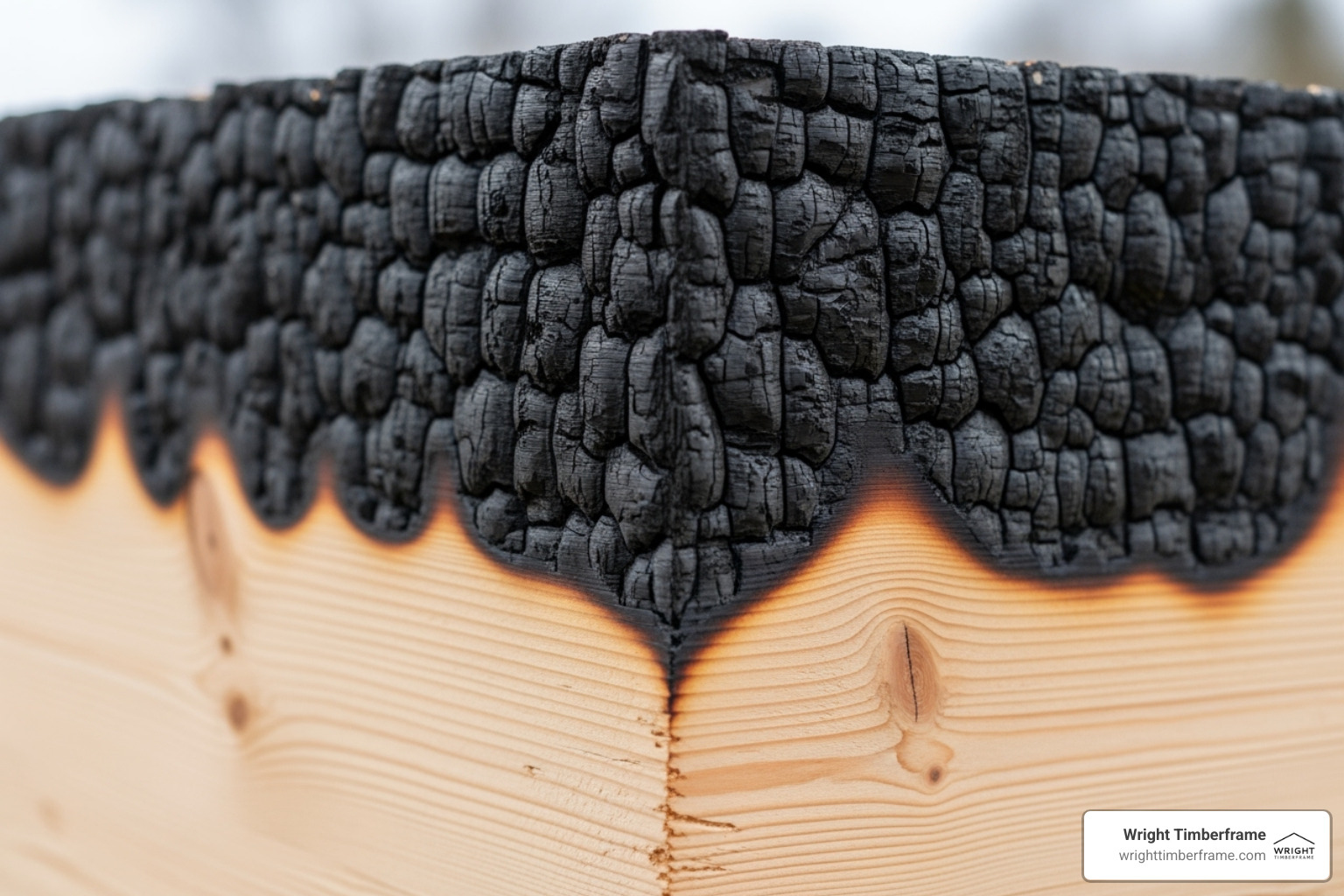
Fire safety is a primary and reasonable concern with wood construction. However, mass timber behaves differently than kindling. Large, solid timber sections perform in a predictable, engineered way that improves safety.
When exposed to fire, mass timber develops a char layer on its exterior. This char acts as a protective shield, insulating the inner wood and slowing the fire’s progress. The char restricts oxygen from reaching unburnt wood, which can even cause the fire to self-extinguish. Engineers can calculate how long a mass timber element will maintain its structural integrity, allowing them to design buildings that meet or exceed the same safety standards as steel and concrete.
Building codes demand the same level of fire performance from every material. Mass timber buildings incorporate sprinkler systems and other fire-resistant details to ensure occupant safety. At Wright Timberframe, our commitment to superior craftsmanship means we build every structure to the highest standards, ensuring beauty and safety go hand in hand.
Durability and Challenges of Engineered Timber Structures
While engineered timber offers remarkable performance, it needs thoughtful design and care to last. Wood is a natural material that must be protected to reach its full potential.
Moisture management is the most important factor in timber durability, as consistently wet wood can rot. Proper design with roof overhangs, drainage, and ventilation is critical. For our outdoor structures, we use durable species like Douglas Fir and Incense Cedar, which handle moisture well. We also apply high-grade, UV protective stains to every piece before it leaves our shop for an extra layer of defense.
Protection from the elements like direct sunlight and temperature swings is also important. Our designs account for these factors, and the natural resilience of our timber species means your structure will age gracefully.
Pest resistance is another consideration. Termites and wood-boring insects are manageable with smart design, like keeping wood from direct ground contact, proper treatment, and occasional inspections. When designed for the local climate with quality materials, timber structures can last for centuries.
One consideration is that some engineered timber products carry a higher upfront material cost. However, this initial investment often pays dividends through faster construction, reduced labor, and superior performance.
How Building Codes Are Evolving for Taller Wood Buildings
Building codes have evolved rapidly to accommodate modern engineered timber structures. Building skyscrapers from wood, once thought impossible, is now written into the code.
The International Code Council made history by approving proposals for tall wood buildings in the 2021 International Building Code (IBC). This decision followed years of research demonstrating that mass timber could safely reach new heights.
The 2021 IBC introduced three new construction types for mass timber. Type IV-A allows buildings up to 18 stories, Type IV-B up to 12 stories, and Type IV-C up to 9 stories. These provisions are based on solid engineering and proven fire safety.
The Future is Built with Wood: Trends and Inspiring Examples
The momentum behind engineered timber structures is undeniable. We’re witnessing a revolution in building, driven by sustainability goals, technological innovation, and a renewed appreciation for wood. It’s an exciting time to be in the timber industry, watching structures rise that once seemed impossible.
Notable Examples of Large-Scale Engineered Timber Structures
The scale of recent timber projects is inspiring. Ascent MKE in Milwaukee, a 25-story, 87-meter tower completed in 2022, is the world’s tallest mass timber building—a true wooden skyscraper. Other examples include Norway’s 18-story Mjöstårnet and London’s 9-story Stadthaus, a pioneer in urban mass timber construction.
As of 2022, over 84 mass timber buildings at least eight stories tall were either under construction or completed worldwide. This is a global movement, not a niche experiment.
Engineered timber structures aren’t just changing skylines. In Seville, Spain, the Metropol Parasol is one of the largest timber structures ever built. The material’s versatility extends to infrastructure, like the 160-meter Mistissini Bridge in Quebec. Even the Glenwood CLT Parking Garage in Oregon shows that mass timber is practical for large-scale commercial use.
These projects push boundaries and inspire us to think differently about what wood can achieve.
Current Trends and the Future Outlook
The future of construction is increasingly wooden, with several key trends shaping this change. Hybrid construction, which combines timber with steel and concrete, is gaining traction to leverage each material’s strengths.
Digital fabrication and CNC machining are revolutionizing work with engineered timber. These technologies enable incredibly precise cutting, ensuring perfect fits, streamlining assembly, and reducing waste. This precision mirrors the craftsmanship in our mortise and tenon dovetail joinery, where meticulous detail creates strong, lasting connections.
We’re also seeing increased adoption in residential and commercial projects of all sizes. Mid-rise buildings, offices, and custom homes are embracing engineered timber for its aesthetic and biophilic qualities—the innate human connection to nature.
Urban densification is another exciting frontier, as engineered timber is ideal for adding stories to existing buildings and filling vacant lots, providing sustainable solutions for growing cities.
The outlook for engineered timber structures is bright, promising a future of strong, efficient buildings connected to environmental stewardship. At Wright Timberframe, we focus on custom outdoor living spaces but are inspired by these larger trends. The principles of strength, beauty, and sustainability changing city skylines inform every pavilion and pergola we build. Explore the beauty and robust construction of our structures in our gallery.
Frequently Asked Questions about Engineered Timber
When you’re considering engineered timber structures for your next project, questions naturally arise. We’ve been building custom timber structures for years, and these are the questions we hear most often from homeowners just like you.
Is engineered timber stronger than regular wood?
Yes. The manufacturing process removes natural defects like knots that weaken solid timber. By laminating layers of wood, engineered timber becomes more uniform, predictable, and significantly stronger than a solid wood beam of the same size, ensuring consistent, reliable performance.
Are engineered timber structures expensive?
While some engineered products have a higher upfront material cost, the overall project is often more cost-effective. Savings come from faster construction, reduced labor, lighter foundation needs, and minimal waste due to prefabrication. The total project value often favors timber.
How does engineered timber hold up in the outdoors?
Yes, when designed and treated correctly. We use durable species like Douglas Fir and Incense Cedar with high-grade UV protective stains, and our designs prioritize moisture management. This ensures our outdoor structures perform exceptionally well and age gracefully.
Can I use engineered timber for a pergola or pavilion?
Absolutely. Engineered timber like glulam is ideal for the long, strong spans that make pergolas and pavilions stunning, allowing for open designs. We combine these principles with handcrafted mortise and tenon dovetail joinery to create durable, beautiful outdoor spaces.
Conclusion: Accept the Future with Engineered Timber Structures
Engineered timber structures offer a remarkable combination of strength, sustainability, and beauty. From skyscrapers to backyard retreats, this innovative material is a smart, forward-thinking approach to building that honors our planet and our desire for lasting quality.
These structures are changing modern construction by storing carbon, enabling faster builds, and offering new design possibilities. Engineered timber proves that sustainability and strength can go hand-in-hand, from the long spans of glulam beams to robust CLT panels.
At Wright Timberframe, we are passionate about timber’s performance and appeal. We bring the same commitment to precision, quality, and sustainability seen in large-scale projects to a personal scale. As your local timber frame experts in Utah, we blend innovative techniques with handcrafted quality using premium Douglas Fir and Incense Cedar.
Our custom pergolas, pavilions, and trellises are investments in beauty, durability, and the kind of gathering spaces that become the backdrop for your family’s best memories. We use traditional mortise and tenon joinery because it works, creating structures that will last for your lifetime and beyond.
The future of building is being written in wood. Whether you’re dreaming of a stunning pavilion, a pergola, or a custom trellis, we’re here to make it real.
Ready to bring the lasting beauty of a custom timber structure to your home? Contact us today to discuss your vision. Let’s build something beautiful together.