

Why Timber Frame Assembly Matters for Your Outdoor Living Space
Timber frame assembly is the time-honored craft of changing precisely cut timbers into a stunning, structurally sound outdoor structure. The process involves preparing the site, assembling sections called “bents” on the ground, raising them into place, and connecting them with ridge beams and rafters. The entire frame is then locked together with hardwood pegs, creating a structure where the joinery itself is a key part of the aesthetic.
The beauty of this method is the blend of ancient techniques with modern precision. Each timber is pre-cut and test-fitted in our shop, ensuring a perfect fit on-site. This allows a skilled crew to erect a large frame in just 1-3 days, while smaller pergolas can be assembled in an afternoon. These structures rely on mortise and tenon joints secured with wooden pegs, creating connections that grow stronger as the wood seasons.
At Wright Timberframe, our passion for this craft drives us. We bring a deep commitment to precision and tradition to every custom pergola, pavilion, and trellis we create. Our work across Utah is built on a simple principle: assemble it right the first time with quality materials, and you’ll never have to build it twice.

Before the Raise: Preparation for a Smooth Assembly
A successful timber frame assembly begins long before the first timber is lifted. Proper preparation transforms potential chaos into a carefully choreographed process, saving time, preventing mistakes, and ensuring raising day flows smoothly. Every timber has its place, every joint has been tested, and the crew knows exactly what to do next.
Site Logistics and Staging Your Timbers
When your timber kit arrives, the real work begins. Each piece, from towering posts to smaller braces, is labeled to show its exact location in the final structure. Our team organizes the timbers into logical groups: bent materials, purlins, and rafters are staged for easy access according to the assembly sequence.
We maintain clean tidy job sites by keeping walkways clear, which is crucial for safety and efficiency. We also protect staged timbers with tarps to shield them from sun or rain. This attention to detail is part of our commitment to timely delivery and ensures your timbers are in perfect condition for assembly.
The Power of Pre-Cut Kits and Shop Preparation
Long before your timbers arrive, they undergo an exhaustive preparation process in our shop. This is what separates a smooth raising from a frustrating one. Every joint is test-fitted in a controlled environment to ensure each mortise and tenon connection slides together perfectly. This is the core of our superior craftsmanship, we don’t just cut timbers and hope they fit.
Every timber is pre-cut, pre-drilled for pegs, and clearly labeled before it leaves our facility. The advantage is that virtually no on-site cutting is required. This means less waste, fewer errors, and a dramatically faster assembly. What could take days of on-site fitting happens in hours instead.
Understanding Your Materials
Understanding your timber makes a real difference during timber frame assembly. We primarily work with two exceptional species: Douglas Fir and Cedar.
Douglas Fir is the workhorse of timber framing. Its incredible strength-to-weight ratio provides maximum structural integrity. It’s stable, resists warping, and has a beautiful grain, making it ideal for the main structural elements of a Timber Frame Pavilion.
Cedar is naturally resistant to insects and decay. It has a wonderful aroma, a rich color that ages to a silvery gray, and is lighter than Douglas Fir, making it easier to handle. It’s an excellent choice for pergolas and trellises where weather resistance is key.
Before assembly, we inspect every timber. It’s important to know that wood is a natural material; small surface cracks called checks are normal and add character without compromising structural integrity. Our guide on Choosing the Right Wood for Your Timber Frame Pavilion offers more insight, and you can learn about the natural checking process in our article, Understanding Cracks in the Timber of Your New Timber Frame Structure: Causes and Solutions.
The Heart of the Craft: Understanding Timber Frame Joinery
The magic of timber framing lies in its interlocking joints, a tradition that creates immense strength without relying on metal fasteners. When you watch a timber frame come together, you’re witnessing centuries of refined technique. These connections are what separate a true timber frame from ordinary construction, and they are the key to a successful timber frame assembly.
The Classic Mortise and Tenon
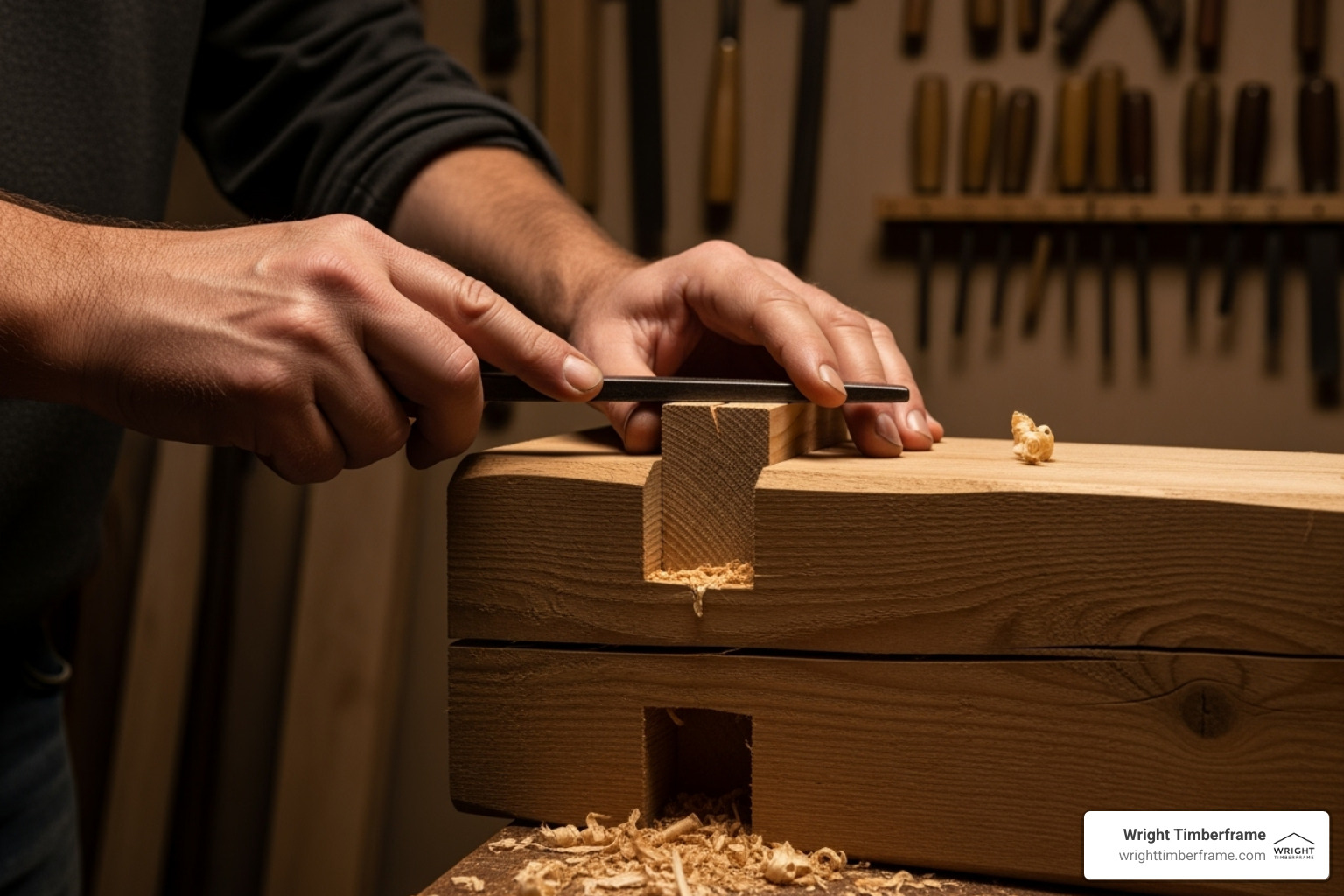
The mortise and tenon is the quintessential timber frame joint. It’s a simple concept: a projecting tongue (the tenon) fits snugly into a pocket (the mortise) in another timber. While it looks straightforward, it requires exceptional precision.
The genius of the joint is the shoulder of the tenon, where the two timbers meet face-to-face. This shoulder bears the weight and transfers loads through direct wood-on-wood contact, giving timber frames their remarkable durability. For us, the mortise and tenon represents a commitment to Traditional Timber Frame Joinery that has stood the test of time.
Dovetails, Laps, and Other Essential Joints
While the mortise and tenon is the workhorse, other joints add strength and character. The dovetail joint, with its trapezoidal shape, is excellent at resisting tension, making it ideal for connections that need to lock together mechanically. We often use Mortise and Tenon Dovetail Joinery, especially for connecting joists to girts, as they are self-supporting even before being pegged.
Scarf joints are an ingenious solution for creating longer beams from shorter pieces. These interlocking joints distribute forces along the connection, maintaining the strength of a single continuous timber. Choosing the right joint for each connection in a Timber Frame Pavilion is part of the art of timber framing.
Securing the Joints: The Art of Pegging
Once fitted, joints are secured with hardwood pegs. The most effective technique is called draw boring. We drill the peg hole in the tenon slightly offset from the hole in the mortise. When the peg is driven through, it pulls the tenon tightly into the mortise, creating an incredibly strong connection that tightens as the wood seasons.
Unlike metal fasteners that can rust or loosen, wooden pegs move with the timber, allowing for natural expansion and contraction without compromising the joint. The visible pegs are a beautiful aesthetic element and a sign of authentic craftsmanship.
The Main Event: A Step-by-Step Guide to Timber Frame Assembly and Raising
This is where the “blue-denim ballet” begins, as careful planning and teamwork transform timbers into a magnificent structure. A typical 24×36 frame can be raised in just 1–3 days with a skilled crew, a testament to the efficiency of the process.
Step 1: Assembling Bents on the Ground
The timber frame assembly process starts with assembling “bents” on the ground. A bent is a cross-section of the structure, typically including posts, girts, and braces. We lay these components out on blocks to keep them clean and accessible.
Following detailed plans, the crew fits the mortise and tenon joints together. Thanks to our shop preparation, the joints slide together smoothly, though heavy mallets or come-alongs are sometimes used to pull them tight without damaging the wood. Once aligned, we drive initial pegs to secure the bent, making the raising process safer and more predictable.
Step 2: Raising the Frame – Hand vs. Machine
The raising method depends on the structure’s size. For smaller projects like a Timber Frame Pergola kit, traditional hand-raising with poles, ropes, and a good crew can be a satisfying experience.
However, for larger pavilions, mechanical equipment like cranes and telehandlers is essential for safety and efficiency. They allow for the precise and swift lifting of heavy bents and roof components. The choice between methods impacts your timeline and budget.
| Method | Equipment Used | Advantages | Disadvantages | Best Suited For |
|---|---|---|---|---|
| Hand Raising | Gin poles, ropes, levers, many people | Traditional, communal, lower equipment cost | Labor-intensive, slower, safety risk for large pieces | Small pergolas, arbors, historic reconstructions |
| Machine Raising | Crane, Telehandler, Boom truck, lifting straps | Fast, precise, safer for heavy timbers, fewer people | Equipment rental cost, requires skilled operator, site access | Large pavilions, homes, multi-story frames |
Step 3: Setting, Bracing, and Connecting the Bents
This is the moment of truth. The first bent is carefully hoisted into place, with crew members using tag lines to guide it. Clear communication between the equipment operator and ground crew is critical.
Once the bent is vertical and aligned on its foundation points, we secure it and add temporary 2×4 cross-braces. This bracing holds the bent plumb and stable. We repeat the process for the next bent, connecting it to the first with horizontal timbers called plates and girts.
As these connections are made, the frame transforms from individual sections into a unified, three-dimensional structure, and the vision becomes reality.
From Skeleton to Structure: The Final Steps of Timber Frame Assembly
Once the main bents are standing, the final structural elements are added to lock everything into a single, robust unit. This is where the frame gains its full strength and architectural character, changing from a skeleton into a complete structure.
Step 1: Installing Ridge Beams, Purlins, and Rafters
With the bents braced, the focus shifts to the roof. The ridge beam, or spine of the roof, is lifted into position, connecting the bents and providing longitudinal stability. Next, we install purlins or rafters, depending on the design.
Purlins are horizontal timbers spanning from bent to bent, while rafters typically run from the ridge down to the plates. These components are fitted into their pre-cut pockets and create the framework for your roof covering. As each piece locks into place, the frame stiffens, becoming a unified system ready to bear loads and resist wind for decades.
Step 2: Final Pegging and Finishing Touches
With all major components in place, the final pegging begins. Our crew works through the structure, driving hardwood pegs into every draw-bored joint. The satisfying thunk of the mallet driving a peg home signals a permanent, secure connection.
This process locks the entire structure together, creating a unified whole that will only grow stronger over time. The exposed pegs are a signature of authentic timber framing and a testament to the traditional methods used in your timber frame assembly.
Step 3: The “Topping Out” Tradition
As the frame stands complete, we often perform the “topping out” ceremony, an ancient tradition celebrating the completion of the structural frame. This involves nailing a small evergreen bough to the highest point of the structure. Rooted in Scandinavian history, this ‘whetting bush’ is a symbol of good luck and a blessing for the new structure.
For us at Wright Timberframe, it’s a meaningful way to acknowledge the hard work and collaboration that brought your Timber Frame Pavilion to life. It’s a moment of pride for our craftspeople and a special memory for homeowners, connecting your modern structure to a long lineage of builders.
Safety First: Essential Protocols for a Successful Raising
A safe job site is a successful job site. The weight and scale of timber framing demand strict safety protocols throughout the timber frame assembly process. There is no room for shortcuts when working with massive beams weighing hundreds of pounds.
Personal Protective Equipment (PPE) and Site Awareness
Safety begins the moment our crew steps on site. Hard hats, steel-toed boots, gloves, and eye protection are mandatory. A cluttered site is a dangerous one, which is why our commitment to clean tidy job sites is as much about safety as it is about professionalism. Clear walkways and organized materials prevent trips and reduce risks.
During the raising, site awareness is critical. Everyone must constantly scan for overhead lifting operations and stay clear of pinch points where timbers come together. Only essential personnel are allowed in active lifting zones. Regular safety briefings ensure everyone understands their role and the day’s potential hazards.
Safe Lifting and Rigging Practices
Lifting a heavy timber beam requires expertise and communication. We always use tag lines (control ropes) to guide swinging timbers and prevent dangerous pendulum effects. Understanding the capacity of lifting straps and equipment is non-negotiable; we never exceed rated limits, and any worn rigging is immediately retired.
Clear, constant communication between the equipment operator and the ground crew, using established hand signals and radios, is paramount. All lifting equipment must be positioned on stable, level ground. A machine that tips during a lift can be catastrophic. For official standards, organizations like the Timber Frame Engineering Council provide invaluable guidelines.
The Value of Professional Expertise
For large-scale projects, the value of an experienced crew is immeasurable. Our Expert Team brings an ingrained safety culture to every job. Years of experience raising hundreds of frames means we anticipate challenges, solve problems on the fly, and maintain calm focus under pressure.
Professionals understand the subtle signs that something isn’t right, an intuition that keeps everyone safe and ensures the timber frame assembly adheres to the highest standards. While smaller kits can be rewarding DIY projects, the risks involved with larger frames make professional installation the smart choice for safety and peace of mind.

Frequently Asked Questions about Timber Frame Assembly
How long does it take to assemble a timber frame?
The time needed for timber frame assembly depends on the project’s size. A simple Timber Frame Pergola kit can often be assembled in a single day. A larger, custom 24×36 pavilion typically takes our professional crew 1-3 days to raise with the help of a telehandler.
Can I assemble a timber frame kit myself?
Yes, our smaller pergola and trellis kits are designed for DIY assembly with a few helpers. For larger pavilions with heavy timbers, we recommend professional installation for safety and efficiency, as it requires specialized lifting equipment.
What tools are essential for timber frame assembly?
For a DIY kit, you’ll need heavy-duty mallets, sharp chisels, an impact driver, lifting straps, ladders or scaffolding, and temporary 2×4 bracing. Larger projects require a telehandler or crane and proper rigging equipment, which is why professional installation is often recommended.
The Final Peg in Your Timber Frame Assembly Journey
Understanding timber frame assembly reveals a unique blend of artistry, engineering, and tradition. From the first Traditional Timber Frame Joinery cut in our shop to the dramatic raising day, every step is a deliberate act of craftsmanship that creates structures built to last for generations.
There’s an honesty to timber framing where the structure itself is the beauty. The exposed joinery, the natural character of the wood, and the solid feel of the beams create outdoor living spaces that don’t just function well, they inspire. As your local timber frame experts in Utah, we’ve had the privilege of bringing dozens of these structures to life.
We use premium Douglas Fir and Cedar timbers and time-tested techniques to build structures that exceed expectations and age gracefully. A timber frame pavilion or pergola becomes part of your family’s story.
Ready to start your own journey? Explore our custom Timber Frame Pavilion options or reach out to discuss your vision. Let’s build something beautiful together.

