

Most Utah homeowners start thinking about a pergola in April or May, when the backyard calls and the weather finally cooperates. That instinct is understandable, but it is also the most expensive time to buy. Contractors are booked, material lead times stretch out, and the rush-season premium is baked into every quote you receive. We have been building custom timber-frame outdoor structures in Utah for more than 10 years, and the homeowners who get the best projects, the best pricing, and the smoothest installs are the ones who plan in the off-season.
Quick Answer: The best time to buy a pergola is late fall through winter, roughly November through February. Builder schedules open up, lead times shorten, and you can lock in your design and pricing well before the spring rush.
Why Timing a Pergola Purchase Actually Matters
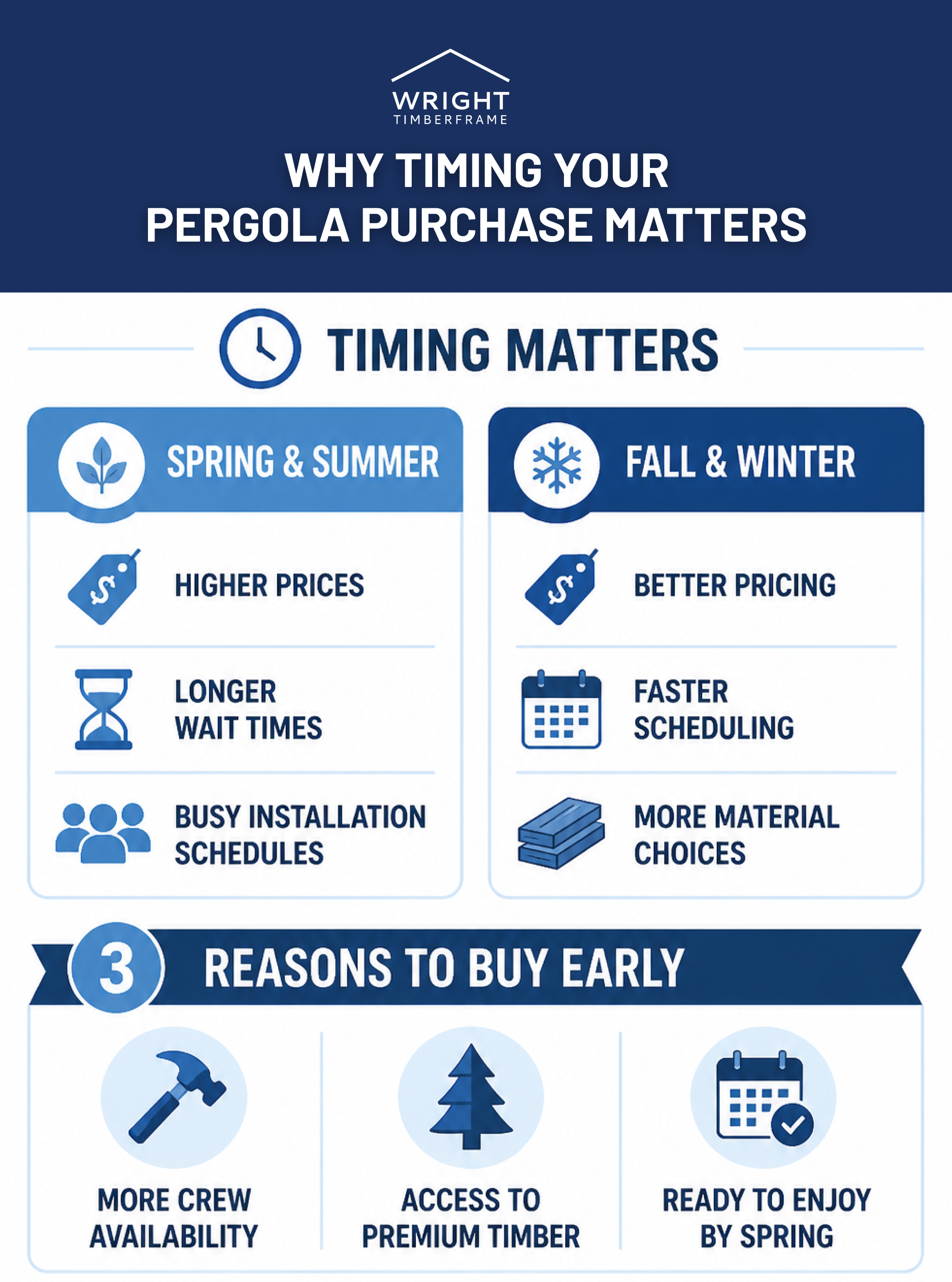
Timing a pergola purchase matters because the season you buy in directly affects pricing, scheduling, and material availability. Pergola pricing is not fixed the way a product on a shelf is priced. You are buying a custom-built structure tied to labor availability, material sourcing, and project scheduling. Those three variables all move with the seasons, and they all move in the same direction: up in spring and summer, down in fall and winter.
Labor is the biggest driver. Skilled timber-frame crews are a finite resource. When every homeowner in Salt Lake Valley decides to start their outdoor project in May, builders face a backlog. That backlog means longer wait times and, in some cases, higher pricing to compensate for the scheduling pressure. In our off-season, we have the capacity to give a project the attention it deserves.
Material sourcing is the second factor. Select Douglas Fir and Western Red Cedar, the species we use for every custom build and pre-cut kit, are harvested and milled year-round. Ordering in winter means our yard has full inventory, and we can hand-pick the straightest, clearest stock for your beams. High-demand spring months can create competition for the best-grade timber.
Lead time is the third variable, and it is the one that trips up the most homeowners. A custom timber-frame pergola is not an off-the-shelf product. Design, permitting (where required), cutting, finishing, and scheduling an install crew all take time. Starting that clock in December or January means you are ready to enjoy your pergola the moment the weather cooperates in spring.
Buying a Pergola in Winter: 5 Concrete Advantages
Winter is not just the cheapest time to buy a pergola. It is the time that gives you the most control over the entire project.
- Builder availability is at its peak. Our installation schedule opens up significantly between November and February. That means you are not competing with a dozen other homeowners for a slot in our calendar. You get our full attention on the design, the wood selection, and the timeline.
- You lock in your design before the rush. A custom pergola starts with a consultation and a set of project-specific plans. Going through that process in winter means the design is finalized and the materials are staged before the first warm weekend of the year. Your neighbors who waited until April are just starting their consultations when you are booking your install date.
- Lead time works in your favor. Our review of project timelines shows that off-season builds move from contract to install faster than peak-season jobs. With a less-congested schedule, we can cut, stain, and prep your timber components without juggling competing installs. Customers in reviews have noted installs completed in weeks, not months. Actual timelines vary by project complexity, so we will give you a specific schedule at the quote stage.
- Pre-cut kit buyers have a national advantage. If you are ordering one of our pre-cut, pre-stained timber frame pergola kits and shipping it anywhere in the country, winter ordering means your kit is built and staged before peak carrier demand. Spring shipping congestion is real; ordering early sidesteps it.
- You can plan around permit timelines. Permit review times at Utah building departments vary by city and county and tend to back up when the spring remodeling season hits. Filing in January or February often means faster approval. We always tell customers to confirm permit requirements with their local authority, since thresholds and setback rules differ across Utah jurisdictions.
Winter Lead Times: How Booking Early Protects Your Spring Install
The single most common regret we hear from homeowners is that they started the process too late. They call in April wanting a pergola for a May graduation party or a June wedding in the backyard, and we have to tell them the schedule is full or the timeline is tight. A winter consultation locks your spot. Once your design is approved and your deposit is placed, your project is in the queue. The timbers are selected, cut, and pre-stained during our quieter months, and your install happens the moment weather and your schedule align in spring. You spend winter planning and get to spend summer enjoying.
Spring Pergola Buying: The Rush Season and What It Costs You
Spring is when most people pull the trigger, and that collective behavior creates a genuine supply-and-demand problem. Builder schedules fill in February and March for the best crews, which means a homeowner calling in April is already working against the calendar.
The design and permitting clock does not pause during the busy season. If your city requires a permit for a structure above a certain size, that review can take several weeks during spring filing peaks. Add in material lead times and install scheduling, and a May consultation realistically translates to a July or August install at the earliest.
Spring buying is not a mistake if spring is when you discovered the idea. It just means managing expectations about the timeline and accepting less schedule flexibility. If you want the structure ready for a specific date, a spring purchase rarely gives you that certainty.
| Season | Builder Availability | Lead Time | Permit Queue | Best For |
| Winter (Nov-Feb) | High | Shortest | Low | Planning, locking in design |
| Spring (Mar-May) | Moderate to Low | Longer | Moderate-High | Quick decisions if flexible on date |
| Summer (Jun-Aug) | Low | Longest | High | Contracts with long notice |
| Fall (Sep-Oct) | Moderate | Moderate | Moderate | Off-season pricing begins |
Summer and Fall: What to Expect If You Wait
Summer is the hardest time to start a pergola project. Builder schedules are at their most congested, permit queues are long, and material demand is at its peak. If you find yourself wanting a pergola in July, the most realistic advice is to start the consultation and design process now, accept a fall install date, and use the extra lead time to make sure every detail of the design is exactly right.
Fall is actually an underrated window. September and October see builder schedules starting to open up again, and material sourcing is less competitive than in the summer. An October start, especially for a custom build, often produces a late-October or November install before the ground freezes in northern Utah. For DIY pergola kit buyers, fall is an excellent time to order: the kit ships quickly, and a motivated DIYer can assemble it in a single weekend before the cold sets in.
If you are comparing a custom build to prefab options, the seasonal calculus is different. A mass-produced aluminum or vinyl pergola ships from a warehouse and installs in a day, so the timing pressure is lower. But that convenience comes at a material and structural cost. Mortise-and-tenon Douglas Fir joinery does not rust, does not hollow-sound, and does not read as a temporary addition. The wait is worth it.
How Long Does a Pergola Project Actually Take?
Understanding the real project timeline helps clarify why starting early matters. The timeline below reflects a custom on-site build in Utah. Kit timelines are shorter because cutting and staining happen before the order ships.
| Phase | Custom Utah Build | Pre-Cut Kit (Nationwide) |
| Initial consultation and quote | 1-2 weeks | Same day online |
| Design and plan finalization | 1-3 weeks | Choose profile/brace/stain |
| Permit application and review | 2-8 weeks (varies by city) | Buyer handles locally |
| Timber cutting and finishing | 1-3 weeks | Included in production |
| Install / assembly | 1 day to 1 week | DIY (typically 1-2 days) |
| Total from contract to done | 6-16 weeks typical | 4-8 weeks typical |
Note: permit review times vary significantly across Utah cities and counties. Always confirm requirements with your local building department before finalizing a timeline.
Douglas Fir and Cedar in Cold Weather: What Off-Season Storage Means for Your Kit
One question we get from kit buyers is whether ordering in winter affects the wood quality. It does not, and for a specific reason. Select Douglas Fir and Western Red Cedar are kiln-dried and finish-stained before they leave our yard. Douglas Fir is prized for its high strength-to-weight ratio and straight grain. Cedar is valued for its natural oils and dimensional stability in changing temperatures. Both species are well-suited to outdoor conditions, including the freeze-thaw cycles common in Utah and northern states.
The Western Red Cedar Lumber Association notes that cedar’s natural preservatives give it genuine resistance to moisture and insects without chemical treatment. The APA – The Engineered Wood Association provides structural design data and grading standards for Douglas-fir used in engineered wood products such as beams, joists, and glulam, which are commonly used in residential and commercial construction. Both endorsements reflect what we have seen over more than 10 years of building in Utah’s variable climate: the right species, properly finished, holds up season after season.
Kits stored in a dry garage or covered space through winter arrive at the install site in the same condition as a summer-delivered kit. Our Behr stain finish is UV-rated and weather-resistant from the day it is applied. See our custom timber pergola options for the full range of beam profiles, knee-brace styles, and stain colors available.
Planning Your Pergola Project for Maximum Value
The homeowners who get the most out of their pergola investment are the ones who treat it as a planned project, not an impulse. Here is how to approach it.
- Start the conversation in October or November. Even if you are not ready to sign a contract, a free consultation gives you a realistic timeline and a sense of the design possibilities.
- Know your space before the first call. Measure the area you want to cover, note whether you want freestanding or attached to the house, and think about how you will use the space (shade, entertaining, plant coverage).
- Check your permit situation early. Permit requirements for pergolas in Utah vary by city and county. Some jurisdictions exempt open-roof structures under a certain footprint; others require a full building permit and engineered plans. Knowing this in December saves you a surprise in March.
- Think about your wood species preference. Douglas Fir gives a classic timber look with high structural strength. Western Red Cedar adds natural color variation and a lighter feel. Both are available for custom builds and kits. Our timber team can walk you through the trade-offs.
- Review our project gallery and completed projects like the Suncrest Project and the Evans Project for real-world design reference. Seeing finished work is the fastest way to narrow down your preferences.
- Budget realistically. Pergola pricing varies by size, species, roofline complexity, and finish. We do not publish a per-square-foot rate because every structure is different. A free quote gives you an accurate number for your specific project, with no obligation.
How Wright Timberframe Works Year-Round
Some builders go quiet in winter. We do not. Our shop runs on the same production schedule year-round because custom timber-frame work does not require warm weather. Cutting mortise-and-tenon joints, fitting knee braces, hand-selecting beam stock, and applying a UV-rated Behr stain finish are all indoor processes. The ground-level install work is weather-dependent for Utah on-site builds, but the fabrication that makes our structures last 20 to 50 years happens in a controlled environment, regardless of the month.
That consistent year-round approach is one reason homeowners continue to trust us for their projects. We hold a 4.9 Google rating, built on more than 10 years of projects across Utah. Review after review mentions two things: the crew shows up on time, and the structure looks exactly as expected. Whether you sign a contract in January or June, you get the same local team, the same hand-cut joinery, and the same no-metal-brackets craftsmanship.
Mortise-and-Tenon Joinery: Why Our Off-Season Builds Are Just as Strong
A common question we hear is whether cold-weather fabrication affects joint quality. It does not. Mortise-and-tenon joinery is a wood-to-wood connection; the joint is shaped by a cutting tool, not by adhesive or a chemical cure process. The tenon is cut to fit the mortise, and the connection is held by the geometry of the wood itself. This is why traditional timber-frame structures survive for generations, and why we chose this method over the metal bracket systems most production builders use.
Metal brackets expand and contract with temperature swings. Over a decade of Utah winters, that movement works against the fasteners and creates the wobble and creaking that homeowners notice in cheaper pergolas. Our mortise-and-tenon joints tighten with age as the wood acclimates to its environment. That is not a marketing claim; it is the mechanical behavior of a properly fitted wood joint. Learn more about how we build our timber frame pergola and pavilion guides.

Frequently Asked Questions
Is winter really the best time to buy a pergola?
For most homeowners, yes. Builder availability is higher, lead times are shorter, and you can lock in your design before the spring rush. We operate year-round, so an off-season order gets the same craftsmanship and materials as a summer build.
Can you install a pergola in winter in Utah?
Outdoor installation depends on ground conditions and weather. We evaluate each job site and schedule installs when conditions are safe. In many cases, we can complete fabrication in winter and install at the first appropriate weather window in early spring. Contact us to discuss your specific situation and location.
How much does a custom pergola cost?
We quote pergola projects individually after a free consultation. Pricing depends on size, species (Douglas Fir standard, Cedar upgrade), roofline complexity, and site conditions. We do not publish a fixed rate because every structure is different. A free quote gives you an accurate number for your project with no obligation.
What is the difference between a custom build and a pre-cut kit?
A custom Utah build is designed and installed by our crew. We hand-cut every joint on-site or in our shop to fit your specific space. A pre-cut kit ships nationwide with mortise-and-tenon joinery already cut and Behr stain already applied; you or your contractor assembles it using our instructions and remote support. Both options use the same Douglas Fir or Cedar stock and the same joinery method. See our DIY pergola kit guide for a full comparison.
Do I need a permit for a pergola in Utah?
Permit requirements vary by city and county in Utah. Some jurisdictions exempt open-roof, freestanding structures under a certain footprint; others require a full building permit with structural plans. We strongly recommend confirming requirements with your local building department before finalizing your project. Our permit guide for freestanding pergolas covers the general landscape, but it does not substitute for a check with your specific authority.
What wood does Wright Timberframe use?
We build with select Douglas Fir as our standard species and Western Red Cedar as an upgrade option. We do not use pressure-treated pine or composite materials. Every beam is hand-picked for straight grain and clear stock. Both species are well-suited to Utah’s climate and outdoor applications.
How long does a custom pergola last?
A properly maintained timber-frame pergola built with real Douglas Fir or Cedar and mortise-and-tenon joinery can last 20 to 50 years, depending on species, finish maintenance, and local climate. Our structures are sealed with a UV-rated Behr stain finish at the time of build. Periodic restaining, typically every three to five years depending on sun exposure, keeps the wood protected. We have returned to customer sites after a year to re-tighten and restain when needed, because we stand behind the work.
Ready to Plan Your Pergola This Winter?
The homeowners who get the best pergola experiences are the ones who start the conversation before the rush. Winter is that window. Our schedules are open, our timber yard is stocked, and our design team is ready to help you figure out exactly what your space needs, whether that is a custom Utah install or a pre-cut kit shipping anywhere in the country.
Our company has built hundreds of custom timber-frame outdoor structures across Utah over more than 10 years. Every one of them started with a free conversation. We hold a 4.9 Google rating because we do what we say and build it the way it is supposed to be built: real Douglas Fir or Cedar, mortise-and-tenon joinery, no metal brackets, and a crew you will actually recognize from the first visit to the last.
For a no-obligation quote on your custom pergola or pre-cut kit, get a free quote from us. Let’s get your project on the calendar before the spring rush.

