Choosing between a pergola vs. pavilion vs. trellis kit comes down to one question. How much weather protection does your backyard actually need? A pergola filters light through open rafters. A pavilion carries a solid roof built for real rain and snow. A trellis adds height and privacy without covering the sky at all. If you already know you want a pre-cut timber frame kit shipped to your site rather than a fully installed build, the same three-way choice still applies. It just arrives on a pallet instead of getting built in front of you.
The short answer is that roof coverage decides the fit. A pergola works when you want dappled shade and an open-air feel. A pavilion works when the space needs to function rain or shine, all year round. A trellis works when privacy, a garden feature, or a smaller footprint matters more than a roof at all. Span, budget, and how the structure attaches to your home narrow the choice from there.
A few things matter more than most buyers expect once they start comparing kits side by side.
- Roof coverage, not overall size, is what actually separates these three structures.
- A trellis kit typically costs less and goes together faster than either roofed option.
- Pavilion kits carry more structural load, which changes footing and post requirements.
- All three ship with the same mortise-and-tenon joinery and the same two species choices.
- Pairing a trellis with a pergola solves privacy and shade in a single build.
Pergola vs. Pavilion vs. Trellis Kit at a Glance

A pergola kit gives filtered shade through open rafters, a pavilion kit has a solid roof for real rain and sun protection, and a trellis kit is a vertical structure built for privacy or climbing plants. Roof coverage is the difference that decides which one fits your space.
| Structure | Roof Type | Best For | Typical Size Range | Shade Level | Starting Complexity |
| Pergola kit | Open rafters, no roof deck | Dining areas, hot tub covers, filtered shade | 10×10 to 16×16 | Partial, filtered | Moderate |
| Pavilion kit | Solid roof deck over a timber frame | Year-round entertaining, all-weather lounging | 12×12 to 20×20+ | Full | Higher |
| Trellis kit | Open vertical lattice, no roof | Privacy screening, climbing plants, garden accents | 4 ft to 10 ft wide panels | None to minimal | Lower |
If you are looking for the simplest decision rule, start with the top of the structure. No roof means trellis, open rafters mean pergola, and a solid roof means pavilion. From there, consider the size, location, and intended use to make the final choice.
The short version, once you strip away the marketing language:
- Choose a pergola kit for shade with an open-air feel.
- Choose a pavilion kit if the space needs to work in rain or snow.
- Choose a trellis kit for privacy or a garden feature, not shelter.
What Is a Pergola Kit, and When Should You Choose One?
A pergola kit is a pre-cut timber structure with open rafters that filters sunlight instead of blocking it. We cut the joinery as mortise and tenon, the same wood-to-wood connection used on installed builds, so a kit buyer gets the identical joint quality without the on-site labor. A pergola suits a dining area, a hot tub cover, or any space where you want shade without losing the open sky.
A pergola is the right choice when full weather protection is not the goal. Rain still comes through open rafters, so it works best over a patio you already partially cover, or in a climate where afternoon sun is the bigger problem than rain. Choose a pergola when the priority is an airy, defined outdoor room rather than an all-weather shelter.
Pergola Kit Spans, Bays, and Beam Profiles
A pergola kit’s structure breaks down into bays, the repeating sections between posts, and spans, the distance a beam has to carry without extra support. Wider bays need a heavier beam profile to avoid sag. Wright Timberframe kits are configured in three steps: a beam profile chosen from seven end-cut styles, a knee-brace style chosen from four profiles, and any Behr stain color. Corners interlock and support beams slide into place, which is what lets a pre-cut kit go up quickly without hardware doing the structural work. See the full range of pergola styles and finishes if you want to compare profiles before deciding on a kit.
What Is a Pavilion Kit, and When Should You Choose One?

A pavilion kit is a pre-cut timber structure with a solid roof deck, built for year-round use and real weather protection. Where a pergola lets rain through, a pavilion sheds it. That makes a pavilion the right pick for an outdoor kitchen, a hot tub you want covered in winter, or any space where lounging or entertaining should not depend on the forecast. Explore the pavilion product page for a closer look at how these structures are built.
A pavilion makes the most sense when the outdoor area needs to operate more like an extension of the home. The solid roof creates a defined covered zone that can support furniture, cooking areas, seating, or other features that benefit from protection from the elements. It also provides a stronger sense of enclosure without requiring the walls of a traditional room.
Pavilion Kit Roof Framing: Purlins, Ridge Beams, and King Post Trusses
A solid roof adds real weight, and that changes the frame underneath it. A ridge beam runs the length of the roof at the peak, and purlins run perpendicular to it to carry the roof deck between rafters. Wider spans often call for a king post or queen post truss, which distributes the load down through the timber rather than relying on the roof deck alone. This is the Timber Framers Guild’s own description of what separates timber framing from ordinary stick framing, and it is why a pavilion’s structural layout deserves more attention than a pergola’s before you finalize a span.
What Is a Trellis Kit, and When Should You Choose One?
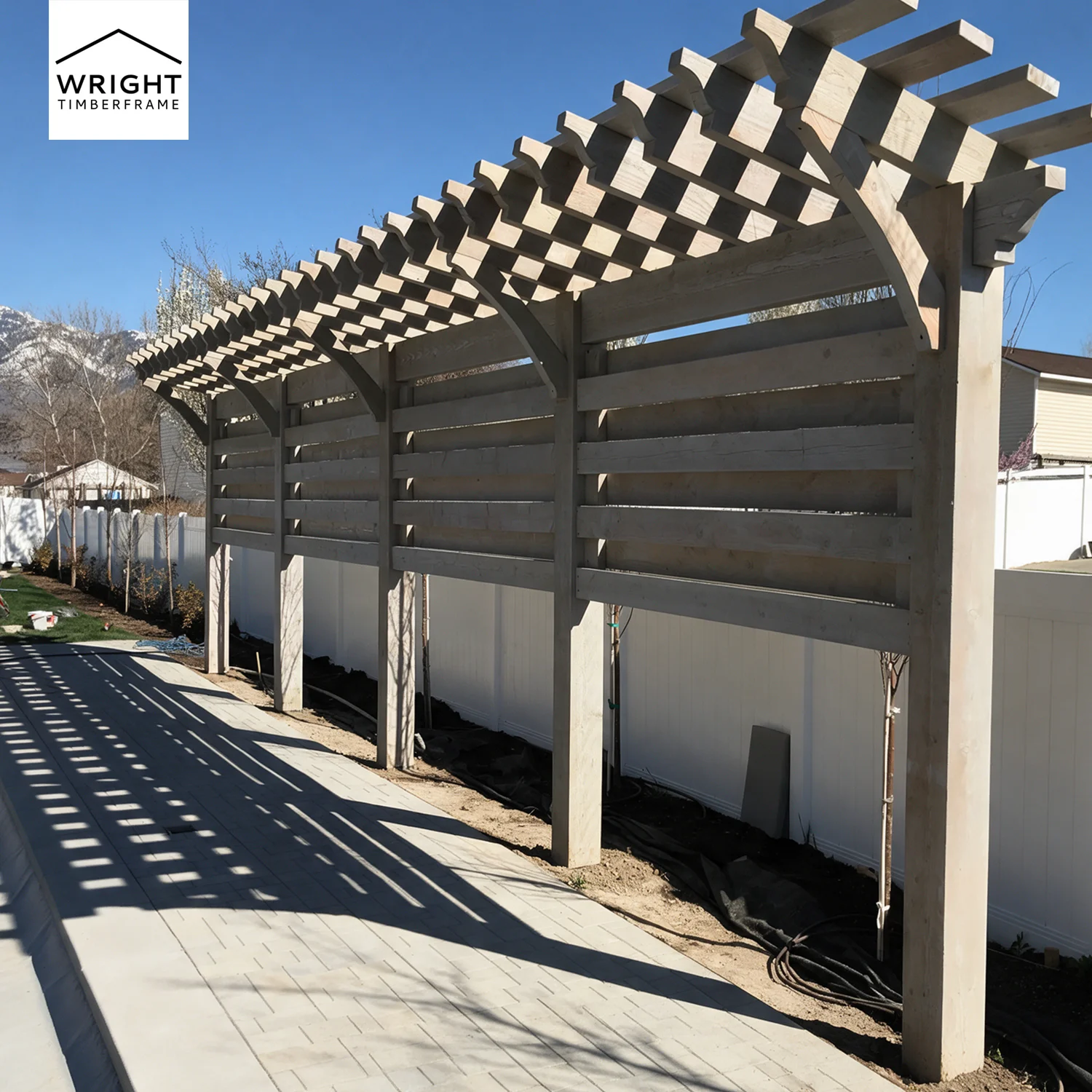
A trellis kit is an open, vertical timber structure built with mortise and tenon joinery, without a roof at all. It is customizable in beam profile, stain, and size, and it is built for privacy, garden charm, or architectural detail rather than shade. A trellis is often the right answer when a pergola or pavilion would be more structured than the space calls for. Browse the trellis product page to see how a trellis compares to a pergola or pavilion in scale.
Trellises are particularly useful when the goal is to change how a space feels without adding overhead construction. They can frame a garden entrance, separate one area of the yard from another, or provide a vertical surface for climbing plants. They can also help create privacy along a property line without requiring a full wall.
Trellis Kit Styles: Freestanding, Wall-Mounted, and Slatted Privacy Backing
A freestanding trellis kit works as a garden feature or a stand-alone privacy screen along a property line. A wall-mounted version attaches to an existing structure and works well for climbing plants against a house or fence. Adding a slatted privacy backing turns a decorative trellis into a real sightline barrier, which is a detail worth deciding on before you order rather than after.
Placement is especially important with a trellis because its effectiveness depends on the sightlines around it. A panel positioned between a seating area and a neighboring property can provide a very different result from the same panel placed at the edge of a garden. Consider what you want to hide, frame, or emphasize before deciding on the final orientation.
Comparing Cost, Shade, and Weather Protection Across All Three
Cost, shade, and weather protection move together across these three structures because each one trades material and labor for a different level of coverage. Pricing is driven by span, species, beam profile complexity, and whether the structure is installed or shipped as a pre-cut kit, so we quote each project instead of publishing a price list.
| Factor | Pergola Kit | Pavilion Kit | Trellis Kit |
| Relative material cost | Moderate | Highest | Lowest |
| Weather protection | Sun filtering only, no rain coverage | Full protection from rain and snow | None, structural privacy only |
| Typical install time | Faster than a pavilion | Longer, due to roof framing | Fastest of the three |
| Species options | Douglas Fir standard, Cedar upgrade | Douglas Fir standard, Cedar upgrade | Douglas Fir standard, Cedar upgrade |
If you want a deeper look at how kit quality tiers compare before you buy, our guide to comparing premium outdoor timber kits walks through what separates a hand-fitted mortise-and-tenon kit from a mass-produced bolt-together version.
Footings, Posts, and Frost Depth: How Structural Requirements Differ
A pavilion needs a more substantial footing than a pergola or trellis because a solid roof puts more weight and more wind load on every post. Installed builds typically sit on a concrete pier or footing set below the local frost depth, with a post base anchor connecting the timber to the concrete without trapping moisture against the wood. A trellis, by contrast, is light enough that a simpler footing or a post base anchor set in a smaller footing is often enough.
The exact foundation approach depends on the structure, soil conditions, local climate, and the loads the finished structure must support. A larger pavilion in a snow-prone or high-wind location can have very different requirements from a small trellis installed in a sheltered garden. That is why foundation details should be considered as part of the initial design rather than left until installation.
Frost depth, setback distance from a property line, and whether a structure needs an accessory structure permit all vary by city and county. Utah’s Wasatch Front alone has different rules from one municipality to the next. Always confirm footing depth, setback, and permit requirements with your local building department before you finalize a design, whether you are building with us in Utah or assembling a kit somewhere else.
The Cracks You’ll See in Year One Aren’t a Flaw in Any of These Structures
The hairline cracks that show up in your beams during the first year are checks, not failures. Heavy timber releases moisture as it dries and splits along the grain as it does. This is normal in a solid timber structure and does not affect how the joint carries load. This happens the same way in a pergola, a pavilion, or a trellis because all three use the same solid-sawn timber rather than engineered lumber.
Kiln-dried timber checks less than green timber because more of the moisture has already left the wood before it is cut, but some checking is normal either way and is part of what gives solid timber its dimensional character over time. A buyer who has not been told this may mistake a natural check for a defect, so it is worth understanding what to expect before your kit ever arrives.
As the timber continues to adjust to its environment, checking may appear, change, or become more noticeable through the seasons. These changes are part of the natural behavior of solid wood as it reaches equilibrium with the surrounding temperature and humidity. They don’t mean the structure is deteriorating or that the timber has lost its intended strength. Understanding this process from the start helps set realistic expectations and lets you appreciate the natural character that develops in your structure over time.
Can You Combine Structures? Pergola-Trellis and Pavilion-Trellis Pairings
Yes, a trellis kit can be paired with either a pergola or a pavilion, and this is one of the more common configurations for backyards that need both shade and privacy. A trellis attached along one open side of a pergola blocks a sightline from a neighboring yard without closing in the whole structure. The same pairing works on a pavilion, where a trellis section can screen an entertaining area from a driveway or a street-facing side. Our pergola and trellis combination guide goes further into how the two structures join and stain together.
Combining structures is also a practical way to phase a project. Some clients start with a trellis for privacy and add a pergola or pavilion in a later season, since the species and joinery stay consistent across both.

Frequently Asked Questions About Choosing a Pergola, Pavilion, or Trellis Kit
Which typically costs less, a pergola or a pavilion kit?
A pergola kit typically costs less than a pavilion kit of a similar footprint, because a pavilion’s solid roof deck and heavier roof framing use more material and more labor. Exact pricing depends on span, species, and stain, which is why we quote each project rather than publishing a fixed number.
Does a trellis kit provide any usable shade?
A trellis provides minimal shade at best, since it has no roof deck. Some buyers add climbing vines over time, which fills in partial shade, but a trellis should be chosen for privacy and structure, not as a shade solution.
Can a pergola kit be upgraded to a pavilion later?
Converting a pergola into a pavilion after the fact usually means adding roof framing and a roof deck to a structure that was not engineered to carry that load, which is not a simple retrofit. It is more reliable to decide on full weather protection before you order, or to plan the original posts and footings with a future roof in mind.
Which structure adds the most value to a home?
Covered outdoor living space is one of the features real estate professionals most consistently point to as a buyer draw. According to the National Association of Realtors’ Remodeling Impact Report on outdoor features, outdoor living upgrades rank among the projects homeowners find most satisfying after completion. A pavilion, with its full weather protection, tends to read as the most usable year-round space to a future buyer, while a well-placed pergola or trellis still adds real curb appeal at a lower cost.
Do all three kit types use the same wood species and joinery?
Yes. Every kit – whether pergola, pavilion, or trellis – uses Douglas Fir as the standard species, with a Western Red Cedar upgrade available. Every joint is cut using mortise-and-tenon construction, creating a strong wood-to-wood connection consistent across our entire kit lineup.
Choosing Between a Pergola, Pavilion, or Trellis Kit
Choosing between a pergola, pavilion, or trellis kit comes back to what the space needs to do. A pergola provides shade while keeping the sky open, a pavilion offers full weather protection for year-round use, and a trellis adds privacy and structure without a roof. If you’re still weighing which option fits your backyard, tell us about your space, and we’ll help you match the right structure to the job. Get a free quote from us. Whichever you choose, all three share the same mortise-and-tenon joinery and Douglas Fir construction, with Western Red Cedar available as an upgrade, so the decision ultimately comes down to function, not build quality.