
Why Understanding the Functions of Trellises Matters for Your Outdoor Space

The functions of trellises extend far beyond simple plant support—they’re architectural workhorses that we believe can transform gardens from flat, utilitarian spaces into productive, beautiful outdoor rooms. Whether you’re growing tomatoes in a small urban backyard or designing a landscape feature for a sprawling property, understanding what trellises can do for your space is the first step toward maximizing both form and function.
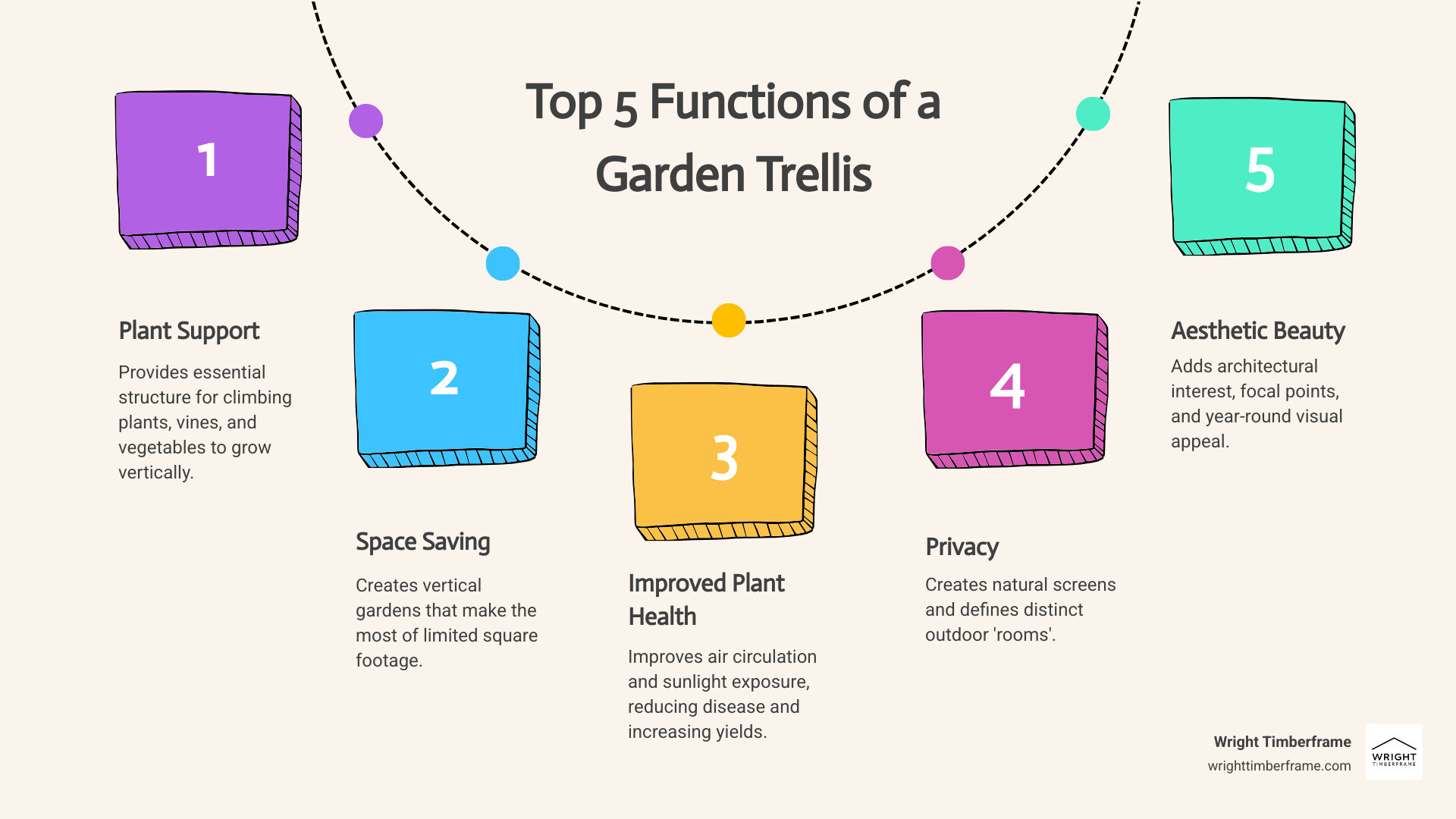
Key Functions of Trellises:
- Plant Support – Provides essential structure for climbing plants, vines, and vegetables to grow vertically
- Space Maximization – Creates vertical gardens that make the most of limited square footage
- Plant Health – Improves air circulation and sunlight exposure, reducing disease and increasing yields
- Aesthetic Improvement – Adds architectural interest, focal points, and year-round visual appeal
- Privacy and Definition – Creates natural screens and defines distinct outdoor “rooms”
- Simplified Maintenance – Makes watering, pruning, and harvesting easier by bringing plants to a comfortable height
Trellises have served gardens for centuries, evolving from purely functional vine supports in ancient Rome to the elaborate “treillage” structures of Renaissance estates, and now to the modern timber frames that blend traditional craftsmanship with contemporary outdoor living. Today’s trellises can do everything from supporting a bumper crop of cucumbers to creating an intimate dining nook on your patio.
As Utah’s local timber experts, we’ve spent years crafting custom timber structures that transform outdoor spaces. We’ve seen firsthand how the strategic functions of trellises can elevate a garden, whether it’s a simple wall-mounted frame for climbing roses or an elaborate arched entryway covered in wisteria. We believe the right trellis—built with proper joinery and quality materials—becomes a permanent asset that serves your garden for generations.
The Core Functional Benefits of a Trellis
At its heart, a trellis is a gardener’s best friend, offering a multitude of practical advantages that contribute to a thriving, productive garden. These structures provide the necessary framework for plants to flourish, directly impacting their health, yield, and the overall efficiency of your gardening efforts. The primary functions of trellises in this regard revolve around optimizing space, nurturing healthier plants, and streamlining your daily gardening tasks.
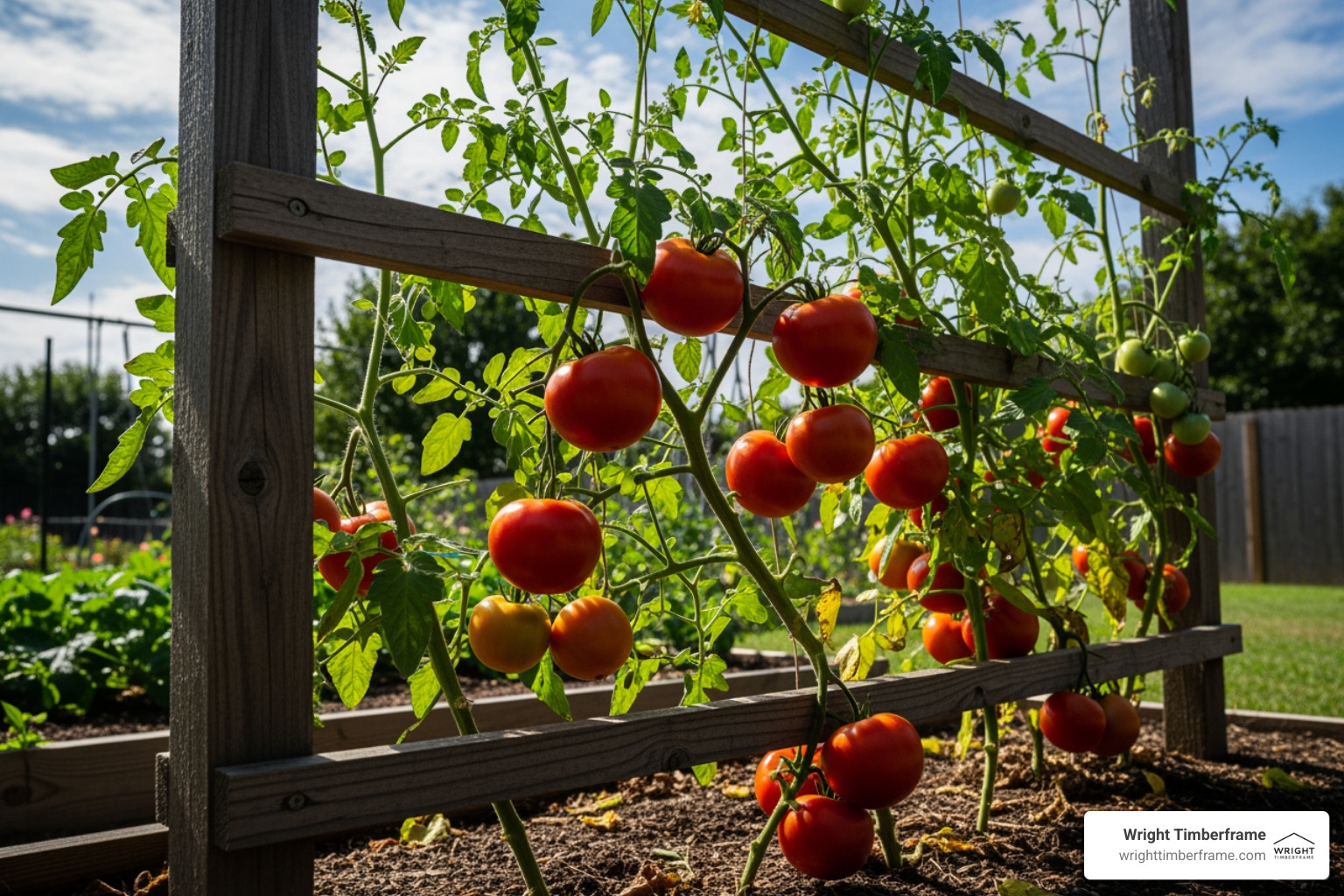
From supporting delicate climbing flowers to robust vegetable vines, trellises play an indispensable role in cultivating a bountiful harvest. They are particularly beneficial for vining crops like squash, melons, and cucumbers, which can produce straighter, cleaner fruit when grown vertically. Even indeterminate tomato varieties, which grow throughout the season, greatly benefit from the support of trellises or cages, keeping their precious fruit off the ground. For more detailed guidance on specific vegetable supports, you can refer to resources like Trellises and cages to support garden vegetables.
Maximizing Your Garden’s Potential with Vertical Growth
One of the most celebrated functions of trellises is their ability to revolutionize how you think about garden space. In our experience, where urban gardening and small outdoor areas are increasingly common, trellises are a game-changer. They encourage plants to grow up instead of out, effectively turning limited horizontal space into abundant vertical real estate. This means you can create lush, productive gardens even on patios, balconies, or in compact backyard plots.
We love helping homeowners double or even triple their planting capacity without expanding their garden’s footprint. That’s the power of vertical gardening with trellises. They maximize every inch of your outdoor area, making them perfect for urban gardens and patios where ground space is a luxury. By utilizing vertical square footage, you can grow more food and flowers than ever before, changing even the smallest nook into a vibrant green oasis.
Promoting Healthier Plants and Bigger Harvests
Beyond just saving space, the functions of trellises are crucial for fostering robust plant health and significantly increasing your harvest yields. When plants grow vertically on a trellis, they benefit immensely from improved air circulation. This increased airflow is vital for preventing common fungal diseases like powdery mildew, which thrives in damp, stagnant conditions. With better air movement, leaves dry faster after rain or watering, drastically reducing the risk of pathogen growth.
Furthermore, vertical growth ensures that all parts of the plant receive more exposure to sunlight. Plants love this increased light, leading to stronger growth, more vigorous flowering, and often, a higher yield of fruits and vegetables. When produce hangs freely from a trellis, it’s kept off the damp ground, preventing rot and protecting it from soil-borne diseases and pests. This not only results in healthier, cleaner produce but also a more abundant and successful harvest.
Simplifying Garden Maintenance and Harvesting
The practical functions of trellises extend to making your gardening life considerably easier. By elevating plants, trellises simplify many routine garden tasks. Watering becomes more efficient as water can reach the root zone directly without getting trapped under sprawling foliage. Pruning is also much simpler; with plants neatly arranged vertically, it’s easier to identify and remove dead or diseased branches, improving plant vigor.
Perhaps one of the most appreciated benefits is the ease of harvesting. No more bending and stooping for cucumbers or searching through dense foliage for ripe tomatoes! Produce hangs at a comfortable height, making it effortless to pick. This elevation also plays a significant role in pest deterrence, as many ground-dwelling pests find it harder to access crops that are growing vertically. The result is a more enjoyable gardening experience, healthier plants, and a cleaner, more accessible harvest.
A Guide to Trellis Types, Materials, and Key Distinctions
To fully appreciate the diverse functions of trellises, it helps to be familiar with the various forms they take and the materials we use to craft them. We know that just as every plant has unique needs, every garden has specific aesthetic and practical requirements. Choosing the right trellis involves considering the plant it will support, the overall design of your landscape, and the desired longevity of the structure.
Whether you’re aiming for a subtle backdrop or a dramatic focal point, there’s a trellis style and material perfect for the job. Our expertise as timber frame specialists lies in creating timber trellises that not only fulfill these practical needs but also stand as beautiful, enduring features in your outdoor space.
Common Trellis Styles and Their Uses
Trellises come in a remarkable array of styles, each designed to serve specific functions of trellises and complement different plants and garden layouts:
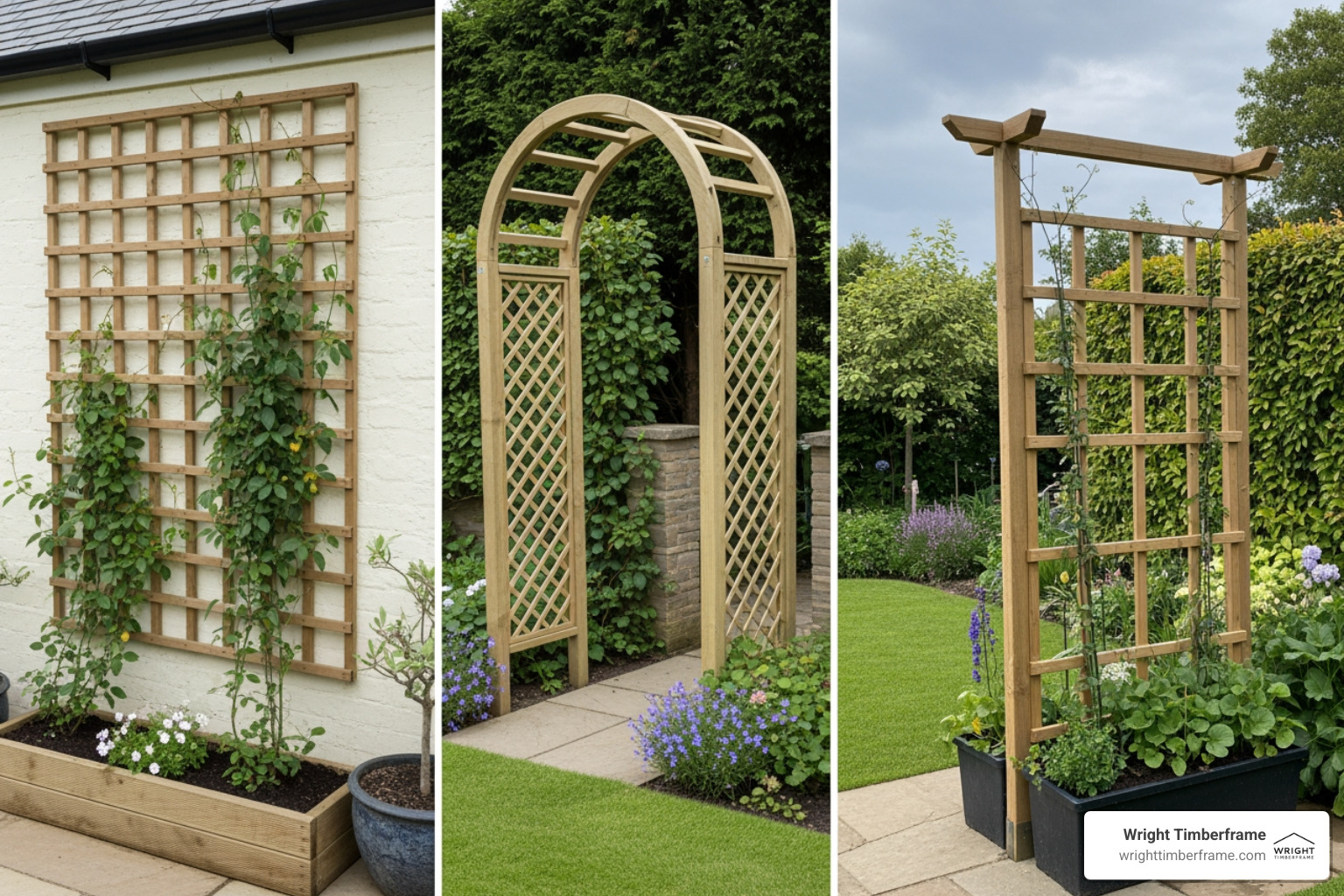
- Wall-Mounted Trellis: These are flat panels attached directly to a wall, fence, or even the side of a building. They are ideal for creating green facades, hiding unsightly surfaces, or adding vertical interest to a blank space. Plants like ivy, climbing hydrangeas, or espaliered fruit trees thrive on wall-mounted trellises, which offer excellent stability.
- Freestanding Trellis: As the name suggests, these trellises stand on their own in the garden. They can be used as dividers, screens, or focal points. Examples include obelisk trellises (often conical or pyramidal, perfect for sweet peas, morning glories, or small climbing roses) and fan trellises (which spread out at the top, ideal for plants with a broader growth habit like clematis or trumpet vines).
- Arched Trellis: Forming an archway, these trellises are perfect for creating dramatic entrances, framing pathways, or defining transitions between garden areas. Climbing roses, wisteria, and jasmine are classic choices, creating fragrant, living tunnels that invite exploration.
- A-Frame Trellis: Shaped like the letter ‘A’, these are particularly popular in vegetable gardens. They provide sturdy support for vining vegetables such as cucumbers, pole beans, and small squash, making harvesting easy and keeping produce clean. Their angled design also allows for good light exposure.
- Lattice Trellis: Characterized by a crisscross pattern, lattice trellises are versatile and can be wall-mounted or freestanding. They are excellent for supporting a wide range of climbers and can also be used for privacy or decorative screening.
- Expanding Trellis: These flexible trellises can be stretched or compressed to fit various spaces, offering adaptability for temporary support or evolving garden designs.
Trellis vs. Arbor vs. Pergola: Understanding the Difference
While often used interchangeably, trellises, arbors, and pergolas serve distinct functions of trellises and purposes in landscape design. We craft all three from beautiful, durable timber, but their structural differences are key:
| Feature | Trellis | Arbor | Pergola |
|---|---|---|---|
| Primary Function | Plant support, vertical accent, privacy screen | Entryway, focal point, small shaded seating | Outdoor room, shaded living area, architectural feature |
| Structure | Flat or arched framework, open lattice | Arch-shaped, often with latticework sides | Open roof of cross-beams, supported by posts |
| Size | Typically smaller, vertical orientation | Medium-sized, often defining a passage | Larger, can cover extensive areas |
| Planting | Designed for climbing plants to grow on | Often covered with climbing plants, especially for decorative effect | Provides framework for plants to grow over |
| Defining Space | Can create visual breaks or screens | Marks transitions, creates a sense of arrival | Defines and shades an outdoor living area |
A trellis is fundamentally a framework for supporting climbing plants vertically. An arbor is a freestanding, often arch-shaped structure that serves as an entryway or a small, intimate shaded seating area, frequently covered with climbing plants. A pergola, on the other hand, is a larger outdoor structure with an open roof of cross-beams supported by posts, designed to define an outdoor living area and provide partial shade. While a trellis focuses on vertical plant support, arbors and pergolas integrate plant life into larger architectural statements, defining and shading outdoor living spaces. Our Pergola vs Trellis page offers more insights into these distinctions.
Choosing the Right Materials for Durability and Style
The choice of material significantly impacts a trellis’s durability, aesthetic appeal, and maintenance requirements. While metal, plastic, and bamboo trellises are available, we specialize in timber, particularly premium Western Red Cedar and Douglas Fir, for their beauty and longevity.
- Wood: In our experience, wood trellises offer a timeless, natural aesthetic that blends seamlessly with any garden style. Our timber trellises, crafted from Cedar or Douglas Fir, are renowned for their natural resistance to rot, decay, and insect infestation. This inherent durability means they stand strong for decades, even in varying climates. We use traditional joinery methods like mortise and tenon or dovetail joints, which create incredibly strong connections without relying on unsightly metal fasteners. This craftsmanship not only improves the structural integrity but also contributes to the trellis’s classic beauty. While wood requires occasional sealing or staining to maintain its appearance, the warmth and character it brings to a garden are unparalleled. You can explore our handcrafted options on our Custom Timber Trellis page.
- Metal: Metal trellises, often made from steel or wrought iron, are highly durable and can be very decorative. They are excellent for supporting heavy vines and offer a sleek, modern look. However, they can heat up in direct sun and may require powder coating or regular painting to prevent rust.
- Plastic/Vinyl: These materials are budget-friendly and require minimal maintenance, as they don’t rot or rust. However, they can sometimes look less natural and may not offer the same structural integrity or aesthetic charm as timber or metal, especially for larger, more permanent installations.
- Bamboo: Lightweight and economical, bamboo trellises offer a rustic, natural look. They are typically used for annuals or lighter climbers, as their lifespan is generally shorter than other materials.
For structures designed to last for generations, offering both exceptional strength and timeless beauty, premium timber is our material of choice.
Beyond the Garden: The Many Aesthetic Functions of Trellises
While their functional benefits are undeniable, the functions of trellises extend far into the field of aesthetics, helping us transform ordinary outdoor spaces into captivating landscapes. We see them not as mere plant supports but as integral design elements that add architectural interest, create inviting outdoor rooms, and provide elegant privacy solutions.
A well-placed timber trellis can lift your garden’s design, becoming a sculptural piece of art even when the plants are dormant. As local timber experts in Utah, we know their ability to introduce vertical lines and intricate patterns makes them a powerful tool for any landscape designer.
Creating Architectural Interest and Focal Points
One of the most striking functions of trellises is their capacity to add significant architectural interest to any landscape. Gardens, especially those on flatter terrain, often benefit from vertical elements that draw the eye upward, creating a sense of depth and grandeur. We find that trellises do this beautifully, breaking up monotonous horizontal lines and providing a dynamic visual counterpoint.
They can act as stunning focal points, whether as a standalone obelisk draped with blooming vines or an arched entry framing a picturesque view. When covered in lush greenery or vibrant flowers, a trellis becomes a living sculpture, blending art and nature seamlessly. Even without plants, the intricate patterns of a timber trellis can offer sculptural beauty and an elegant design statement, enhancing the overall aesthetic of your outdoor space.
One of the Key Functions of Trellises: Designing for Privacy and Defining “Outdoor Rooms”
In addition to their decorative appeal, the functions of trellises are incredibly practical when it comes to enhancing privacy and creating distinct zones within your outdoor living area. A strategically placed trellis, especially when adorned with dense climbing plants like jasmine or bougainvillea, can form a natural privacy screen, shielding your patio or deck from prying eyes. We feel this organic barrier is much softer and more inviting than a solid fence.
Trellises are also excellent for hiding unsightly elements in your yard, such as utility boxes, compost bins, or air conditioning units, transforming them into attractive green features. Beyond privacy, they excel at defining outdoor “rooms.” We love helping homeowners use a series of trellises to create a cozy garden nook for reading, an intimate dining area, or to establish elegant walkways that invite guests to explore their landscape. This allows you to carve out functional and beautiful spaces within a larger garden, making it feel more organized and purposeful. For more ideas on how trellises can serve these diverse purposes, explore our article on The Many Functions of Trellises: From Privacy Screens to Vertical Gardens.
The Year-Round Beauty of a Structural Trellis
The beauty of a well-crafted trellis isn’t limited to the growing season. One of the subtle yet significant functions of trellises is their contribution to year-round visual interest in the garden. While our trellises support lush greenery and vibrant blooms in spring and summer, they offer a stark, sculptural beauty in autumn and winter.
When deciduous vines shed their leaves, the elegant lines and robust structure of a timber trellis emerge, providing architectural interest even against a snowy backdrop. This seasonal dynamic ensures that your garden remains captivating throughout the year, offering a testament to thoughtful design and quality craftsmanship. Our timber trellises are designed to be beautiful in every season, their enduring form adding character and charm to your outdoor space no matter the weather.
Frequently Asked Questions about the Functions of Trellises
What is the main purpose of a trellis?
The main purpose of a trellis is to provide sturdy support for climbing plants, encouraging healthy vertical growth. It also enhances the beauty and structure of your outdoor space, maximizes growing area, improves plant health, and simplifies garden maintenance.
Can any climbing plant grow on a trellis?
Most climbing plants benefit from a trellis, but it’s important to match the trellis style and strength to the plant’s growth habit. Heavier vines need a robust timber trellis, while lighter annuals can thrive on more delicate structures. Always consider the mature size and weight of the plant.
How do I attach a plant to a trellis?
Gently weave new plant growth through the trellis as it develops. For plants that don’t cling naturally, you can use soft ties or twine, being careful not to constrict the stems as they grow. Regular training will encourage upward growth and a full, beautiful display.
What materials are best for a long-lasting trellis?
For a long-lasting structure, we recommend premium timbers like Cedar and Douglas Fir, which are naturally durable and resistant to rot. When we craft them using traditional joinery techniques, their strength and lifespan are significantly enhanced. Metal is another durable option, though it may require rust-proofing.
How can a trellis add privacy to my yard?
A well-placed trellis, especially when paired with lush climbing plants, can create a natural privacy screen, define outdoor rooms, and block unwanted views. Its vertical structure allows for dense foliage to grow, offering an organic and aesthetically pleasing barrier.
Conclusion: Opening Up Your Garden’s Potential with the Functions of Trellises
The diverse and powerful functions of trellises make them indispensable elements in any thoughtful outdoor design. We believe they are the unsung heroes of the garden, streamlining tasks, increasing yields, and providing year-round beauty. From their core role in maximizing space and fostering healthier plants to their aesthetic contributions in creating architectural interest and defining private outdoor rooms, trellises prove that functionality and elegance can go hand-in-hand.
As Utah’s local timber experts, we have seen how a thoughtfully crafted timber trellis can transform any landscape. Our dedication to traditional joinery and premium timbers ensures that our structures don’t just support plants—they become enduring works of art that improve your outdoor living for generations. Whether you’re envisioning a vibrant vertical garden or a serene private nook, we can help you open up your garden’s full potential with a structure built for lasting strength and beauty.

