
Finding the Perfect Custom Pergola Builders in Utah
When we talk about custom pergola builders in Utah, we’re really talking about creating outdoor spaces that feel like an extension of your home—places where you actually want to spend time, all year long. Our goal as local timber experts is to help you turn a basic yard or patio into a comfortable, beautiful oasis that also holds up to Utah’s demanding weather.
From years of designing and crafting pergolas, pavilions, and trellises across the state, we’ve learned that the right pergola is never one‑size‑fits‑all. It has to match how you live, how Utah’s sun and snow hit your property, and the style of your home.
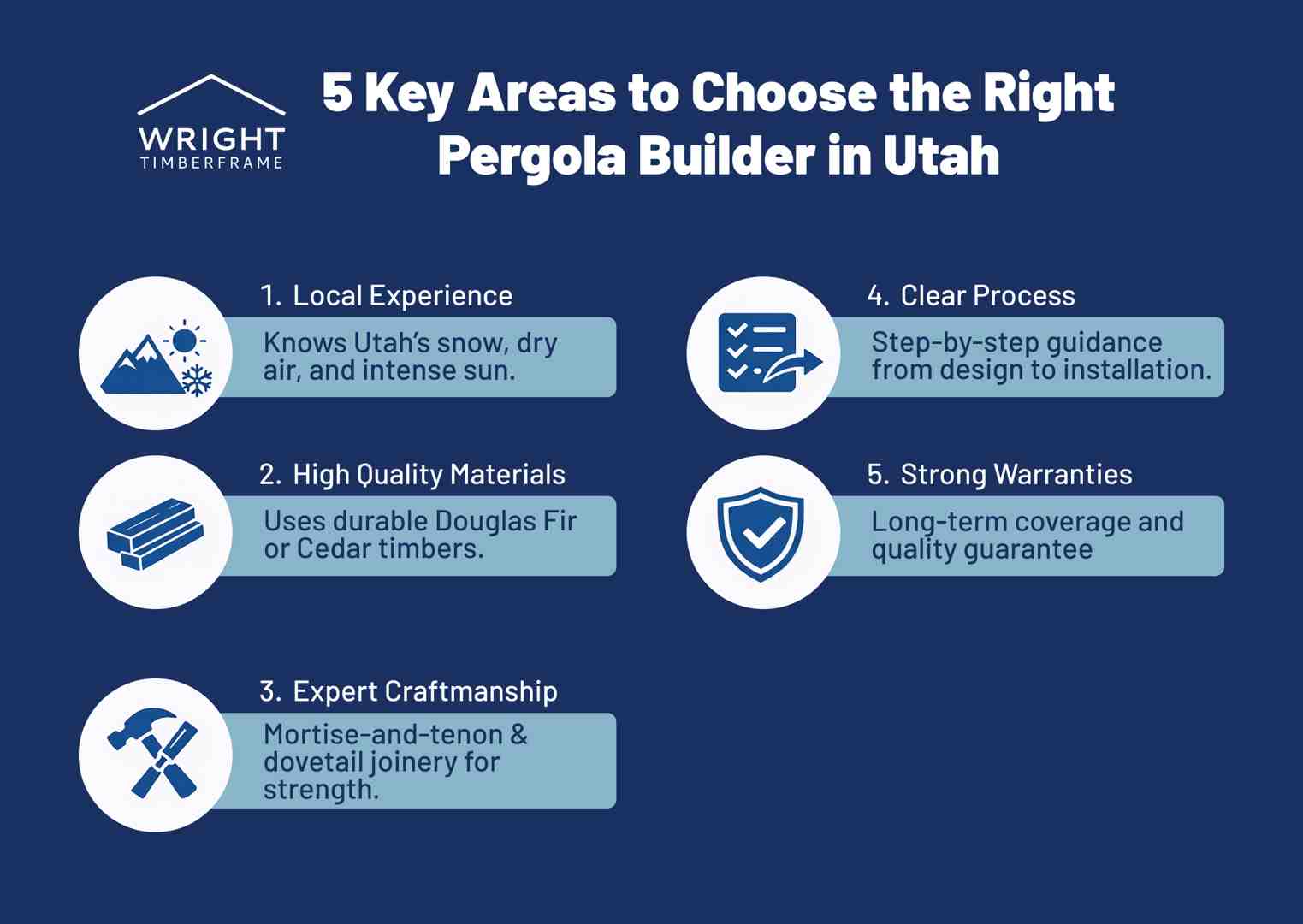
5 Key Areas When Looking for Custom Pergola Builders in Utah
- Experience with Utah’s Climate – Your builder should understand how to engineer for heavy snow loads, dry air, and intense UV exposure.
- Quality Materials – Look for Douglas Fir and Cedar timbers that are specifically suited to long‑term outdoor use in our region.
- Traditional Craftsmanship – Mortise‑and‑tenon and dovetail joinery create stronger, longer‑lasting timber structures than simple metal fasteners alone.
- Transparent, Step‑by‑Step Process – You should know what to expect at every stage: design, permitting, fabrication, and installation.
- Strong Warranties and Clear Standards – Reputable builders stand behind their work with long-term coverage and clearly defined quality benchmarks.
Because Utah’s climate is so unique—dry air, big swings between hot summers and snowy winters—your pergola needs to be engineered, not just assembled. In many of our projects along the Wasatch Front and in mountain communities, we’ve had to design for substantial snow loads while still keeping the structure light, open, and beautiful. That balance only happens when a builder really understands timber behavior and local conditions.
As local timber experts, we focus exclusively on custom timber frame pergolas, pavilions, trellises, and pergola kits. We lean on traditional joinery and careful engineering because we want your structure to feel solid on day one and still look and perform beautifully years down the road. In the sections that follow, we’ll walk through a clear, step‑by‑step approach to working with custom pergola builders in Utah so you can move from ideas to a finished outdoor oasis with confidence.
Strategy 1: Define Your Vision with Custom Pergola Builders in Utah
Before you even start calling custom pergola builders in Utah, it helps to get very clear on what you want your outdoor space to do for you. We’ve found that when homeowners come to us with a well‑defined vision, even if it’s just a few priorities written down, the whole process becomes easier, faster, and more rewarding.
Here’s a simple way to define your vision in four steps:
1. Decide how you’ll use the space
Ask yourself: Are we mainly looking for shade for everyday relaxing, a space to host larger gatherings, or a shelter for a hot tub or outdoor kitchen?
2. Choose the right structure type
It’s easy to mix up pergolas, pavilions, and gazebos. Here’s how we explain the differences when we’re walking a property with homeowners:
*   **Pergola:** An open, slatted roof that creates partial shade and a strong architectural frame. It’s perfect for defining an "outdoor room" while still letting in light and sky. We often design our pergolas to hit a comfortable balance of shade and filtered light so patios stay usable even on bright Utah afternoons.
*   **Pavilion:** A solid‑roof structure that gives full protection from sun, rain, and snow. We recommend pavilions when clients are planning outdoor kitchens, year‑round dining areas, or larger gathering spaces.
*   **Gazebo:** A more enclosed, often octagonal or round focal point in a yard. While we focus our craft on pergolas, pavilions, trellises, and pergola kits, understanding gazebos helps clarify what style of structure truly fits your vision.
3. Decide between attached and freestanding
This is a big choice we walk through with almost every client:
Attached pergolas extend from your home, tying directly into the architecture. They’re great for shading a deck or patio that’s already right off your back door. An Attached Pergola can feel like a natural extension of your interior living room.
Freestanding pergolas sit anywhere on your property and create a separate outdoor destination. A Freestanding Pergola can anchor a pool area, a fire pit, or a quiet corner of the yard.
4. Align style with your home and the Utah climate
Once you know how you’ll use the space and where the structure will sit, it’s time to think style and performance together:
Style: Do you lean toward rustic timber, clean modern lines, or something in between? We often help clients match beam sizes, rooflines, and details to their home’s architecture so the pergola or pavilion looks like it was always meant to be there.
Climate: Utah’s sun and snow can’t be an afterthought. One inch of snow can weigh more than 1.6 pounds per square foot, according to data compiled by the National Weather Service, and we frequently design for much higher loads in mountain or snow‑belt areas. That affects timber sizing, spacing, and joinery.
When we design a pergola or pavilion, we look closely at how the sun moves across your property through the day and across the seasons. A structure that feels perfect in May might be too exposed in August if shade and orientation aren’t carefully planned. Working with experienced custom pergola builders in Utah means you get a structure shaped not only around your style, but also around Utah’s specific light, wind, and snow patterns.
Strategy 2: Choose Materials Built for the Utah Climate
When you’re investing in a custom pergola, the materials you choose determine how it looks, feels, and performs 5, 10, and 20 years from now. As local timber experts and custom pergola builders in Utah, we focus on premium Douglas Fir and Cedar because they consistently stand up to our dry air, intense UV exposure, and winter snow.
We’re often asked why we recommend timber over alternatives. While steel and other materials can have their place, a thoughtfully engineered timber structure offers a warmth and presence in a backyard that’s hard to match. The key is pairing the right species with the right craftsmanship.
Here’s how we think through material selection with homeowners:
-
Start with the right structural timber
For the main frame, posts, and beams, we typically recommend:-
Douglas Fir:
- Excellent strength-to-weight ratio, which matters when we’re engineering for snow loads.
- Holds its shape well, which helps keep joinery tight over time.
- Ideal for larger spans in pavilions and pergolas where you want fewer posts and a more open feel.
-
Cedar:
- Naturally resistant to decay and insects, thanks to its natural oils.
- Lighter in weight, with a beautiful grain and color that ages gracefully.
- Often chosen for pergolas and trellises where visual warmth and texture are a priority.
We’ll often blend these timbers depending on the design—using Douglas Fir for major structural members and Cedar where you’ll see and touch it most.
-
-
Pair quality timber with traditional joinery
Premium material only pays off if it’s assembled correctly. That’s why we rely on traditional timber frame techniques such as mortise-and-tenon and dovetail joinery, instead of relying solely on surface-mounted brackets.- Mortise-and-tenon joints lock timbers together in a way that resists twisting and racking, which is crucial in Utah’s high-wind areas.
- Dovetail connections help tie beams and braces together so loads are transferred cleanly through the frame.
These methods take more planning and precision, but they’re a big part of why well-built timber pergolas feel solid underfoot decade after decade. According to the U.S. Forest Products Laboratory, structural performance in exterior wood applications depends heavily on proper detailing and connections, not just the species alone.
-
Plan for realistic maintenance—not constant work
A common concern we hear is, “Will a timber pergola be a maintenance headache?” In our experience, when the right species, finishes, and details are used, upkeep is manageable and predictable:- Routine cleaning with mild soap and water as needed.
- Reapplying a quality exterior stain or sealer every few years, depending on exposure.
- Simple inspections of hardware and exposed surfaces.
The idea that wood structures always require “constant repairs” usually comes from experiences with undersized lumber, poor joinery, or untreated, low-grade materials. When you pair Douglas Fir and Cedar with proper detailing, a custom timber pergola or pavilion can age beautifully in Utah’s climate with modest care.
By choosing materials with intention—and by working with custom pergola builders in Utah who understand how those materials behave outdoors—you set yourself up for an outdoor structure that looks better, not worse, as the years go by.
Strategy 3: Vet Potential Custom Pergola Builders in Utah
Choosing the right custom pergola builders in Utah is just as important as choosing the right design. We’ve met many homeowners who came to us after a disappointing first experience elsewhere—usually because craftsmanship, communication, or engineering fell short. To help you avoid that, we recommend a deliberate, step‑by‑step vetting process.
Step 1: Build a focused short list
Start by identifying a small group of builders who:
- Clearly specialize in pergolas, pavilions, trellises, or pergola kits (not just “general construction”).
- Show real timber work in their portfolios, not just stock images.
- Have experience building in Utah’s varied climates, from the valley floor to higher‑snow areas.
Ask neighbors, friends, and local suppliers whom they’ve seen deliver solid work. Then review each company’s website, photo galleries, and project descriptions to see if their style and products align with what you want.
Step 2: Verify credentials and Utah‑specific experience
Once you have a short list, dig deeper:
- Confirm that they are properly licensed and insured to work in Utah.
- Look for repeat mentions of pergolas, pavilions, and trellises in their services—not just as an add‑on.
- Read reviews carefully for patterns: communication, punctuality, quality, and how they handled challenges.
We always encourage homeowners to pay particular attention to reviews and photos that mention structural performance over time—how the pergola handled snow, wind, and seasonal changes.
Step 3: Ask targeted questions in your first conversation
When you speak with potential builders, bring a short list of questions. Here are some we suggest:
-
Experience:
“How long have you been building custom pergolas, pavilions, or trellises in Utah, and what types of projects do you do most often?” -
Materials:
“Which timbers do you recommend for our location—Douglas Fir, Cedar, or a combination—and why?” -
Joinery and techniques:
“Do you use mortise‑and‑tenon or dovetail joinery in your timber frames, and where do you rely on metal hardware?” -
Process:
“Can you walk us through your process from design to installation, including permitting and HOA approvals if needed?” -
Past projects:
“Can we see photos or references from past pergola or pavilion projects that are similar in size and style to what we’re considering?”
The way a builder answers these questions tells you a lot about their depth of experience and how they’ll communicate with you over the life of the project.
Step 4: Review proposals for clarity—not just price
When estimates come in, look beyond the bottom line:
- Are timber species, sizes, and finishes clearly specified?
- Is the type of joinery and overall structural approach described in at least basic terms?
- Are permitting, foundations, and installation included or clearly addressed?
- Is there a written warranty that explains what’s covered and for how long?
Be cautious of quotes that are dramatically lower than others. That often means thinner timbers, minimal engineering, or shortcuts in fabrication and installation.
By thoroughly vetting custom pergola builders in Utah up front, you dramatically increase the chance that your finished pergola, pavilion, or trellis will feel as solid and beautiful in five or ten years as it does the week it’s installed.
Strategy 4: Understand the Design-to-Installation Process with Custom Pergola Builders in Utah
_compressed.jpg?alt=media&token=65f6f69c-4f1a-4e04-8ebb-dbc4c6bd5fe4 "Custom Timber Pergola Outdoor Living Space")
Knowing what to expect from start to finish makes the entire experience with custom pergola builders in Utah smoother and far less stressful. When we guide homeowners through a new pergola, pavilion, or trellis project, we typically follow a clear, step‑by‑step process.
Step 1: Initial conversation and site review
We begin by talking through how you want to use your space and what’s currently working, or not working, in your yard. During a site review, we look at:
- Sun patterns and primary wind directions.
- Views you want to frame or block.
- Existing patios, decks, or landscaping that we’ll be working around.
This is where we’ll discuss whether an attached or freestanding structure makes more sense, and whether a pergola, pavilion, or trellis best matches your goals.
Step 2: Collaborative design and engineering
Next, we translate your ideas into a buildable design, always keeping Utah’s climate front and center. In this phase, we:
- Size posts and beams appropriately for expected snow and wind loads.
- Select Douglas Fir, Cedar, or a combination based on structure type and exposure.
- Determine how mortise‑and‑tenon and dovetail joinery will be used for strength and aesthetics.
- Refine proportions, roof style, and details so the structure harmonizes with your home.
For some clients, we also discuss whether a fully custom build or one of our pre‑cut pergola kits makes more sense, depending on budget, timing, and how hands‑on they want to be during assembly.
Step 3: Permitting, approvals, and site preparation
Before fabrication starts, we address the practicalities:
- Confirm local building requirements for your city or county.
- Identify whether HOA approval is required and what documentation they’ll want to see.
- Plan the foundation or footings appropriate for your soil, structure size, and intended use.
A professional builder should either handle or actively guide you through this process so there are no surprises mid‑project.
Step 4: Timber fabrication
In the fabrication phase, your structure begins to take shape. Timbers are:
- Selected, cut, and shaped to precise dimensions.
- Crafted with mortise‑and‑tenon or dovetail joints where specified.
- Pre‑fit and prepared for a smooth installation.
For our timber frame pergolas, pavilions, and kits, we focus heavily on accuracy here, because careful shop work leads to faster, cleaner assembly on site.
Step 5: Installation and final walkthrough
When installation day arrives, the frame is assembled on your property, following the engineered design. A well‑run crew will:
- Keep the site as clean and organized as possible.
- Communicate clearly about daily progress.
- Invite you to review key milestones, like frame‑raising and final alignment.
At the end, you should walk the project with your builder, confirm that everything matches the agreed‑upon design, and review care and maintenance basics.
When custom pergola builders in Utah follow a clear design‑to‑installation process like this, you always know what’s happening next—and you can enjoy watching your new outdoor space come to life step by step.
Strategy 5: Plan Your Budget for Lasting Value
A well‑planned budget helps you focus on what really matters: getting a pergola, pavilion, or trellis that looks beautiful, feels solid, and lasts in Utah’s climate. When we talk numbers with homeowners, we like to break costs down into simple, understandable pieces so you can see exactly where your investment is going.
Understand the main cost drivers
Several factors tend to have the biggest impact on price:
- Size and scale: Larger spans, higher roofs, and bigger footprints require more timber and more labor.
- Structure type: A solid‑roof pavilion with full snow‑load engineering will generally cost more than a smaller open‑slat pergola.
- Timber choice: Premium Douglas Fir and Cedar come at a higher upfront cost than lower‑grade woods, but they typically perform better over time outdoors.
- Design complexity: Decorative braces, more intricate joinery, or integrated trellis elements add detail and labor, but they also elevate the overall look and feel.
- Site conditions: Sloped sites, existing concrete, or tight access can affect footing work and installation time.
Think in terms of long‑term value, not just lowest bid
When comparing proposals from different custom pergola builders in Utah, it can be tempting to pick the lowest number. We encourage homeowners to ask a few key questions instead:
- How thick are the posts and beams compared to other quotes?
- Are Douglas Fir and Cedar clearly specified, or is the material description vague?
- Is there a defined approach to joinery and connections, or just generic “framing” language?
- What kind of warranty supports the structure over time?
Spending a bit more upfront on proper timber sizes, quality species, and proven joinery often means fewer issues, less maintenance, and better performance over the life of the structure.
Match your budget to your priorities
We often help clients balance cost and features by:
- Adjusting the footprint slightly to reduce timber quantity without sacrificing usability.
- Simplifying some decorative elements while keeping critical structural details intact.
- Exploring whether a pre‑cut pergola kit can deliver the look and performance they want with more predictable installation costs.
By approaching your project this way, your budget becomes a tool to shape the best combination of size, materials, and features, rather than just a constraint.
When you plan carefully with experienced custom pergola builders in Utah, you end up investing in an outdoor structure that consistently adds comfort, beauty, and value to your home—season after season.
Frequently Asked Questions About Custom Pergola Builders in Utah
Do I need a permit for a pergola or pavilion in Utah?
Permit requirements vary by city and county, and can depend on size, height, and whether the structure is attached to your home. It’s always best to check with your local building department before starting. Reputable custom pergola builders in Utah will help you understand what’s required and can often assist with the permitting process.
How do I decide between a pergola and a pavilion?
Choose a pergola if you want filtered light, an open feel, and a strong architectural frame over your patio or yard. Choose a pavilion if you need full weather protection for things like an outdoor kitchen, dining area, or hot tub. Many Utah homeowners end up pairing both: a pavilion for all‑weather use and a pergola or trellis nearby for additional shade and visual interest.
What kind of maintenance does a timber pergola need in Utah’s climate?
With quality Douglas Fir or Cedar and proper finishes, maintenance is straightforward: periodic cleaning, visual inspections, and re‑staining or sealing every few years depending on exposure. Your builder should provide basic care guidelines tailored to your specific structure and location.
Can a timber pergola handle heavy Utah snow?
Yes, if it’s engineered correctly. Proper timber sizing, spacing, and joinery are essential. When designed for local snow loads and built with strong species like Douglas Fir, a pergola or pavilion can safely handle typical Utah winter conditions.
Are timber pergola kits a good option compared to fully custom builds?
Pre‑cut timber pergola kits can be an excellent choice when you want quality materials and joinery with a more streamlined design and predictable cost. A fully custom build makes sense when you need a specific footprint, attachment to your home, or a unique layout that a standard kit can’t match.
Partnering with the Right Custom Pergola Builders in Utah
Finding the ideal custom pergola builders in Utah is a journey that culminates in changing your outdoor space into a cherished extension of your home. By following these five smart strategies—defining your vision, choosing climate-appropriate materials, thoroughly vetting builders, understanding the design-to-installation process, and planning your budget for lasting value—you empower yourself to make an informed decision.
The importance of quality and expertise cannot be overstated, especially in a state like Utah, where structures must withstand everything from intense sun to heavy snow loads. Investing in a custom-built timber frame pergola isn’t just about adding a structure; it’s about creating a long-term investment that improves your lifestyle and significantly increases your property’s value.
As Utah’s local timber frame experts, we at Wright Timberframe are passionate about creating structures that last a lifetime, blending timeless design with enduring strength. We are committed to using premium timbers and traditional joinery, ensuring every pergola we build is a testament to craftsmanship and durability.
Ready to bring your outdoor vision to life? We invite you to explore our custom pergola options in Utah and find how our dedication to quality and service can create the perfect outdoor oasis for your home. Explore our custom pergola options in Utah.

