Why Choosing the Right Timber Sets the Foundation for Your Pergola
When homeowners ask us about the best hardwood for pergola projects, we often explain that the strongest, most beautiful pergolas aren’t always built from “hardwood” at all. In our experience as local timber experts at Wright Timberframe, premium softwoods like Douglas Fir and Western Red Cedar routinely outperform many tropical hardwoods for real-world pergolas, pavilions, trellises, and timber kits.
While dense hardwoods like Ipe and Teak have impressive durability on paper, they can be extremely heavy, difficult to install, and far more expensive than they need to be for a backyard structure. In contrast, the timbers we use every day in our custom projects offer an ideal balance of strength, workability, and long-term value.
Top Timber Choices for Pergolas (Based on Our Project Experience):
- Western Red Cedar – Naturally rot and insect resistant, dimensionally stable, and known for its warm color that we’ve seen age beautifully on many of our pergolas and trellises.
- Douglas Fir – A structural workhorse with an excellent strength-to-weight ratio (the U.S. Forest Products Laboratory reports bending strengths around 12,000+ psi), perfect for long spans and heavy snow loads in the mountain West.
- Ipe (Brazilian Walnut) – Extremely hard (Janka \~3,680) and long-lasting, but heavy, costly, and challenging to work with using the traditional mortise-and-tenon and dovetail joinery we favor.
- Cumaru – Similar to Ipe in hardness and durability (Janka \~3,300), but with the same trade-offs in weight, tooling, and sourcing.
- Pressure-Treated Pine – A budget choice that we typically steer homeowners away from for premium pergolas because of its tendency to warp and its shorter service life.
When you invest in a handcrafted outdoor structure, your timber selection shapes everything: how long it will last, how much maintenance it will need, how it will handle sun, snow, and wind, and how it will actually feel to live under and around it.
On our Utah projects, from mountain pavilions that see deep snow to backyard cedar pergolas that frame a family’s patio, we’ve seen again and again that choosing the right timber is the single biggest factor in whether a structure still looks and performs beautifully 20 or 30 years down the road.
Why Your Timber Choice is Crucial for the Best Hardwood for Pergola Projects
When we help a homeowner design a pergola, pavilion, or trellis, we start with one core decision: timber selection. The wood you choose doesn’t just influence the look of your structure, it determines whether it feels solid years from now, how it weathers in your yard, and how much time you’ll spend maintaining it.
As local timber experts at Wright Timberframe, we’ve guided many Utah families through this choice. We’ve seen Douglas Fir and Western Red Cedar perform on real projects through harsh winters, dry summers, and high UV exposure, which gives us a practical perspective that goes beyond catalog specs.
The most important performance factors are:
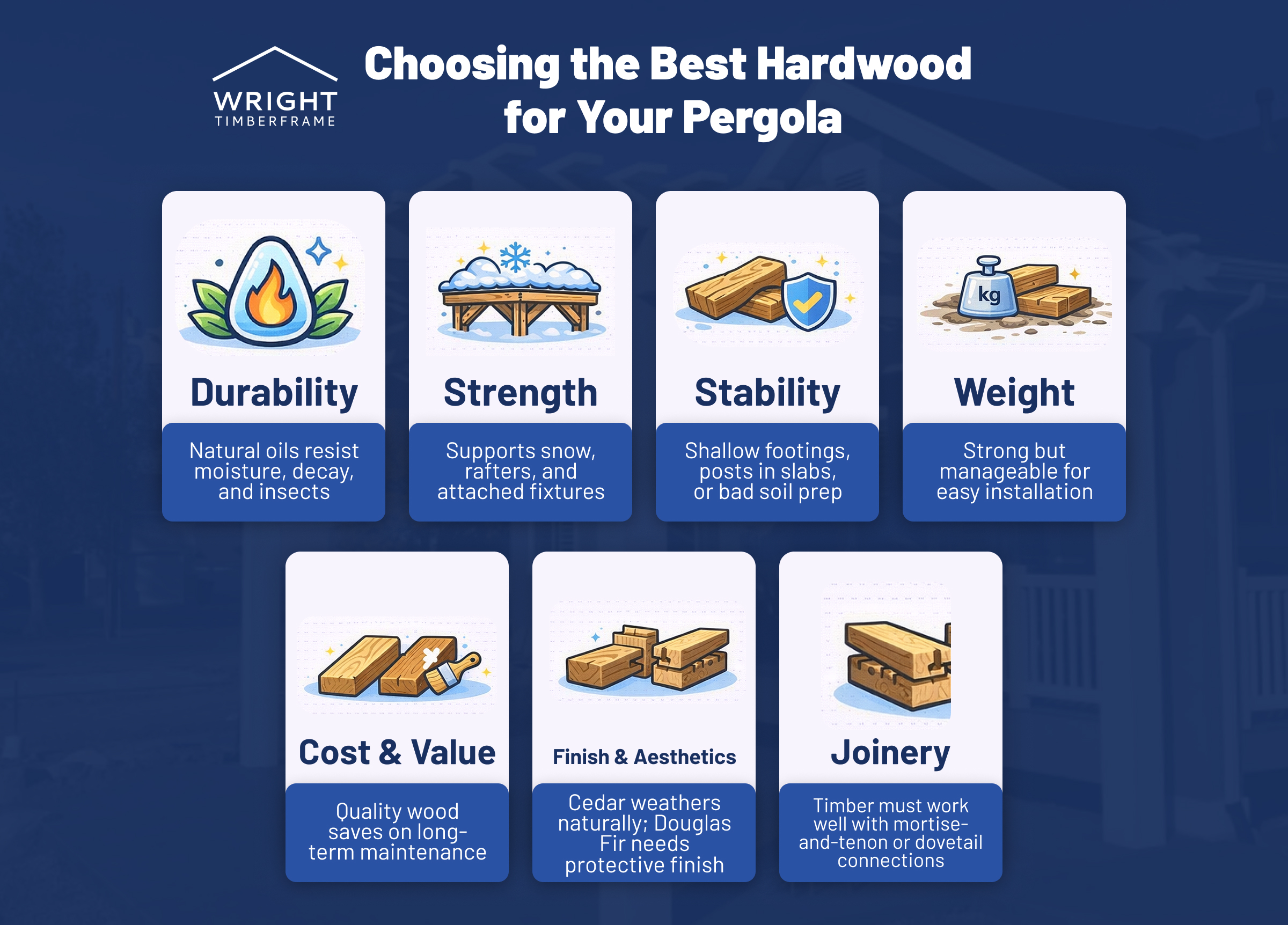
- Natural durability and rot resistance – Woods with inherent oils and resins have built-in defense against moisture, decay, and insects. Western Red Cedar, for example, contains natural compounds (like thujaplicins) that inhibit fungal growth and insect attack, which is why we often recommend it for pergolas and trellises that will see regular moisture or irrigation.
- Structural strength – Pergolas and pavilions must handle real structural loads: rafters, snow, occasional climbing plants, and sometimes attached lighting or shade systems. In our climate, Douglas Fir’s high bending and compressive strength make it an ideal choice for long spans and substantial snow loads. We routinely rely on it for larger custom pavilions and more ambitious pergola designs.
- Long-term value – Some woods may look appealing because they’re cheaper at first glance, but they can require more frequent sealing, be more prone to movement, or simply not last as long outdoors. We always compare upfront cost to the total “lifetime cost”: materials, maintenance, and potential repairs.
- Aesthetic fit – Grain pattern, color, and how the wood ages matter a lot in a residential setting. Cedar, for example, can be allowed to weather to a soft silver-grey, while Douglas Fir often looks best with a protective finish that highlights its warm reddish tones.
For larger outdoor structures, similar principles apply; if you’re considering a pavilion as well as a pergola, we walk through these same factors in more depth in our guide on choosing the right wood for your timber frame pavilion.
Key Factors to Consider
When you’re evaluating what really is the best hardwood for a pergola or any outdoor frame, we encourage you to think about more than just “hard vs. soft” wood labels.
Wood Hardness and Janka Rating
The Janka hardness test measures a wood’s resistance to denting and wear. It’s useful for decking or flooring, but it doesn’t tell the whole structural story. Ipe, for example, has a Janka rating over 3,500, while pressure-treated pine is around 690. That doesn’t automatically make Ipe the better choice for a pergola’s posts and beams, it simply means it resists surface dents better.
For pergolas, bending strength, compressive strength, and how the wood behaves with joinery are usually more important. Our traditional mortise-and-tenon and dovetail connections perform best with timbers like Douglas Fir and Cedar that balance strength with workability.
Dimensional Stability
Outdoor timber is constantly expanding and contracting with changes in humidity and temperature. Some species move a lot, leading to twisting, checking, and warping. We’ve found that Western Red Cedar and properly dried Douglas Fir stay comparatively stable, helping our joinery stay tight and the lines of the pergola remain crisp over time.
Weight vs. Strength
Heavier wood isn’t always better. Extremely dense hardwoods can increase foundation loads and make installation more complex, especially for backyard sites with limited access. We look for woods that deliver high structural strength without unnecessary weight, which is one reason Douglas Fir is a mainstay in our larger pergolas and timber frame pavilions.
Upfront Cost vs. Lifetime Cost
We often sit down with homeowners and run through this simple comparison: spend more now on a high-quality timber and spend less later on maintenance and replacement, or save a bit on materials and accept higher long-term costs. In our experience, investing in Douglas Fir or Cedar yields lower lifetime costs for most pergolas and kits.
Finishing Options
Some clients want a low-maintenance, natural weathered look; others want to keep the original color for as long as possible. Western Red Cedar, for instance, can be left untreated to gracefully weather, or it can be finished with penetrating oils to maintain its warm tones. Douglas Fir typically benefits from a good exterior finish to protect it from UV exposure and moisture, especially on sun-exposed pergolas or pavilions.
All of these factors work together to determine what will actually feel like the best hardwood for your pergola in day-to-day use, not just on a spec sheet.
The Great Debate: Is the Best Hardwood for a Pergola Actually a Softwood?
When people search for the best hardwood for pergola construction, they often assume “hardwood” automatically means stronger and better. From what we’ve seen building custom pergolas, pavilions, and trellises in Utah, that assumption is only partially true, and can actually lead you away from the most practical, beautiful solution.
The hardwood/softwood distinction is botanical, not a simple measure of strength. Hardwoods come from broadleaf trees, and softwoods from conifers, but there are softwoods that outperform many hardwoods in structural strength and stability. Douglas Fir, for instance, is technically a softwood, yet it has exceptional bending and compressive strength that we rely on for long spans and heavy loads.
What matters more for an outdoor structure is how the wood behaves in the real world: how it spans distances, how it holds up to joinery, how it resists twisting, and how it endures decades of weather.
The Case for Tropicals: Are They Really the Best Hardwood for a Pergola?
Tropical hardwoods like Ipe, Cumaru, Tigerwood, Garapa, Teak, and Brazilian Redwood are impressive materials. Independent data (such as from the U.S. Forest Products Laboratory and similar references) confirm their high density and hardness, and they are widely known for their natural durability and insect resistance.
- Ipe (Brazilian Walnut): Extremely dense and hard (Janka ~3,680), with excellent resistance to wear and decay. It’s often used in high-traffic decks for this reason.
- Cumaru (Brazilian Teak): Similar in hardness and durability to Ipe (Janka ~3,300), also very resistant to weather and insects.
- Teak: Lower on the hardness scale than Ipe (Janka ~1,070) but renowned for its high natural oil content and long service life in marine and outdoor applications.
However, on our type of projects, handcrafted timber frame pergolas and pavilions with traditional mortise-and-tenon joinery, these hardwoods come with real-world downsides:
- They are extremely heavy, which complicates handling and installation in residential backyards.
- They can be very difficult on tools and require more extensive pre-drilling and specialized blades and bits.
- Material costs are typically significantly higher than Douglas Fir or Cedar.
There are also important sourcing considerations. When homeowners do choose tropical hardwoods for elements like decking around one of our pergolas, we encourage them to look for credible certifications such as FSC® certification to help ensure responsible forest management.
Why We Champion Premium Softwoods for Pergolas
Over many completed projects across Utah, we’ve consistently seen premium softwoods, especially Western Red Cedar and Douglas Fir, deliver the best mix of strength, beauty, and practicality for pergolas, trellises, and timber frame pavilions.
- Strength-to-weight ratio: Douglas Fir, in particular, provides excellent structural performance without the extreme weight of tropical hardwoods. This matters when we’re crafting long-span beams using traditional mortise-and-tenon and dovetail joinery.
- Dimensional stability: Properly selected Douglas Fir and Western Red Cedar stay relatively stable as outdoor conditions change, which helps keep our joinery tight and the structure true over time.
- Natural resistance: Cedar’s natural compounds provide built-in resistance to decay and insects, making it an outstanding choice for exposed components and decorative trellis work.
- Workability: Our handcrafted approach depends on precise, clean joinery. Fir and Cedar allow us to cut strong, reliable mortise-and-tenon and dovetail joints that lock the frame together mechanically, rather than relying solely on metal fasteners.
On several of our Utah pergola and pavilion projects, we’ve seen these premium softwoods maintain their strength and visual character through cycles of snow, sun, and wind. That real-world performance is why, for most homeowners, we recommend them over exotic hardwoods as the best long-term choice.
A Closer Look at Our Top Timber Choices for the Best Hardwood for Pergola Frames
At Wright Timberframe, we’ve chosen to specialize in Douglas Fir and Western Red Cedar for our pergolas, pavilions, trellises, and timber kits. Over years of building in Utah’s demanding climate, these timbers have proven themselves again and again in real projects—standing up to snow, UV exposure, and daily family use.
We pair these timbers with traditional mortise-and-tenon and dovetail joinery, which allows us to create pergolas that are both structurally robust and visually refined, without relying on excessive metal brackets.
Western Red Cedar: Natural Beauty for the Best Hardwood for Pergola Look and Feel
Western Red Cedar is often what homeowners picture when they imagine a warm, inviting pergola. Its natural oils and resins provide notable resistance to rot, decay, and insects, making it especially well-suited to exposed applications like open rafters and trellised side panels.
On many of our cedar pergola and trellis projects, we’ve seen the following benefits:
- Long-term durability without heavy chemical treatment – Cedar performs well outdoors with relatively simple maintenance, which appeals to homeowners who want a natural, low-toxicity option.
- Dimensional stability – Cedar is less prone to warping and twisting than many lower-cost softwoods, which helps keep the geometry of your pergola clean and crisp as it ages.
- Flexible aesthetics – Freshly milled Cedar has a warm reddish-brown color that can be maintained with a quality exterior finish, or it can be left to weather to a silver-grey patina.
We often work with clients to decide whether Douglas Fir or Cedar is the better fit for their project’s style and environment.
Douglas Fir: Structural Workhorse for Large Spans and Heavy Loads
Douglas Fir is the backbone of many of our larger pergolas and pavilions. Even though it’s technically a softwood, its structural performance places it among the most capable timbers for outdoor framing.
Key advantages we’ve seen on real projects include:
- High strength for long spans – Data from sources like the U.S. Forest Products Laboratory report Douglas Fir’s bending strength in the 12,000+ psi range and strong compressive values, which we rely on when designing wide, open bays and substantial roof structures.
- Excellent strength-to-weight ratio – Fir allows us to create robust, dramatic frames without overwhelming your space or requiring heavy equipment for every installation.
- Compatibility with traditional joinery – Douglas Fir takes precise mortise-and-tenon and dovetail joints very well, which is crucial for the kind of timber frame pergolas and pavilions we build.
For homeowners considering using Douglas Fir outdoors, we share additional details and examples in our guide on using Douglas Fir in exterior applications.
Long-Term Value: Maintenance, Lifespan, and Cost for the Best Hardwood for Pergola Performance
When we talk with homeowners about the best hardwood for pergola projects, we always zoom out beyond the initial material price. The real question is: what will this structure cost you over 10, 20, or even 30 years—in time, maintenance, and potential replacement?
A pergola or pavilion built with quality Douglas Fir or Western Red Cedar will typically cost more upfront than one built from lower-grade lumber, but the long-term value is usually far better.
Long-Term Performance: Premium Softwoods vs. Traditional Hardwoods
From what we’ve seen on completed projects and industry data:
- Premium softwoods (Douglas Fir, Western Red Cedar): With proper detailing and periodic maintenance, these timbers can serve 25–50 years or more in outdoor structures. They respond well to penetrating oil finishes and remain structurally reliable when properly designed and maintained.
- Tropical hardwoods (Ipe, Cumaru, Teak): These can last 40+ years or longer in many exterior applications and require relatively modest maintenance to preserve their color. However, their higher material and labor costs, plus workability challenges, often make them less practical for full timber frames using traditional joinery.
- Pressure-treated pine: While appealing at first because of lower material cost, it often has a working lifespan closer to 10–15 years in exposed conditions and can require more frequent refinishing.
For most families we work with, Douglas Fir or Cedar provides the most balanced path: long service life, strong structural performance, and a natural look that complements their home and landscaping.
Maintenance Expectations and Hidden Costs
We’ve found homeowners are happiest when they know what to expect over the life of their pergola:
- Douglas Fir and Western Red Cedar: We typically recommend a simple cleaning and re-application of a quality exterior finish every 2–3 years, depending on exposure. This rhythm keeps the wood protected from UV and moisture and preserves its color and character.
- Lower-cost alternatives: Species like pressure-treated pine can require more frequent staining or sealing and are more prone to twisting and splitting. This can lead to more noticeable visual aging and occasional structural repairs.
When you weigh the maintenance and replacement cycles side by side, the “cheaper” option often ends up costing more in both time and money. That’s why, when we design a pergola, pavilion, or timber kit, we guide clients toward timbers that will provide decades of service with reasonable care, rather than just the lowest initial bid.

Frequently Asked Questions about Best Hardwood for Pergola Projects
What is the best hardwood for a pergola if I want low maintenance?
For low maintenance, we recommend Western Red Cedar. Its natural oils resist decay and insects without chemical treatment. While tropical hardwoods like Ipe also require minimal upkeep, we find Cedar offers similar longevity at a fraction of the cost and weight, making it more practical for residential pergolas.
How does Utah’s climate affect which wood is best for my pergola?
Utah’s intense UV exposure, dry conditions, and heavy snow loads demand specific timber qualities. In our experience, Douglas Fir excels under snow loads due to its high strength-to-weight ratio, while Cedar’s natural stability handles temperature swings well. We recommend UV-protective finishes for both to maintain their appearance in our high-altitude sun.
Is pressure-treated pine worth considering for a budget pergola?
While pressure-treated pine costs less initially, we have found it typically warps within a few years and requires frequent refinishing. Its 10-15 year lifespan means you’ll likely replace it twice before a Douglas Fir pergola we build needs major work, making the premium softwoods we use more economical long-term.
How often will I need to refinish a Douglas Fir or Cedar pergola?
We recommend you clean and apply a penetrating oil finish every 2-3 years for optimal protection. Cedar can be left to weather naturally to silver-grey if you prefer zero maintenance, though we find most of our clients choose to preserve the warm wood tones with periodic finishing.
Does using mortise-and-tenon joinery really make a difference for pergolas?
Absolutely. These traditional joints, which are central to our craft, distribute weight through the timber itself rather than concentrating stress on metal brackets. This creates stronger connections that actually tighten over time as the wood seasons, resulting in a more stable structure with cleaner aesthetics.
Choosing the Best Hardwood for Pergola Success
When we help homeowners select the best hardwood for pergola construction, we’re really helping them balance immediate desires with long-term satisfaction. Our experience as local timber experts has consistently shown that Douglas Fir and Western Red Cedar deliver superior value compared to exotic hardwoods or budget alternatives.
These premium softwoods combine the structural integrity needed for Utah’s climate with the workability essential for traditional mortise-and-tenon joinery. They age gracefully, maintain dimensional stability, and provide decades of service with reasonable care. Most importantly, they create outdoor spaces that feel substantial and inviting, places where memories are made season after season.
If you’re ready to invest in a pergola that will enhance your property for generations, the right timber choice is your foundation for success. From there, thoughtful design and expert craftsmanship transform quality materials into the outdoor living space you’ve always envisioned. Request a consultation and start building an outdoor space designed for long-term beauty and strength.